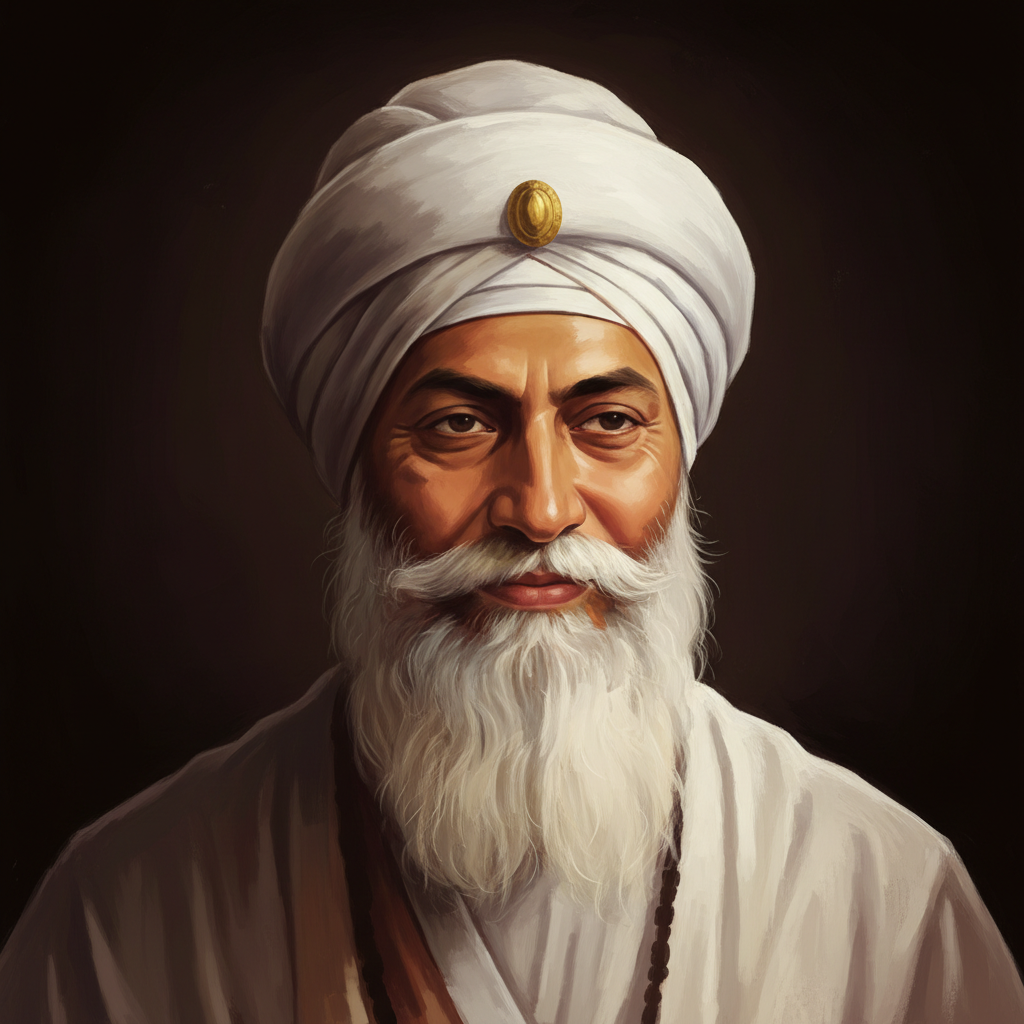
Guru Nanak — "He who is born into a high caste but does not praise God, is like a worm in filt…"
He who is born into a high caste but does not praise God, is like a worm in filth.
He who is born into a high caste but does not praise God, is like a worm in filth.
Click any product to generate a realistic preview. Up to 3 at a time.
* Initial load can take up to 90 seconds — revising the preview in another color is nearly instant.
"He who has no faith in himself can never have faith in God."
"The sun and moon, O Lord, are Thy lamps; the firmament Thy salver; the orbs of the stars the pearls encased in it."
"Death would not be called bad, O people, if one knew how to truly die."
"Live a life of honesty and integrity. And try not to spill your tea on yourself."
"The one who serves others, serves God."
Founder of Sikhism and the first of the Ten Sikh Gurus, whose teachings of one universal God and rejection of caste shaped Punjab. Closely associated with Kabir (mystical poet whose verses appear in the Sikh Guru Granth Sahib). For an intellectual contrast, see Brahmanical orthodoxy, the Hindu caste-and-ritual establishment of his era — Sikhism was founded as a deliberate alternative to both Hindu ritual hierarchy and Islamic exclusivism — Nanak's universalism was a structural rejection of caste and priestly mediation.
Found in 1 providers: gemini
1 source checked
Social rank means nothing without devotion to God. A person born into a privileged caste who fails to live with humility and remembrance of the divine is spiritually worthless, no better than a worm crawling through muck. True dignity comes from inner devotion and sincere praise of God, not from the accident of birth. High status without spiritual substance is degradation, not elevation, and the outwardly respected can be inwardly corrupt.
Guru Nanak rejected the caste system as a core tenet of Sikhism, famously declaring there is no Hindu and no Muslim. Born into a Hindu Khatri family in 1469 Punjab, he broke bread with people of every caste at langar, the communal meal he instituted. His travels across India preached that devotion to one formless God, not priestly lineage or ritual purity, determined a person's true worth before the divine.
Nanak lived from 1469 to 1539 under Lodi and early Mughal rule, when rigid Hindu caste hierarchy and Brahmanical ritualism dominated Punjab alongside Islamic political power. Upper castes monopolized temple access, scripture, and social privilege while untouchables were dehumanized. The Bhakti movement was challenging this orthodoxy with devotional egalitarianism. Nanak's statement was a direct indictment of Brahmin entitlement, aligning Sikhism with Bhakti-Sant rejection of birth-based spiritual authority in favor of personal devotion.
AI-generated insights based on extensive research and information for context. Factual errors? Email [email protected].
Your cart is empty