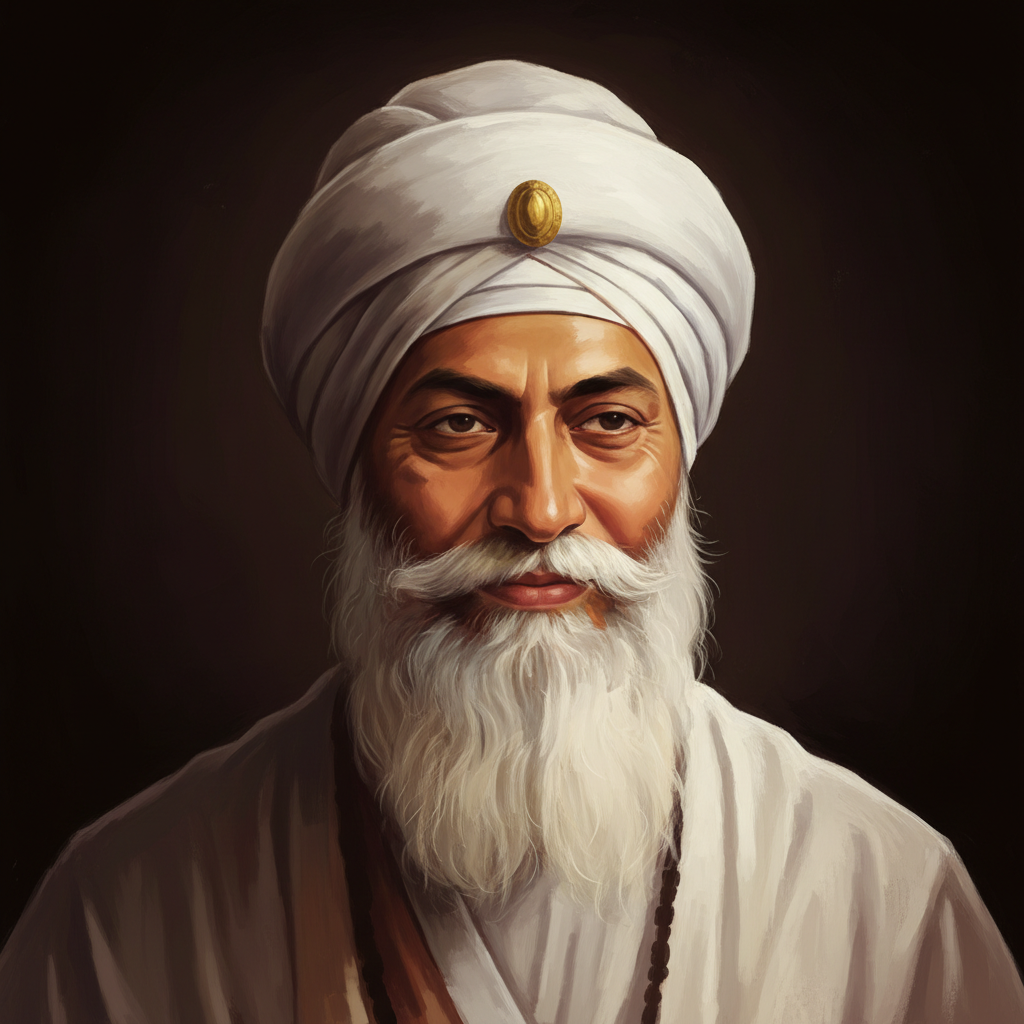
Guru Nanak — "He alone is a true Yogi who knows the essence of the Self."
He alone is a true Yogi who knows the essence of the Self.
He alone is a true Yogi who knows the essence of the Self.
Click any product to generate a realistic preview. Up to 3 at a time.
* Initial load can take up to 90 seconds — revising the preview in another color is nearly instant.
"The Lord is the ocean, and we are the fish in it."
"The Dhoop (burnt incense), lamps and the Naivaed (an offering of eatables presented to deity or idol. All of them become false) by smell. (Then, O Rabb!) If Your Poojaa can be done only with these thi…"
"I bow at His feet constantly and pray to Him. The Guru, the True Guru, has shown me the Way."
"Why do you call her inferior, when from her, kings are born?"
"Let no man in the world live in delusion. Without a Guru, none can cross over to the other shore. Also, don't forget your towel."
Founder of Sikhism and the first of the Ten Sikh Gurus, whose teachings of one universal God and rejection of caste shaped Punjab. Closely associated with Kabir (mystical poet whose verses appear in the Sikh Guru Granth Sahib). For an intellectual contrast, see Brahmanical orthodoxy, the Hindu caste-and-ritual establishment of his era — Sikhism was founded as a deliberate alternative to both Hindu ritual hierarchy and Islamic exclusivism — Nanak's universalism was a structural rejection of caste and priestly mediation.
Found in 1 providers: gemini
1 source checked
True spiritual mastery has nothing to do with physical postures, rituals, or ascetic display. A genuine Yogi is someone who has realized their innermost nature — the divine essence at the core of every being. This is about radical self-awareness: understanding who you truly are beneath ego, role, and identity. Inner knowledge of the Self is the only authentic measure of spiritual attainment, accessible through contemplation and devotion rather than outward performance.
Guru Nanak (1469–1539) spent years traveling across South Asia, Central Asia, and Arabia in four major journeys called Udasis, frequently debating Nath Yogis who emphasized physical austerities and breath control. He consistently argued that external practices without inner realization were hollow. His foundational teaching — Naam Simran, meditating on God's name — is itself an inward discipline. This quote directly mirrors his rejection of performative asceticism in favor of genuine self-knowledge as the path to the divine.
Guru Nanak lived during the 15th–16th century, when the Mughal Empire was consolidating power across South Asia and religious tensions between Hindu and Muslim communities ran deep. Within Hinduism, the Nath Yogi tradition dominated ascetic practice, claiming spiritual authority through physical disciplines and esoteric rituals. Caste hierarchy restricted spiritual knowledge to upper classes. Nanak's insistence that self-knowledge — not caste, creed, or austerity — defined true spirituality was a radical democratizing challenge to every established religious institution.
AI-generated insights based on extensive research and information for context. Factual errors? Email [email protected].
Your cart is empty