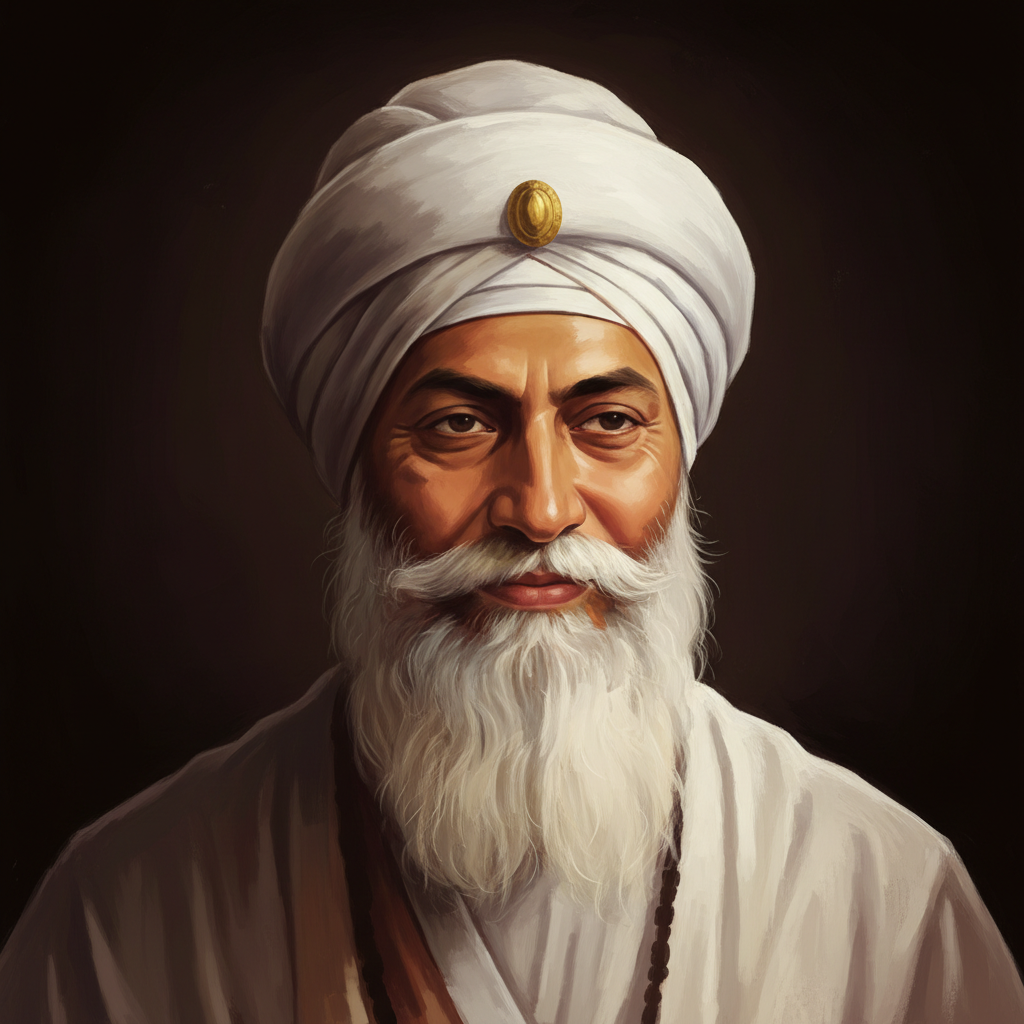
Guru Nanak — "The Lord is the ocean, and we are the fish in it."
The Lord is the ocean, and we are the fish in it.
The Lord is the ocean, and we are the fish in it.
Click any product to generate a realistic preview. Up to 3 at a time.
* Initial load can take up to 90 seconds — revising the preview in another color is nearly instant.
"The lowest among the low castes, lower than the lowliest, Nanak is with them: He envies not those with worldly greatness."
"To conquer the mind is to conquer the world."
"Without virtues, there is no devotion."
"To call woman inferior is to condemn humanity."
"May your spirit be free and your internet speed be fast."
Founder of Sikhism and the first of the Ten Sikh Gurus, whose teachings of one universal God and rejection of caste shaped Punjab. Closely associated with Kabir (mystical poet whose verses appear in the Sikh Guru Granth Sahib). For an intellectual contrast, see Brahmanical orthodoxy, the Hindu caste-and-ritual establishment of his era — Sikhism was founded as a deliberate alternative to both Hindu ritual hierarchy and Islamic exclusivism — Nanak's universalism was a structural rejection of caste and priestly mediation.
Found in 1 providers: grok
1 source checked
This saying compares God to a vast ocean and all living beings to fish swimming within it. Just as fish cannot survive outside water and are completely surrounded, sustained, and contained by it, humans exist entirely within the divine presence. We depend on God for every breath and movement, yet often remain unaware of this immersion. Separation is impossible; the Lord is not a distant ruler but the very medium of our existence.
Guru Nanak founded Sikhism on the principle of Ik Onkar, one universal God permeating all creation. Rejecting caste, ritualism, and idol worship, he taught direct, intimate union with the divine. As a traveling preacher who journeyed across South Asia and the Middle East, Nanak used accessible nature metaphors, fish, ocean, lotus, to reach farmers, traders, and mystics alike. This image captures his non-dualist conviction that devotees live inside God, not apart.
Guru Nanak lived 1469 to 1539 in Punjab, where Hindu bhakti devotionalism and Islamic Sufism collided under Lodi and early Mughal rule. Religious boundaries were rigid, caste hierarchies oppressive, and forced conversions common after Babur's 1526 invasion, which Nanak personally witnessed and condemned. Amid this tension, he preached a reconciling path beyond Hindu-Muslim division, using simple Punjabi verses sung as kirtan. Ocean metaphors resonated deeply with both Sufi wahdat-al-wujud mystics and Vaishnava bhaktas seeking union.
AI-generated insights based on extensive research and information for context. Factual errors? Email [email protected].
Your cart is empty