What it means
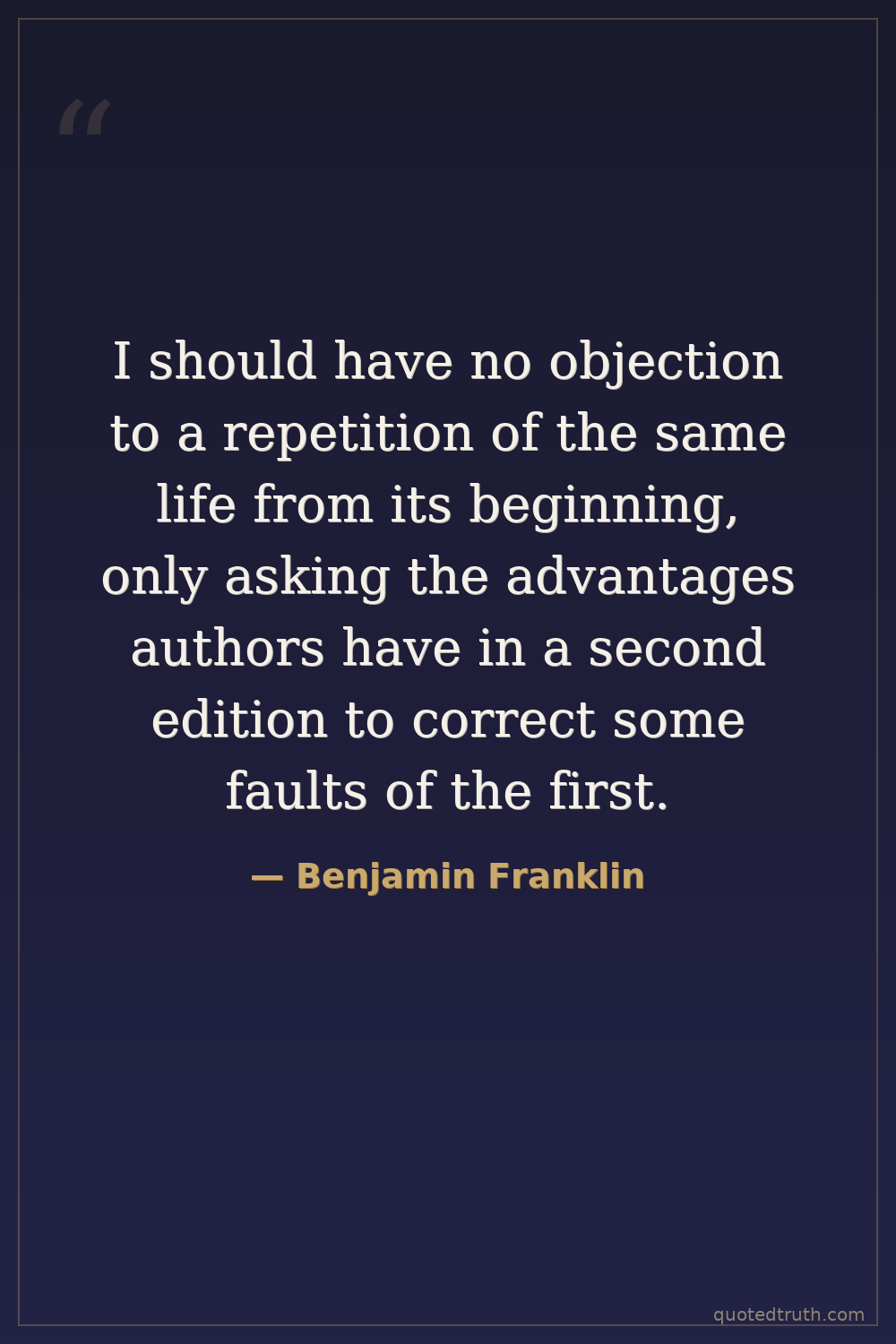
Franklin says he would willingly relive his entire life from the very start — not because it was perfect, but because it was worth repeating. His only condition: the chance to fix his mistakes, the way a writer revises a book for its second printing. It's a statement of deep life satisfaction combined with honest self-awareness — he valued his existence enough to want it again, but wasn't blind to his own faults.
Relevance to Benjamin Franklin
The printing metaphor was Franklin's native language — he worked in print shops from age 12, published Poor Richard's Almanack for 26 years, and wrote his autobiography to pass down life lessons. His famous 13 Virtues project, where he tracked moral failures in a notebook, showed lifelong commitment to self-correction. A man who literally revised texts for a living understood 'correcting faults' concretely. The quote captures his signature pragmatic optimism: grateful for what was, honest about what could have been better.
The era
The Enlightenment championed reason, human perfectibility, and self-improvement — ideas Franklin personified. In an era of high mortality and religious doctrine framing life as a single unrepeatable trial before divine judgment, his secular, contented framing was quietly radical. Print culture was expanding rapidly; revised editions signaled refinement, not shame. Franklin began his autobiography in 1771 as the American republic was being constructed — a society itself attempting to correct the faults of the old monarchical first edition.
AI-generated insights based on extensive research and information for context. Factual errors? Email [email protected].