Carl Linnaeus — "¿Qué tiene de extraño que yo no vea a Dios si no puedo ver siquiera al Yo que vi…"
¿Qué tiene de extraño que yo no vea a Dios si no puedo ver siquiera al Yo que vive en mí?
¿Qué tiene de extraño que yo no vea a Dios si no puedo ver siquiera al Yo que vive en mí?
Click any product to generate a realistic preview. Up to 3 at a time.
* Initial load can take up to 90 seconds — revising the preview in another color is nearly instant.
"A professor can never better distinguish himself in his work than by encouraging a clever pupil, for the true discoverers are among them, as comets amongst the stars."
"The greatest pleasure is to be found in the smallest things."
"The only way to know nature is to love it."
"In natural science the principles of truth ought to be confirmed by observation."
"It is not God, but people themselves who shorten their lives by not keeping physically fit."
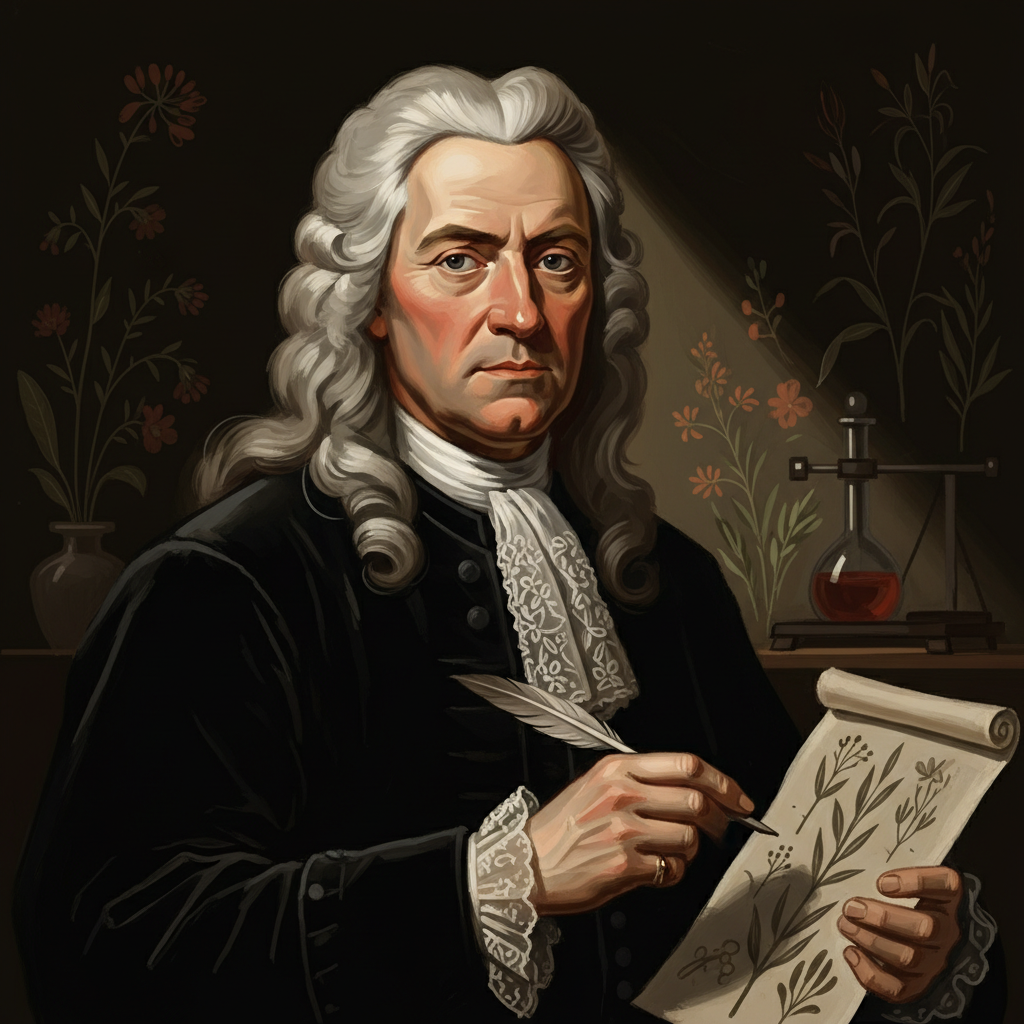
Swedish botanist and the father of modern taxonomy whose Systema Naturae (1735) introduced binomial nomenclature for naming all species. Closely associated with Joseph Banks (British naturalist who carried Linnaean classification on Cook's voyages). For an intellectual contrast, see Comte de Buffon, French naturalist and Histoire Naturelle author (1749-1788) — Buffon explicitly attacked Linnaean fixed-categories taxonomy as artificial and rejected the binomial system; his gradualist, environment-shaped natural history was the explicit alternative. Anticipates the fixed-species-vs-evolution debate Darwin would later resolve.
Translated from Spanish: 'What is strange about me not seeing God if I cannot even see the Self that lives in me?' A deeply introspective and philosophical question about self-awareness and the divine.
Date: 18th Century
PhilosophicalFound in 1 providers: gemini
1 source checked
The quote questions why anyone finds it surprising that humans cannot perceive God, given that we cannot even directly perceive our own inner self. It is an argument for epistemic humility: if introspection fails to reveal the 'I' that animates us, then inability to see the divine is equally unsurprising. Both the soul and God lie beyond direct sensory access, leveling the gap between self-knowledge and theological certainty.
Linnaeus built his legacy on meticulous observation, cataloguing thousands of species through sight and measurement. Yet he was a devout Lutheran who declared 'God creates, Linnaeus arranges,' accepting a boundary between observable nature and its divine author. He could classify every visible organism but could not classify consciousness itself. This quote reflects that same tension: the greatest taxonomist of the visible world acknowledging the hard limits of perception when turned inward or upward.
The 18th-century Enlightenment elevated empirical reason while quietly destabilizing metaphysics. Descartes had already wrestled with the self through 'cogito ergo sum,' and Hume was dismantling personal identity and causality. Natural philosophers increasingly explained nature without invoking God directly, yet most remained devout. This created a live cultural tension between what could be observed and what could only be believed, making the question of whether one can 'see' God or oneself urgently relevant to educated Europeans of Linnaeus's generation.
AI-generated insights based on extensive research and information for context. Factual errors? Email [email protected].
Your cart is empty