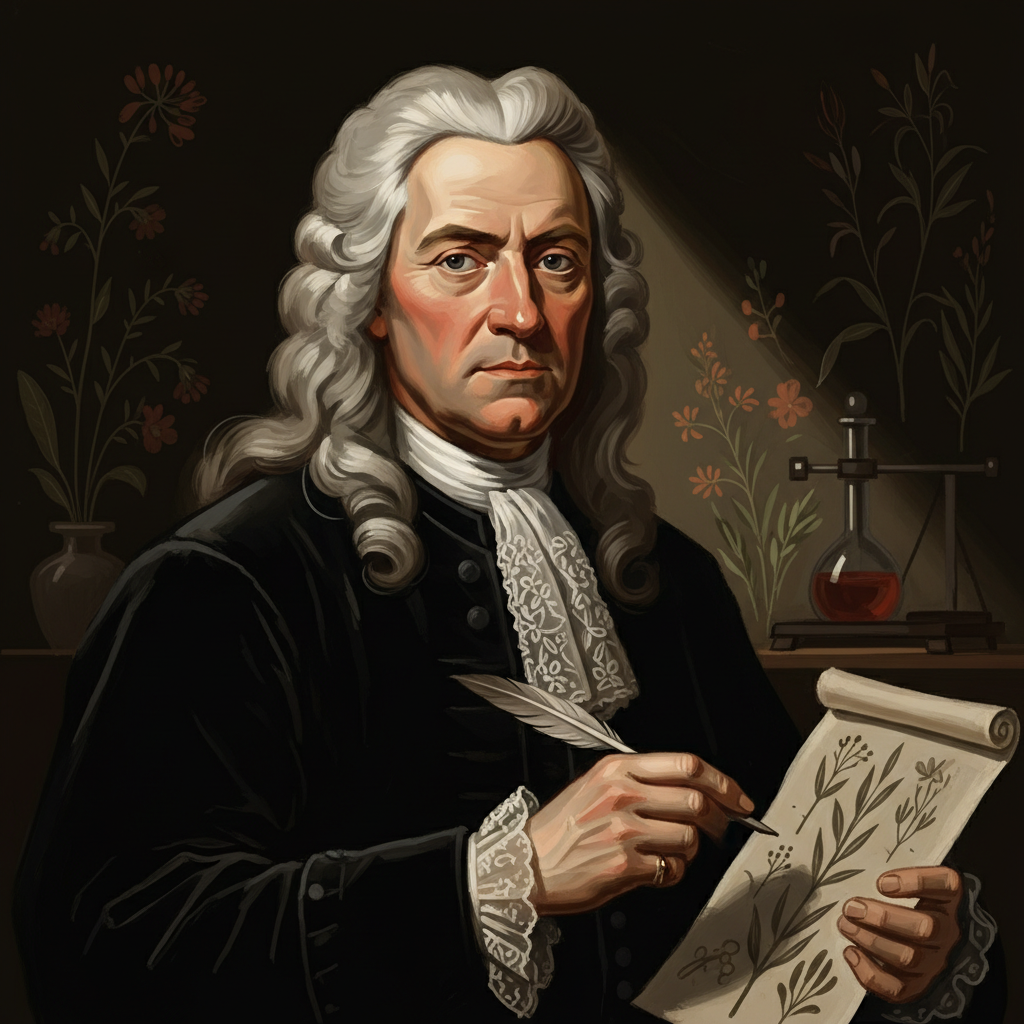
Carl Linnaeus — "The first step in wisdom is to know the things themselves."
The first step in wisdom is to know the things themselves.
The first step in wisdom is to know the things themselves.
Click any product to generate a realistic preview. Up to 3 at a time.
* Initial load can take up to 90 seconds — revising the preview in another color is nearly instant.
"Every genus is natural, created as such in the beginning, hence not to be rashly split up or stuck together by whim or according to anyone's theory."
"The system of nature is a mirror of God's wisdom."
"I have created order out of chaos."
"The distinctions of sex are evident in plants, as in animals."
"The first step in wisdom is to know the things themselves; this notion consists in having a true idea of the objects; objects are distinguished and known by classifying them methodically and giving th…"
Swedish botanist and the father of modern taxonomy whose Systema Naturae (1735) introduced binomial nomenclature for naming all species. Closely associated with Joseph Banks (British naturalist who carried Linnaean classification on Cook's voyages). For an intellectual contrast, see Comte de Buffon, French naturalist and Histoire Naturelle author (1749-1788) — Buffon explicitly attacked Linnaean fixed-categories taxonomy as artificial and rejected the binomial system; his gradualist, environment-shaped natural history was the explicit alternative. Anticipates the fixed-species-vs-evolution debate Darwin would later resolve.
A statement emphasizing empirical observation as the basis of knowledge.
Date: Uncertain (attributed)
WisdomFound in 1 providers: gemini
1 source checked
True wisdom begins with direct, concrete knowledge of actual things — not theory, abstraction, or secondhand authority. Before you can reason about anything, you must first identify and understand what it actually is. This is an empiricist claim: observation precedes interpretation. Classification, science, and understanding all depend on accurately knowing what exists. Until you can correctly name and recognize a thing, any reasoning built on it rests on shaky ground.
Linnaeus spent his life doing exactly this — systematically observing, naming, and classifying every organism he encountered. His binomial nomenclature gave each species a precise Latin name, because without consistent names scientific communication collapses. He trained apostles who traveled the globe collecting specimens before theorizing. His Systema Naturae, revised through 12 editions, built taxonomy from direct observation upward. The quote is essentially his professional creed: know the organism before you claim to understand nature.
Linnaeus worked during the 18th-century Enlightenment, when European explorers returned from the Americas, Asia, and Africa with thousands of undescribed species. Natural philosophers were abandoning scholastic authority in favor of direct observation, yet chaotic inconsistent naming made organisms nearly impossible to discuss across languages. Linnaeus's taxonomic system was a direct response: impose empirical order on nature's abundance. His era desperately needed exactly what the quote prescribes — knowing things precisely before reasoning about them.
AI-generated insights based on extensive research and information for context. Factual errors? Email [email protected].
Your cart is empty