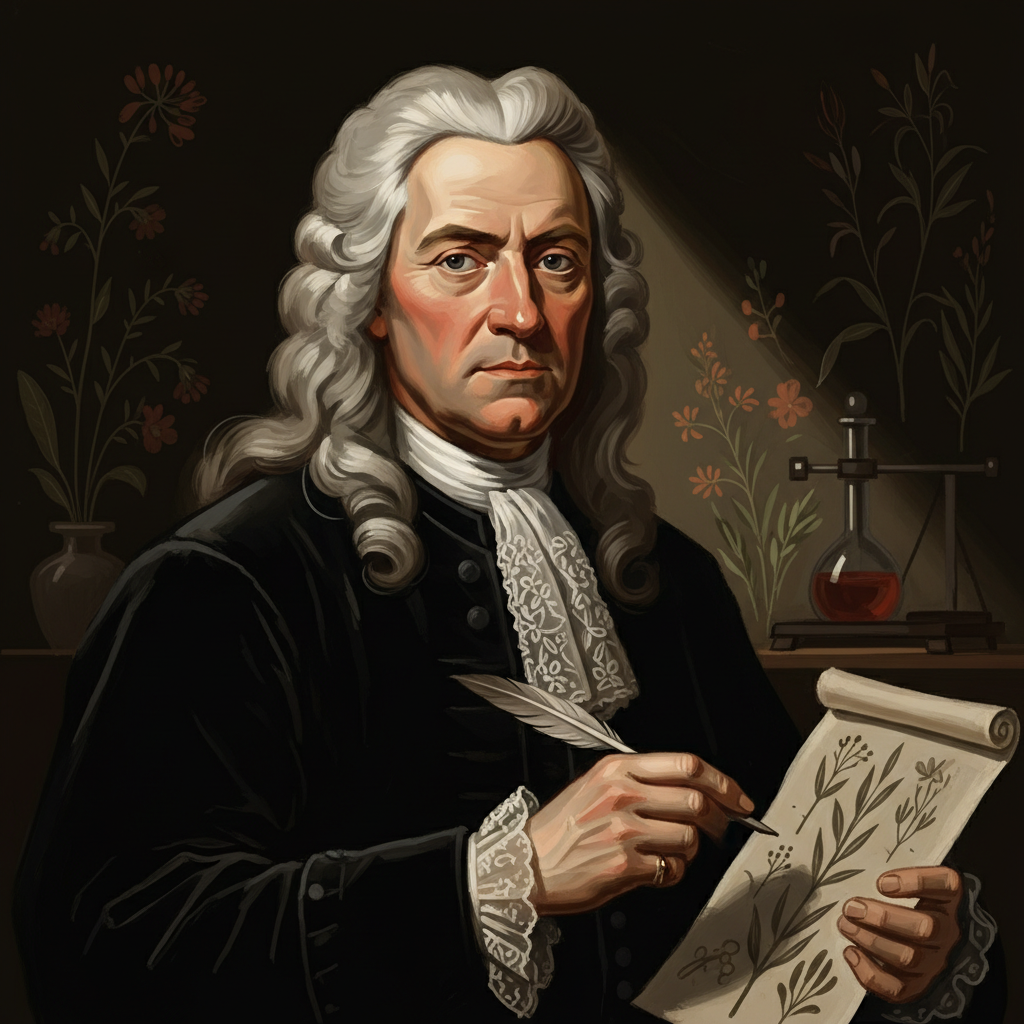
Carl Linnaeus — "Nature does not make any leaps. (Natura non facit saltus)"
Nature does not make any leaps. (Natura non facit saltus)
Nature does not make any leaps. (Natura non facit saltus)
Click any product to generate a realistic preview. Up to 3 at a time.
* Initial load can take up to 90 seconds — revising the preview in another color is nearly instant.
"A worm is a worm, and a man is a man. But if you compare a man to a worm, you will see that a man is only a worm."
"God created, Linnaeus arranged. It is astonishing how many new species are discovered every day."
"The African is lazy, crafty, negligent, and governed by caprice."
"The first step in wisdom is to know the things themselves; this notion consists in having a true idea of the objects; objects are distinguished and known by classifying them methodically and giving th…"
"For wealth disappears, the most magnificent houses fall into decay, the most numerous family at some time or another comes to an end: the greatest and the most prosperous kingdoms can be overthrown: b…"
Swedish botanist and the father of modern taxonomy whose Systema Naturae (1735) introduced binomial nomenclature for naming all species. Closely associated with Joseph Banks (British naturalist who carried Linnaean classification on Cook's voyages). For an intellectual contrast, see Comte de Buffon, French naturalist and Histoire Naturelle author (1749-1788) — Buffon explicitly attacked Linnaean fixed-categories taxonomy as artificial and rejected the binomial system; his gradualist, environment-shaped natural history was the explicit alternative. Anticipates the fixed-species-vs-evolution debate Darwin would later resolve.
A fundamental principle of his natural philosophy, suggesting gradualism in nature, from 'Philosophia Botanica' (1751).
Date: 1751
PhilosophicalFound in 1 providers: gemini
1 source checked
Change in nature happens gradually, through small incremental steps rather than sudden jumps. No organism, species, or natural process skips stages or transforms overnight. Everything transitions smoothly along a continuum. This reflects a deeply ordered, continuous view of the natural world where gaps and discontinuities are illusions of incomplete knowledge rather than genuine breaks in nature's fabric.
Linnaeus built the binomial nomenclature system precisely because he believed nature formed an ordered, continuous hierarchy — Kingdom down to Species. His Systema Naturae assumed species occupied defined but connected positions in a grand Chain of Being. His taxonomic work depended on gradations between organisms being real and classifiable, not arbitrary leaps between unrelated forms.
In the 18th century, natural philosophers debated whether species were fixed divine creations or part of a fluid continuum. The Great Chain of Being dominated intellectual thought, positioning all life in an unbroken hierarchical sequence from minerals to God. Linnaeus worked before Darwin, so gradualism meant divine orderliness, not evolution — nature's continuity reflected God's rational, systematic design rather than random transformation.
AI-generated insights based on extensive research and information for context. Factual errors? Email [email protected].
Your cart is empty