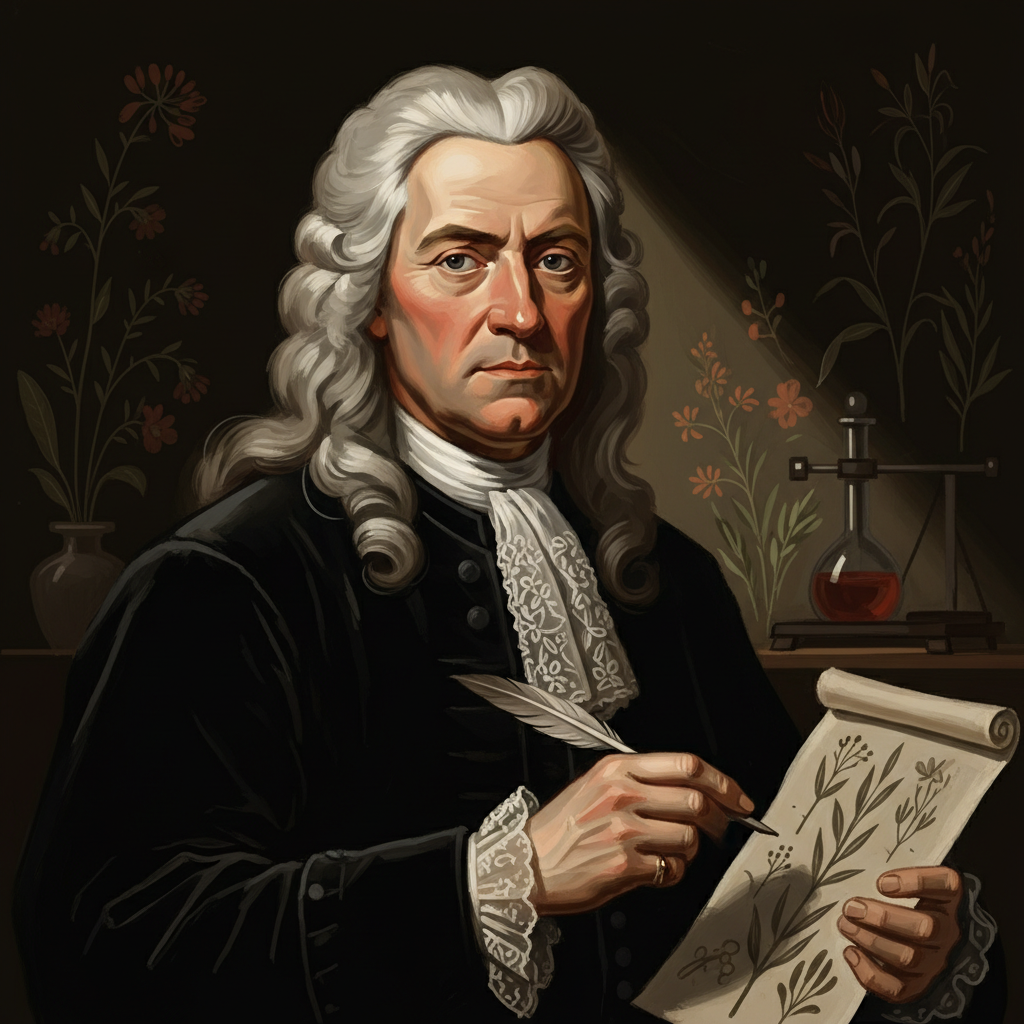
Carl Linnaeus — "The more I study plants, the more I believe in God."
The more I study plants, the more I believe in God.
The more I study plants, the more I believe in God.
Click any product to generate a realistic preview. Up to 3 at a time.
* Initial load can take up to 90 seconds — revising the preview in another color is nearly instant.
"The natural system will always remain the greatest goal for botanists."
"It is not wealth or ancestry, but rather the spirit of the age, which has raised me to the highest pinnacle of fame."
"Man is the masterpiece of creation."
"I was born to be a botanist, and I have never regretted my choice."
"Nature has been kind to me, and I have repaid her by being her faithful interpreter."
Swedish botanist and the father of modern taxonomy whose Systema Naturae (1735) introduced binomial nomenclature for naming all species. Closely associated with Joseph Banks (British naturalist who carried Linnaean classification on Cook's voyages). For an intellectual contrast, see Comte de Buffon, French naturalist and Histoire Naturelle author (1749-1788) — Buffon explicitly attacked Linnaean fixed-categories taxonomy as artificial and rejected the binomial system; his gradualist, environment-shaped natural history was the explicit alternative. Anticipates the fixed-species-vs-evolution debate Darwin would later resolve.
Found in 1 providers: grok
1 source checked
Deep, systematic study of nature strengthens rather than undermines religious faith. The more you examine living things in precise detail — their structure, diversity, and internal order — the more you perceive deliberate design behind them. It argues that science and religion are not opposed: rigorous observation of the natural world reveals an intelligence or purposeful architecture too intricate and consistent to be accidental.
Linnaeus spent his life classifying thousands of plant and animal species, creating the binomial nomenclature system still used today. He explicitly described his taxonomic work as reading God's creation — the staggering order and diversity of species, to him, demanded a Creator. He called nature God's second book alongside scripture, and saw classification itself as an act of theological reverence rather than a purely secular scientific enterprise.
The 18th-century Enlightenment brought rising tension between empirical science and religious doctrine, yet natural theology — the view that studying nature reveals God's existence — remained mainstream among European intellectuals. Physico-theology texts arguing nature's complexity proved divine design were widely read. Linnaeus worked before Darwin, so species appeared fixed and divinely ordained. His statement reflected the era's dominant synthesis: science and faith as complementary, mutually reinforcing pursuits.
AI-generated insights based on extensive research and information for context. Factual errors? Email [email protected].
Your cart is empty