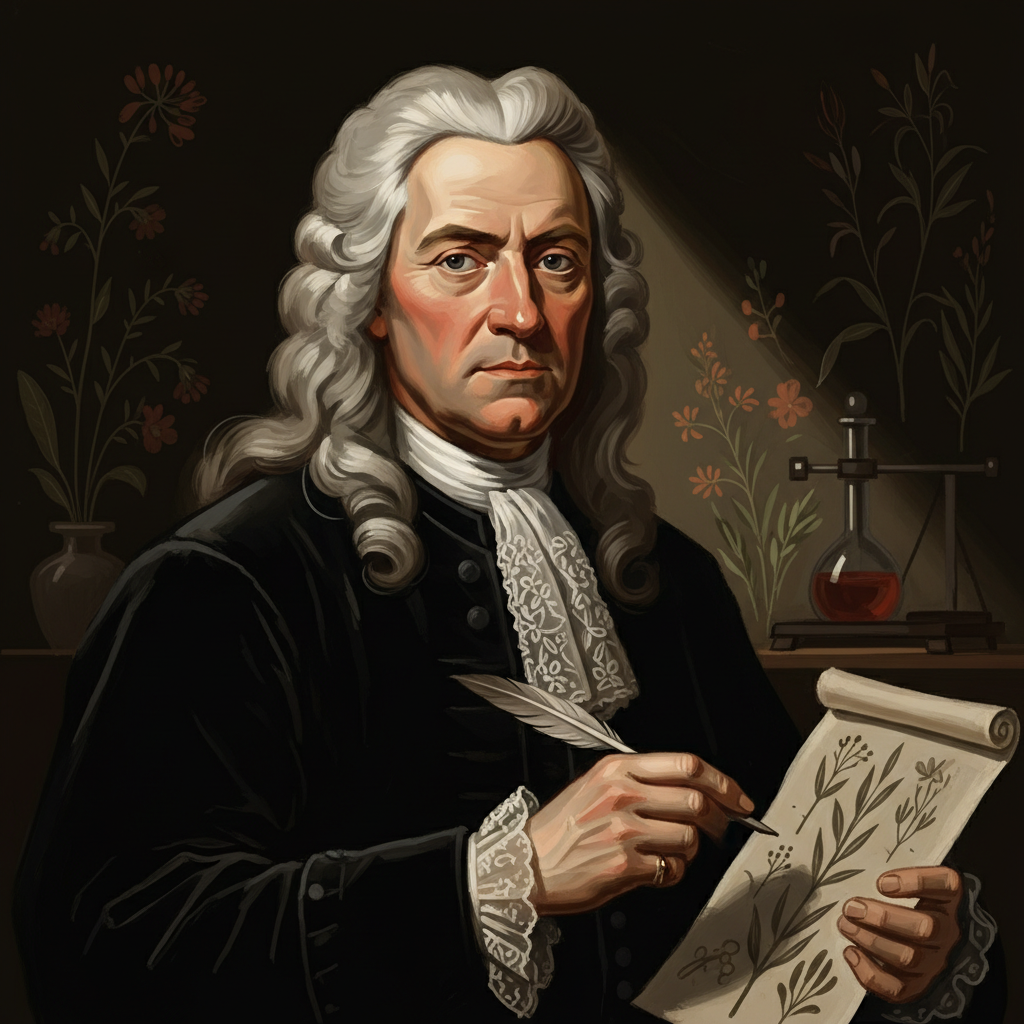
Carl Linnaeus — "The more I collect and examine, the more I marvel at the infinite wisdom of the …"
The more I collect and examine, the more I marvel at the infinite wisdom of the Creator.
The more I collect and examine, the more I marvel at the infinite wisdom of the Creator.
Click any product to generate a realistic preview. Up to 3 at a time.
* Initial load can take up to 90 seconds — revising the preview in another color is nearly instant.
"I have been called a second Adam."
"The earth is the theatre of God's glory."
"My mind reels when, on this height, I look down on the long ages that have flowed by like waves in the sound and have left traces of the ancient world, traces so nearly obscured that they can only whi…"
"I have been called the Prince of Botanists."
"Blessed be the Lord for the beauty of summer and spring, for the air, the water, the verdure, and the song of birds."
Swedish botanist and the father of modern taxonomy whose Systema Naturae (1735) introduced binomial nomenclature for naming all species. Closely associated with Joseph Banks (British naturalist who carried Linnaean classification on Cook's voyages). For an intellectual contrast, see Comte de Buffon, French naturalist and Histoire Naturelle author (1749-1788) — Buffon explicitly attacked Linnaean fixed-categories taxonomy as artificial and rejected the binomial system; his gradualist, environment-shaped natural history was the explicit alternative. Anticipates the fixed-species-vs-evolution debate Darwin would later resolve.
Found in 1 providers: grok
1 source checked
Deeper investigation of nature increases rather than diminishes wonder. The more one systematically studies living things — collecting specimens, examining their structures and relationships — the more one perceives an underlying intelligence behind it all. Science and reverence aren't opposites here: rigorous empirical work leads to awe, not cynicism. Knowledge amplifies wonder rather than explaining it away. The act of cataloguing becomes an act of astonishment.
Linnaeus spent his life collecting, naming, and classifying thousands of species, building the binomial nomenclature system still used today. A devout Lutheran, he viewed taxonomy as reading God's blueprint — each species a divine thought made physical. His Systema Naturae (1735) explicitly framed natural order as God's order. The deeper he catalogued, the more convinced he became that the sheer intricacy and consistency of life revealed purposeful design, not accident.
Eighteenth-century Enlightenment held natural philosophy and Christian theology in productive synthesis. Natural theology — the argument that nature itself demonstrates God's wisdom and existence — was scientifically mainstream. Figures like John Ray and later William Paley built celebrated careers on this framework. Cataloguing creation was itself a devotional act; scientific academies operated alongside church institutions without conflict. Darwin's evolutionary challenge to designed creation was still a century away, leaving Linnaeus's fusion of piety and empiricism entirely uncontroversial.
AI-generated insights based on extensive research and information for context. Factual errors? Email [email protected].
Your cart is empty