What it means
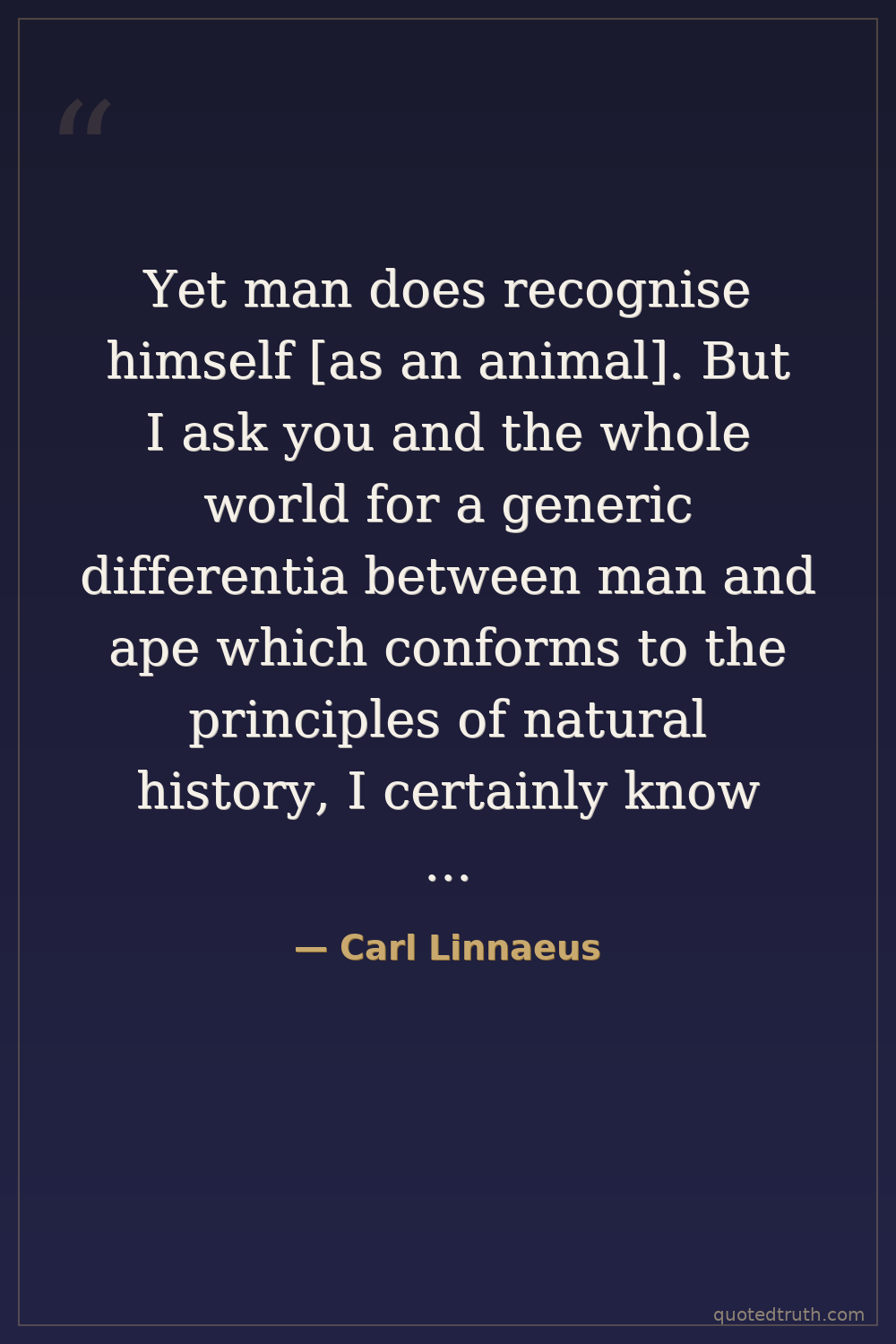
Linnaeus admits he cannot identify any scientific criterion that genuinely separates humans from apes under natural history's rules. He recognizes humans as animals, yet no measurable differentia holds up to scrutiny. He knows formally classifying humans alongside apes would provoke theological outrage, yet acknowledges rigorous science might demand exactly that. The quote captures the tension between empirical honesty and institutional self-preservation—science pointing one way, survival pointing another.
Relevance to Carl Linnaeus
Linnaeus invented binomial nomenclature and built the taxonomic system still used today. He placed humans in the order Primates alongside apes in Systema Naturae (1735), coining Homo sapiens—a radical act for its era. A devout Lutheran who believed taxonomy revealed God's design, he nonetheless followed evidence wherever it led. This quote reveals his characteristic intellectual courage: privately conceding what science demanded while calculating the theological cost of saying it openly.
The era
In the 18th-century Enlightenment, natural philosophy was dismantling old certainties, but the Church retained enormous authority over intellectual life. The Great Chain of Being placed humans uniquely between animals and angels—denying this was near-heresy. Linnaeus published Systema Naturae a full century before Darwin. Enlightenment empiricism demanded facts over doctrine, yet careers and reputations depended on church approval. That collision—science versus sanctioned cosmology—is precisely the dilemma Linnaeus articulates.
AI-generated insights based on extensive research and information for context. Factual errors? Email [email protected].