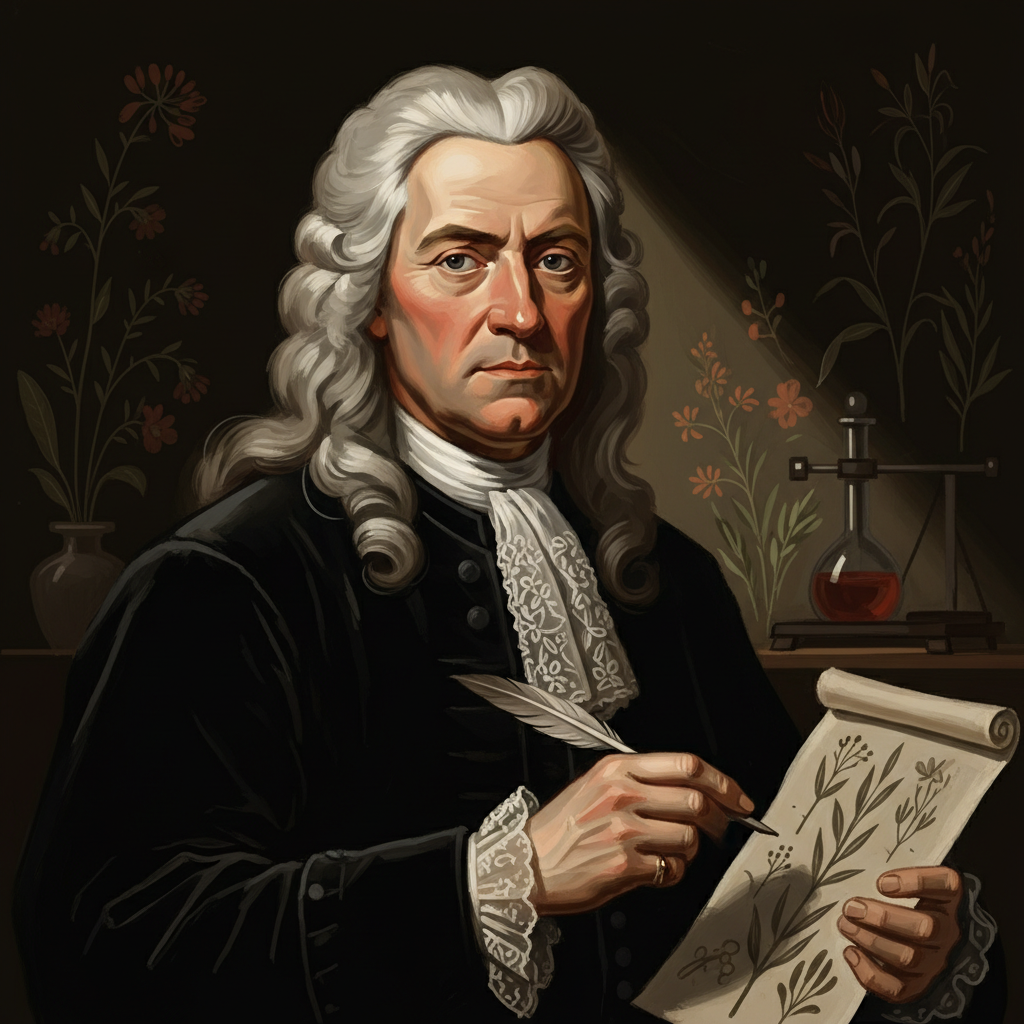
Carl Linnaeus — "The earth is the theatre of God's glory."
The earth is the theatre of God's glory.
The earth is the theatre of God's glory.
Click any product to generate a realistic preview. Up to 3 at a time.
* Initial load can take up to 90 seconds — revising the preview in another color is nearly instant.
"The Asiatic is haughty, greedy, and governed by opinions."
"I saw a monster today: a two-headed calf. It lived for only an hour, but I dissected it to see if God had given it two souls."
"Natura non facit saltus. (Nature makes no leaps.)"
"I have established a new era in natural history."
"The whole earth is a garden, and man is its gardener."
Swedish botanist and the father of modern taxonomy whose Systema Naturae (1735) introduced binomial nomenclature for naming all species. Closely associated with Joseph Banks (British naturalist who carried Linnaean classification on Cook's voyages). For an intellectual contrast, see Comte de Buffon, French naturalist and Histoire Naturelle author (1749-1788) — Buffon explicitly attacked Linnaean fixed-categories taxonomy as artificial and rejected the binomial system; his gradualist, environment-shaped natural history was the explicit alternative. Anticipates the fixed-species-vs-evolution debate Darwin would later resolve.
A theological statement viewing the natural world as a manifestation of divine glory.
Date: c. 1730s
Nature & WorldFound in 1 providers: gemini
1 source checked
The world around us is where divine greatness is displayed and witnessed. Nature itself — its diversity, structure, and beauty — serves as the stage upon which God's power and creativity are made visible to humanity. Every organism, landscape, and natural process is part of this performance. Understanding the natural world is not separate from understanding the divine — it is the direct experience of it.
Linnaeus spent his life cataloguing thousands of species, viewing taxonomy as uncovering divine design. He famously declared 'God created, Linnaeus organized,' seeing his classification system as revealing the order God embedded in creation. A devout Lutheran, he believed scientific observation was a form of worship — studying nature was studying God's handiwork. This quote directly expresses his conviction that biology and botany were sacred callings.
During the early modern period, natural theology dominated intellectual life — scholars believed studying nature revealed God's design. Linnaeus worked during the Enlightenment, when empirical science was emerging but still deeply intertwined with religious thinking. European explorers were cataloguing exotic species worldwide, expanding knowledge of Earth's biodiversity. This abundance of newly discovered life reinforced the era's belief in a purposeful, divinely ordered creation waiting to be systematically understood.
AI-generated insights based on extensive research and information for context. Factual errors? Email [email protected].
Your cart is empty