What it means
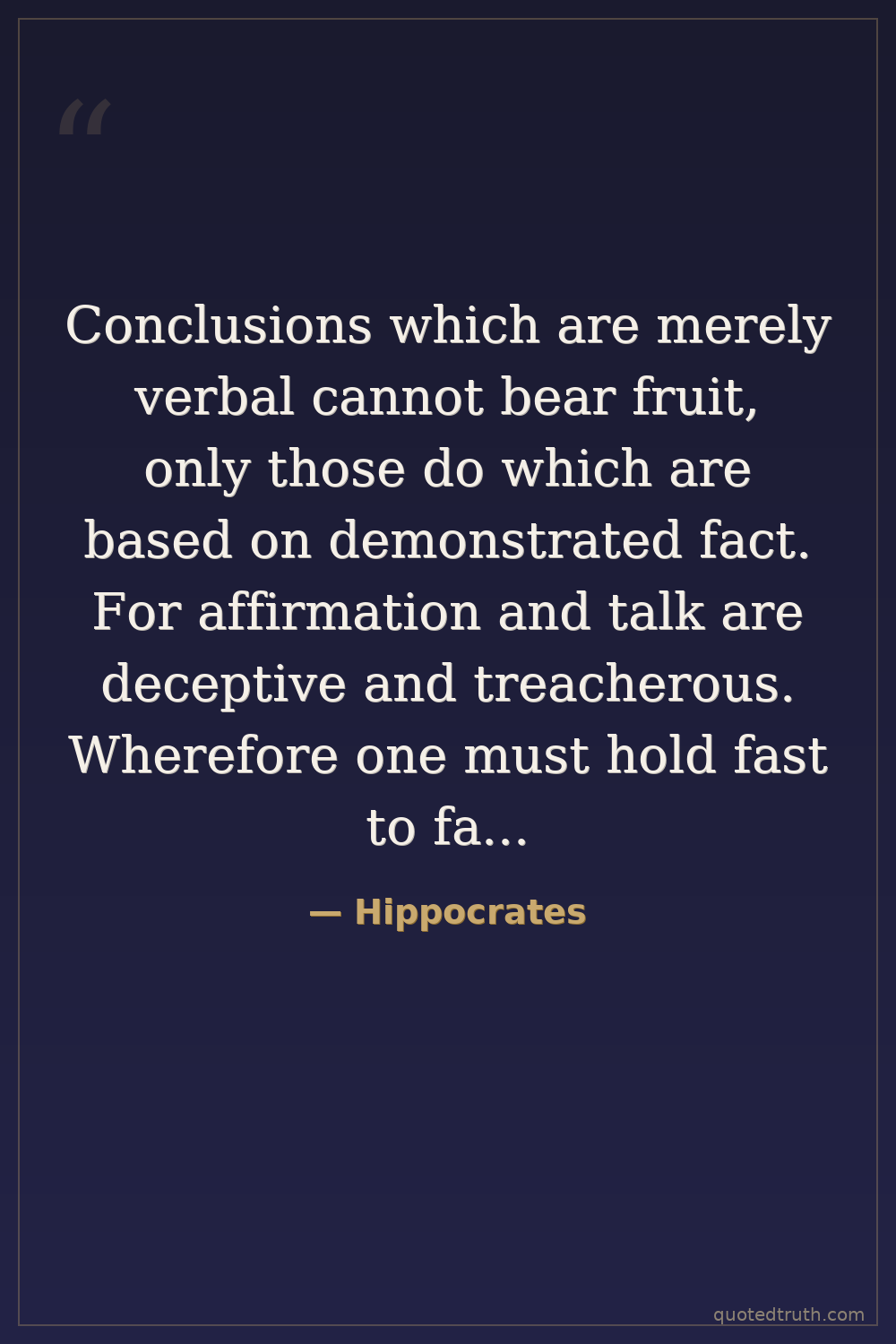
Verbal theories and claims without evidence are worthless—even dangerous. Only conclusions built on directly observed, demonstrated facts have practical value. Mastery of any craft requires persistent, disciplined return to real-world facts rather than abstract argument or persuasive speech. Over time, that sustained engagement with evidence builds the reliable, instinctive judgment that separates true expertise from mere talk.
Relevance to Hippocrates
Hippocrates (~460–370 BCE) systematically rejected supernatural explanations of disease, insisting illness had observable natural causes. He created clinical case histories by recording patient symptoms, environments, and outcomes—radical for his era. He explicitly refused to call epilepsy a 'sacred disease,' grounding his rejection in anatomy. This quote is his core professional manifesto: medicine's authority derives entirely from accumulated observed fact, not philosophical reasoning or inherited dogma.
The era
In 5th–4th century BCE Greece, illness was routinely attributed to divine punishment, and temple priests of Asclepius competed directly with physicians. Sophists dominated public life by teaching persuasive rhetoric as the highest skill. Philosophers built grand theoretical systems with minimal empirical grounding. Hippocrates operated inside this clash, insisting demonstrated observation outranked both priestly authority and philosophical eloquence—a foundational challenge that helped separate medicine from religion and natural philosophy.
AI-generated insights based on extensive research and information for context. Factual errors? Email [email protected].