What it means
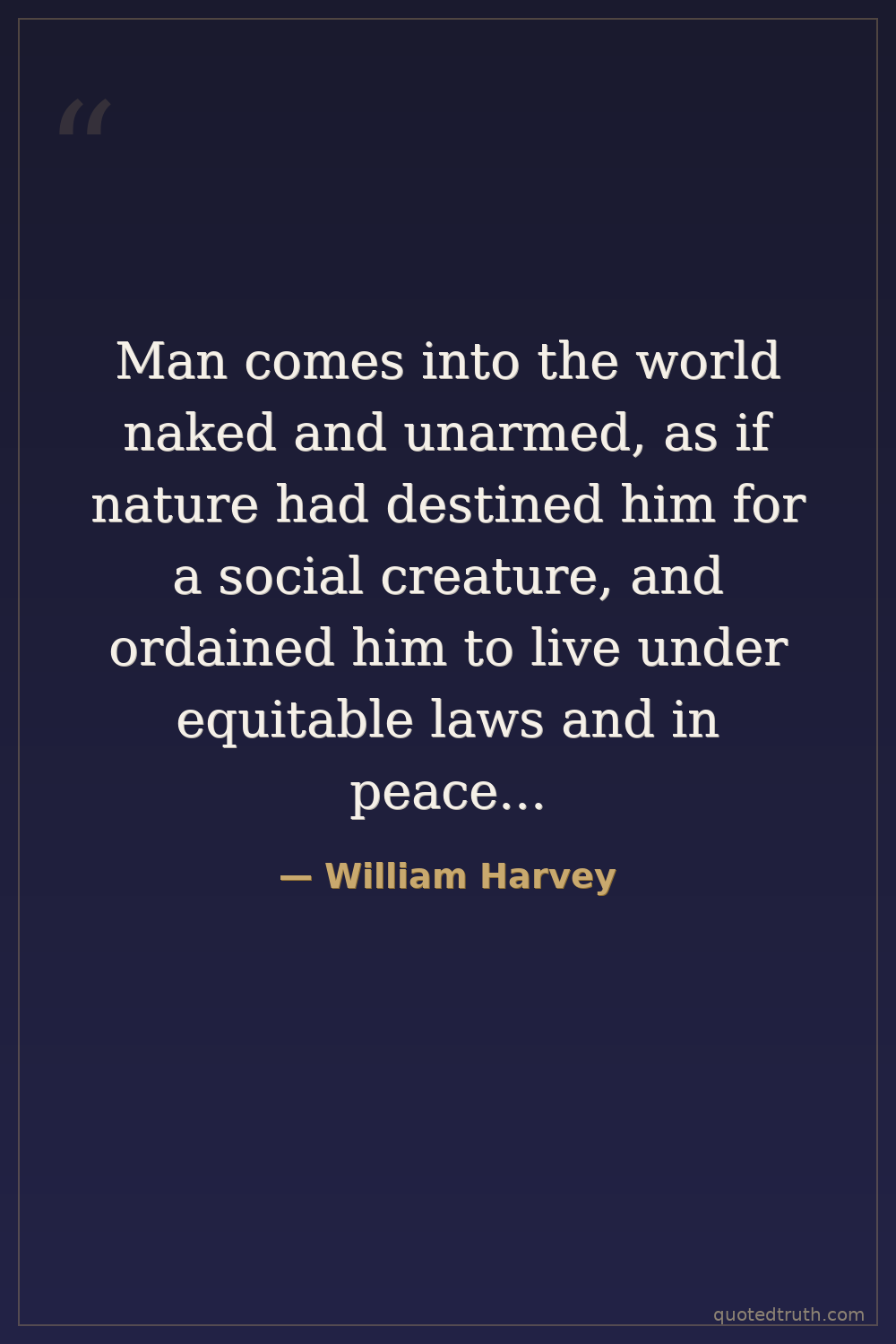
Humans arrive in the world physically defenseless and unequipped for solitary survival. Harvey argues this is nature's deliberate design — a built-in signal that we are meant to live cooperatively, governed by fair laws rather than brute force. Our biological vulnerability at birth is read as nature's blueprint for civil society: peaceful coexistence and legal order are not impositions on human nature but expressions of it.
Relevance to William Harvey
Harvey's entire career rested on reading nature as a precise, purposeful system — the same method that revealed blood's circulation applies here to human society. As physician to King Charles I, he lived inside political upheaval and witnessed the English Civil War firsthand, watching colleagues and patrons fall to violence. His belief that nature itself ordains peaceful, law-governed society reflects both his empirical worldview and his personal horror at the chaos around him.
The era
Harvey worked during one of Europe's most violent centuries — the Thirty Years' War (1618–1648) killed millions across the continent, and England's Civil War (1642–1651) executed a king and shattered civil order. Natural law philosophy was simultaneously rising through thinkers like Grotius and Hobbes, debating whether humans were naturally peaceful or violent. Harvey's claim that nature designed humans for peace and law was a direct, hopeful counter to the bloodshed he witnessed.
AI-generated insights based on extensive research and information for context. Factual errors? Email [email protected].