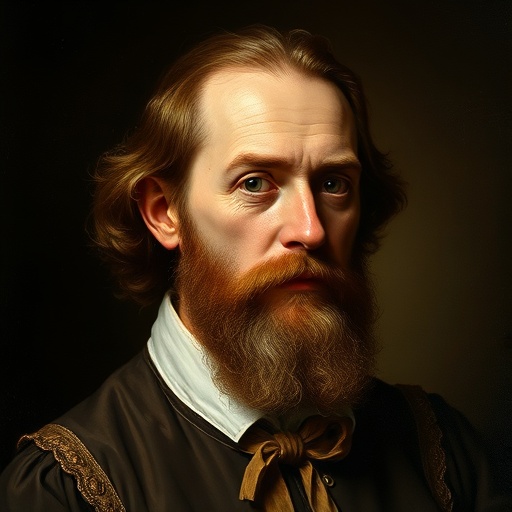
William Harvey — "All we know is still infinitely less than all that still remains unknown."
All we know is still infinitely less than all that still remains unknown.
All we know is still infinitely less than all that still remains unknown.
Click any product to generate a realistic preview. Up to 3 at a time.
* Initial load can take up to 90 seconds — revising the preview in another color is nearly instant.
"The blood, therefore, moves in a circuit, and is impelled by the heart."
"It seems to me that the motion of the blood is like that of water in a mill-stream."
"The body is the instrument of the soul."
"All animals, even man himself, are produced from an egg."
"The greatest pleasure is to discover something new."
English physician whose On the Motion of the Heart and Blood in Animals (1628) demonstrated blood circulation, overturning 1,400 years of Galenic medicine. Closely associated with Francis Bacon (his contemporary in the new English empiricism). For an intellectual contrast, see Galenic medicine, the 2nd-century Greek medical tradition (humors, blood-as-consumed-fuel) — Harvey calculated that the heart pumps more blood per hour than the body could possibly produce as fuel — a single quantitative observation that demolished the entire Galenic-Aristotelian medical worldview. The cleanest example in medical history of arithmetic disproving 14 centuries of authority.
A statement reflecting scientific humility and the vastness of unexplored knowledge, from 'De Motu Cordis' (1628), Dedication to Doctor Argent.
Date: 1628
PhilosophicalFound in 2 providers: gemini,deepseek
2 sources checked
No matter how much humanity learns or discovers, the vast ocean of what remains unknown dwarfs our accumulated knowledge. True understanding begins with recognizing the limits of what we currently grasp. This is not pessimism but intellectual humility — an acknowledgment that discovery is endless, and certainty should be held loosely against the backdrop of perpetual mystery.
Harvey revolutionized medicine by demonstrating blood circulates continuously through the body, overturning Galenic doctrine held for 1,400 years. Yet even after this landmark discovery, he remained deeply humble. His meticulous dissections and vivisections taught him that nature constantly surprised careful observers, making him acutely aware that each answer revealed deeper questions about anatomy and physiology.
The early modern period was the Scientific Revolution, when Copernicus, Galileo, and Harvey were dismantling ancient authorities. Yet simultaneously, plague, superstition, and scholastic dogma dominated. Harvey published De Motu Cordis in 1628 amid fierce resistance from tradition-bound physicians. This tension between emerging empiricism and entrenched ignorance made humility about knowledge both professionally courageous and philosophically necessary.
AI-generated insights based on extensive research and information for context. Factual errors? Email [email protected].
Your cart is empty