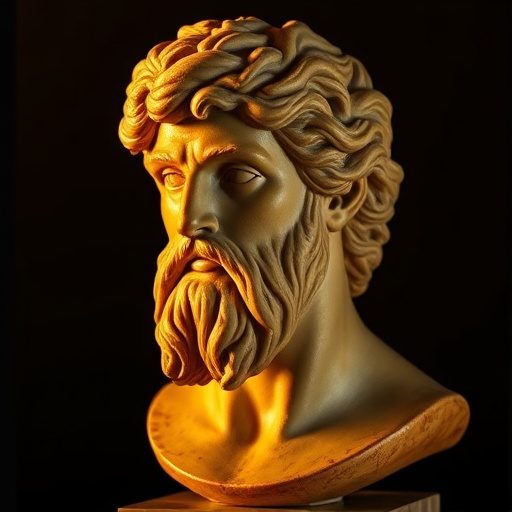
Pythagoras — "Avoid all things that will occasion envy."
Avoid all things that will occasion envy.
Avoid all things that will occasion envy.
Click any product to generate a realistic preview. Up to 3 at a time.
* Initial load can take up to 90 seconds — revising the preview in another color is nearly instant.
"Don't leave the outline of a pan in ashes."
"Concern should drive us into action and not into a depression. No man is free who is not master of himself."
"Choose always the way that seems the best, however rough it may be; custom will soon render it easy and agreeable."
"None can be free who is a slave to, and ruled by, his passions."
"Educate the children and it won't be necessary to punish the men."
Greek philosopher and mathematician whose school in Croton combined geometry (the Pythagorean theorem), number-mysticism, and a religious-vegetarian way of life. Closely associated with Thales of Miletus (earlier pre-Socratic and the first philosopher). For an intellectual contrast, see Heraclitus, pre-Socratic Greek philosopher of flux — Heraclitus called Pythagoras 'the chief of swindlers' — among the founding insults of the philosophical-rivalry tradition. Their 'all is flux' vs 'all is number' poles still organize the philosophy of mathematics today (Platonist vs anti-realist).
Found in 1 providers: gemini
1 source checked
Don't act in ways that provoke envy in others. Envy breeds resentment, rivalry, and conflict—it turns potential allies into enemies. In modern terms: avoid needlessly flaunting wealth, status, or achievements. This is practical social wisdom: living without excess display reduces friction and protects relationships. The advice isn't about hiding success but about recognizing that provoking jealousy in those around you creates hostility that ultimately harms you.
Pythagoras founded a secretive philosophical brotherhood in Croton that strictly governed members' behavior—diet, speech, and conduct. His school emphasized harmony, proportion, and communal living above personal glory. He believed envy disrupts the soul's balance and corrupts community. His mathematical worldview saw excess and imbalance as sources of disorder. Living modestly and avoiding provocations to jealousy aligned perfectly with his vision of a well-ordered life and a harmonious society.
In 6th-century BCE Greece, envy (phthonos) was considered a powerful destructive force—Greek tragedy repeatedly showed how jealousy destroys individuals and communities. Pythagoras lived in Magna Graecia during intense political rivalry between aristocratic factions. His brotherhood at Croton gained significant political influence and eventually faced violent backlash from envious rivals. In a culture obsessed with honor and public reputation, deliberately avoiding envy-provoking behavior was both philosophical wisdom and a pragmatic survival strategy.
AI-generated insights based on extensive research and information for context. Factual errors? Email [email protected].
Your cart is empty