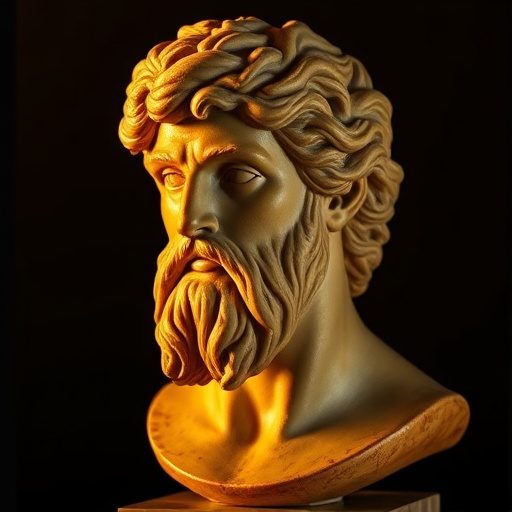
Pythagoras — "Choose rather to be strong of soul than strong of body."
Choose rather to be strong of soul than strong of body.
Choose rather to be strong of soul than strong of body.
Click any product to generate a realistic preview. Up to 3 at a time.
* Initial load can take up to 90 seconds — revising the preview in another color is nearly instant.
"Accustom yourself to a way of living that is neat and decent without luxury."
"The soul of man is divided into three parts, intelligence, reason, and passion. Intelligence and passion are possessed by other animals, but reason by man alone."
"Don't offer your right hand too easily."
"Don't sit on a bushel."
"The strangest (and sexiest) of the legends surrounding the aura of Pythagoras is that he had a golden thigh that he would show to impress people he wanted to join his cult."
Greek philosopher and mathematician whose school in Croton combined geometry (the Pythagorean theorem), number-mysticism, and a religious-vegetarian way of life. Closely associated with Thales of Miletus (earlier pre-Socratic and the first philosopher). For an intellectual contrast, see Heraclitus, pre-Socratic Greek philosopher of flux — Heraclitus called Pythagoras 'the chief of swindlers' — among the founding insults of the philosophical-rivalry tradition. Their 'all is flux' vs 'all is number' poles still organize the philosophy of mathematics today (Platonist vs anti-realist).
A philosophical statement prioritizing inner strength.
Date: c. 570-495 BCE (attributed later)
BiblicalFound in 2 providers: gemini,deepseek
2 sources checked
Inner character and wisdom outlast physical power. A strong body impresses others temporarily, but a strong soul — meaning disciplined thought, ethical integrity, and mental resilience — shapes every decision you make throughout your life. Physical strength peaks and declines; the strength of your character compounds over time. Prioritize building who you are on the inside over how you look or how much force you can exert.
Pythagoras built his entire philosophical community around purifying the soul through mathematical contemplation and strict moral discipline. He taught metempsychosis — that souls transmigrate across lifetimes — making the soul's condition far more consequential than the body's. His Pythagorean Brotherhood in Croton enforced vegetarianism, ritual abstinence, and rigorous study, treating intellectual and ethical cultivation as sacred duties. For Pythagoras, mathematics itself was a spiritual practice for strengthening the immortal soul.
Ancient Greece in the 6th–5th century BC celebrated physical excellence above nearly everything else. The Olympic Games made athletic supremacy a path to divine favor and civic glory, while Spartans built their entire civilization around bodily strength for warfare. Pythagoras's statement was genuinely counter-cultural — asserting that the inner life of reason and moral character outranked the warriors and athletes that Greek society worshipped as its highest ideal.
AI-generated insights based on extensive research and information for context. Factual errors? Email [email protected].
Your cart is empty