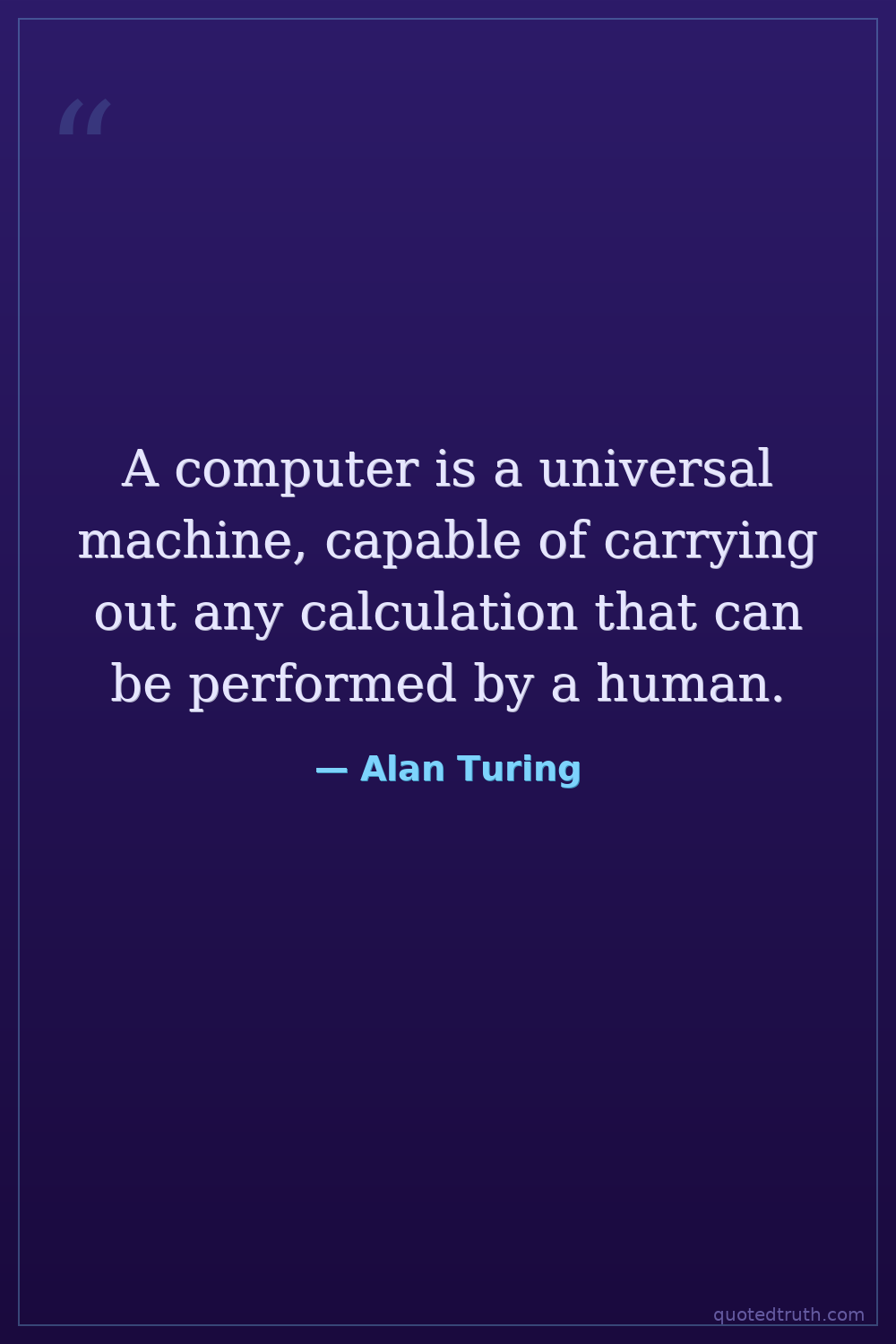
Alan Turing — "A computer is a universal machine, capable of carrying out any calculation that …"
A computer is a universal machine, capable of carrying out any calculation that can be performed by a human.
A computer is a universal machine, capable of carrying out any calculation that can be performed by a human.
Click any product to generate a realistic preview. Up to 3 at a time.
* Initial load can take up to 90 seconds — revising the preview in another color is nearly instant.
"The popular view that the brain is a 'digital computer' is a profound oversimplification."
"We are not interested in the fact that a machine can solve a problem, but in the fact that it can solve a problem that we cannot."
"The computer is a universal simulator."
"The possibility of a machine thinking is a disturbing thought for many people."
"I have had a dream indicating rather clearly that I am on the way to being hetero, though I don't accept it with much enthusiasm either awake or in the dreams."
On Computable Numbers, with an Application to the Entscheidungsproblem
Date: 1936
Art & CreativityFound in 1 providers: grok
1 source checked
Machines aren't specialized tools locked to one task — they're general-purpose engines that can execute any step-by-step process a human can follow. Give a computer the right instructions and it replicates any calculation: arithmetic, logic, symbol manipulation, pattern recognition. This universality distinguishes a computer from a calculator or loom. The only limit is whether a process can be precisely defined as a finite sequence of steps.
Turing proved this mathematically in 1936 with his Universal Turing Machine — a theoretical device capable of simulating any other computing machine. At Bletchley Park he built Bombe machines that mechanized what human codebreakers did by hand, cracking Enigma at scale. His 1950 paper asked whether machines could think, extending universality from calculation to cognition. This conviction that machines could mirror human reasoning defined his entire career and his famous imitation game.
In the 1930s–1950s, 'computer' meant a human worker performing arithmetic by hand — armies of people at desks calculating ballistic tables and census figures. Electronic machines like ENIAC and Colossus had just emerged. The idea that one machine could replace all those specialized human roles was revolutionary and contested. WWII had shown mechanical computation could break codes faster than any human team, making Turing's claim not just theory but demonstrated, war-winning fact.
AI-generated insights based on extensive research and information for context. Factual errors? Email [email protected].
Your cart is empty