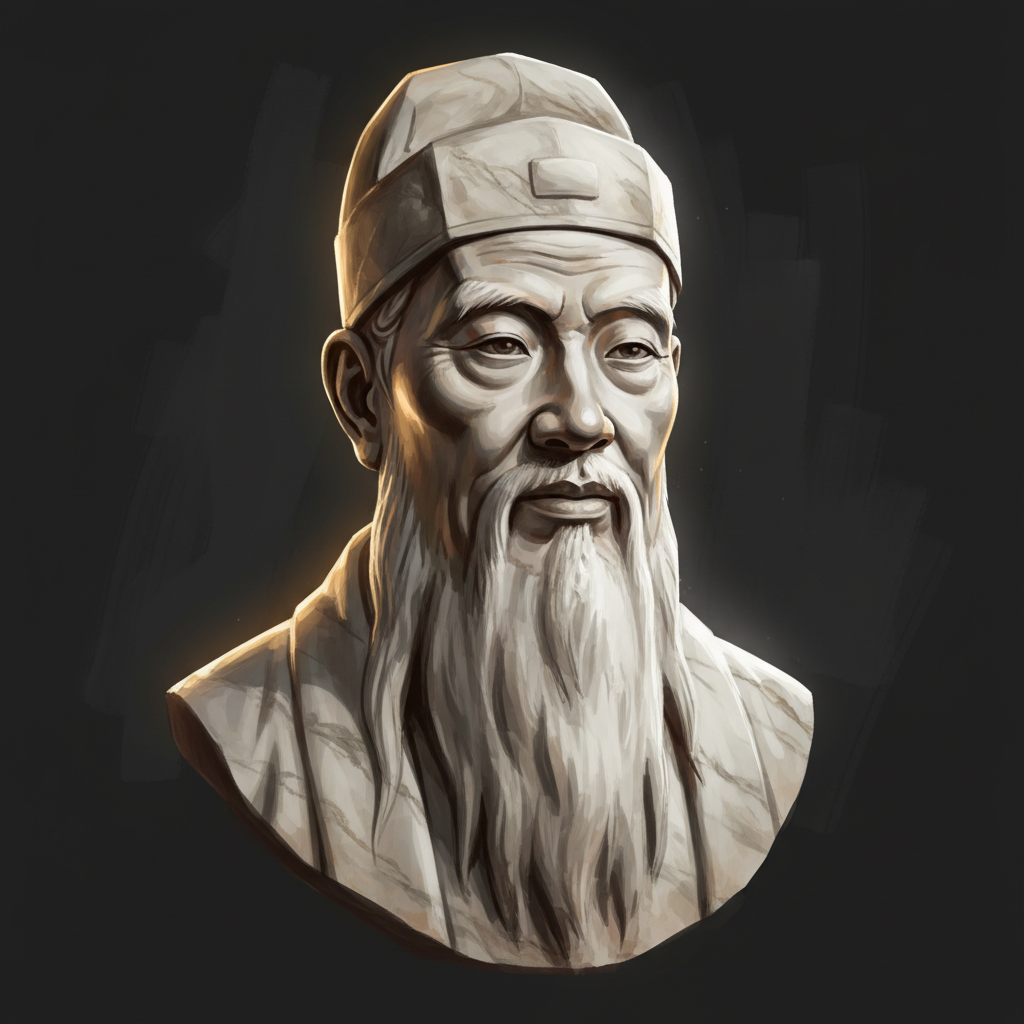
Confucius — "The superior man is slow in speech but quick in action."
The superior man is slow in speech but quick in action.
The superior man is slow in speech but quick in action.
Click any product to generate a realistic preview. Up to 3 at a time.
* Initial load can take up to 90 seconds — revising the preview in another color is nearly instant.
"To be able to practice five things everywhere under heaven constitutes perfect virtue... gravity, generosity of soul, sincerity, earnestness, and kindness."
"The cautious seldom err."
"The superior man understands what is right; the inferior man understands what will sell."
"The superior man thinks of virtue; the small man thinks of comfort."
"The Master said, 'A man can enlarge the Way, but the Way cannot enlarge a man.'"
Chinese philosopher and teacher whose teachings (compiled by his students in the Analects) became the foundational ethical framework of East Asian civilization for 2,500 years. Closely associated with Mencius (his most-influential follower a century later). For an intellectual contrast, see Laozi, near-contemporary Chinese sage and Tao Te Ching author — Confucius systematized social order through ritual and family hierarchy; Laozi's Taoist effortless-action philosophy argued such systems were the disease, not the cure. The two founding poles of Chinese moral philosophy — every East Asian moral tradition since has positioned itself between them.
The standard scholarly entry points to Confucius's work: Philip J. Ivanhoe (Georgetown, Chinese philosophy) — Confucian Moral Self Cultivation (2000); Edward Slingerland (UBC, Asian Studies) — Effortless Action: Wu-wei as Conceptual Metaphor (2003); Tu Weiming (Harvard, Confucian scholar) — Confucian Thought: Selfhood as Creative Transformation (1985). These are the works graduate seminars cite when teaching Confucius.
Found in 1 providers: deepseek
1 source checked
A person of genuine character speaks carefully and sparingly, but acts decisively when it matters. Talk is cheap, and bragging or making promises comes easily to anyone. Real worth shows up in what you actually do, not in how eloquently you describe what you intend to do. Restraint in words combined with readiness in deeds signals maturity, discipline, and trustworthiness.
Confucius spent decades traveling between warring states seeking a ruler who would implement his ethical vision, and he valued conduct over rhetoric. His teachings constantly distinguish the junzi, the morally cultivated person, from the glib talker. As a teacher who preferred demonstration to lecture and who criticized flattery, he embodied this standard, urging disciples to match their words exactly to their deeds.
During the Spring and Autumn period around the sixth and fifth centuries BCE, the Zhou order was collapsing into rivalry between feudal states. Courts overflowed with smooth-tongued advisors, traveling persuaders, and self-promoting officials who offered schemes but rarely delivered results. Confucius was rebuilding a model of virtuous government rooted in ritual, sincerity, and personal integrity, so prizing restrained speech and reliable action directly answered the hollow rhetoric corrupting political life.
AI-generated insights based on extensive research and information for context. Factual errors? Email [email protected].
Your cart is empty