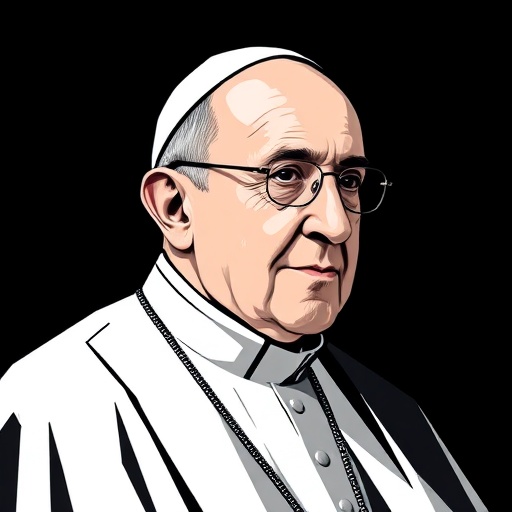
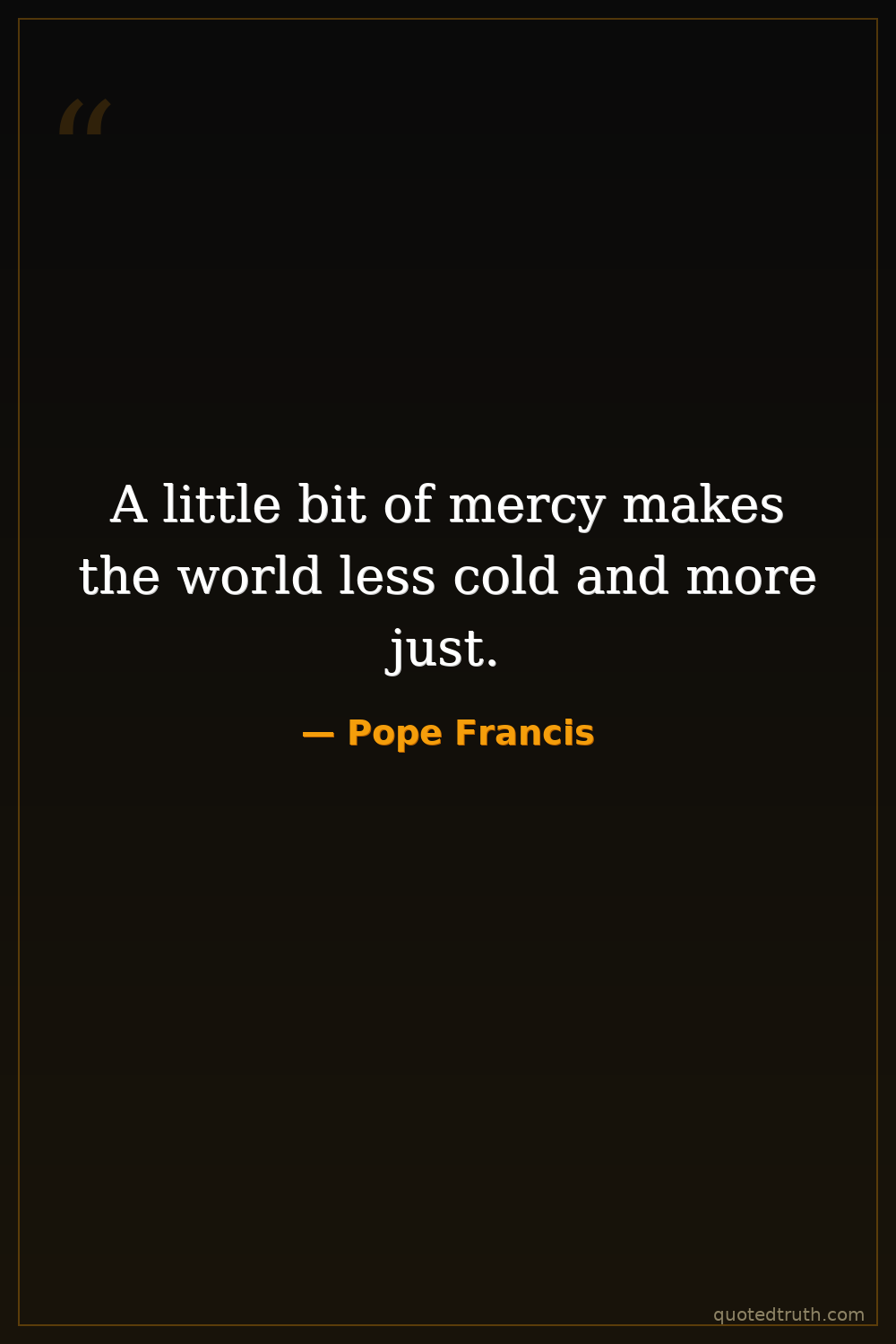
Pope Francis — "A little bit of mercy makes the world less cold and more just."
A little bit of mercy makes the world less cold and more just.
A little bit of mercy makes the world less cold and more just.
Click any product to generate a realistic preview. Up to 3 at a time.
* Initial load can take up to 90 seconds — revising the preview in another color is nearly instant.
"It is not necessary to believe in God to be a good person."
"I believe that when there is a lack of work, a family is suffering, a child is suffering, and when the elderly have no dignity, that is when society is suffering."
"War is madness."
"The world needs more tenderness."
"Who am I to judge a gay person seeking the Lord with good will?"
First Latin American and Jesuit pope (2013-), who has steered the Catholic Church toward pastoral inclusion on LGBTQ pastoral care, divorced Catholics, and climate. Closely associated with Pope John XXIII (the Vatican II reformer pope) and Cardinal Walter Kasper (his theological ally on pastoral reform). For an intellectual contrast, see Cardinal Raymond Burke, American traditionalist cardinal, former head of the Vatican Apostolic Signatura — Burke is the public face of Catholic traditionalism that views Francis's pastoral approach as doctrinally dangerous — he has formally challenged Amoris Laetitia and other Francis reforms.
Found in 1 providers: grok
1 source checked
Mercy—the willingness to show compassion and forgiveness rather than judgment—doesn't require grand gestures. Even small acts of kindness chip away at the indifference and harshness that define daily life. When people extend grace rather than responding with coldness or strict punishment, society becomes not weaker but more equitable. Mercy and justice aren't opposites; mercy is precisely what makes justice humane rather than merely transactional.
Jorge Mario Bergoglio grew up in Buenos Aires, ministered to the poor in Argentina's slums, and chose the name Francis after history's great saint of the marginalized. He declared 2016 the Church's Jubilee of Mercy, washed the feet of prisoners and refugees, and consistently prioritized pastoral compassion over doctrinal rigidity. His remark 'Who am I to judge?' encapsulates a papacy deliberately built around mercy as Christianity's most essential and defining practice.
Francis became Pope in 2013 as Western nations hardened toward refugees fleeing Syria and elsewhere, income inequality widened, and populist movements framed compassion as naïveté. The Mediterranean became a graveyard for migrants. COVID-19 later exposed stark inequities in healthcare and labor. Against this backdrop of nationalist retrenchment and social fragmentation, his insistence that even small acts of mercy can shift the moral temperature of an entire society carried urgent practical weight.
AI-generated insights based on extensive research and information for context. Factual errors? Email [email protected].
Your cart is empty