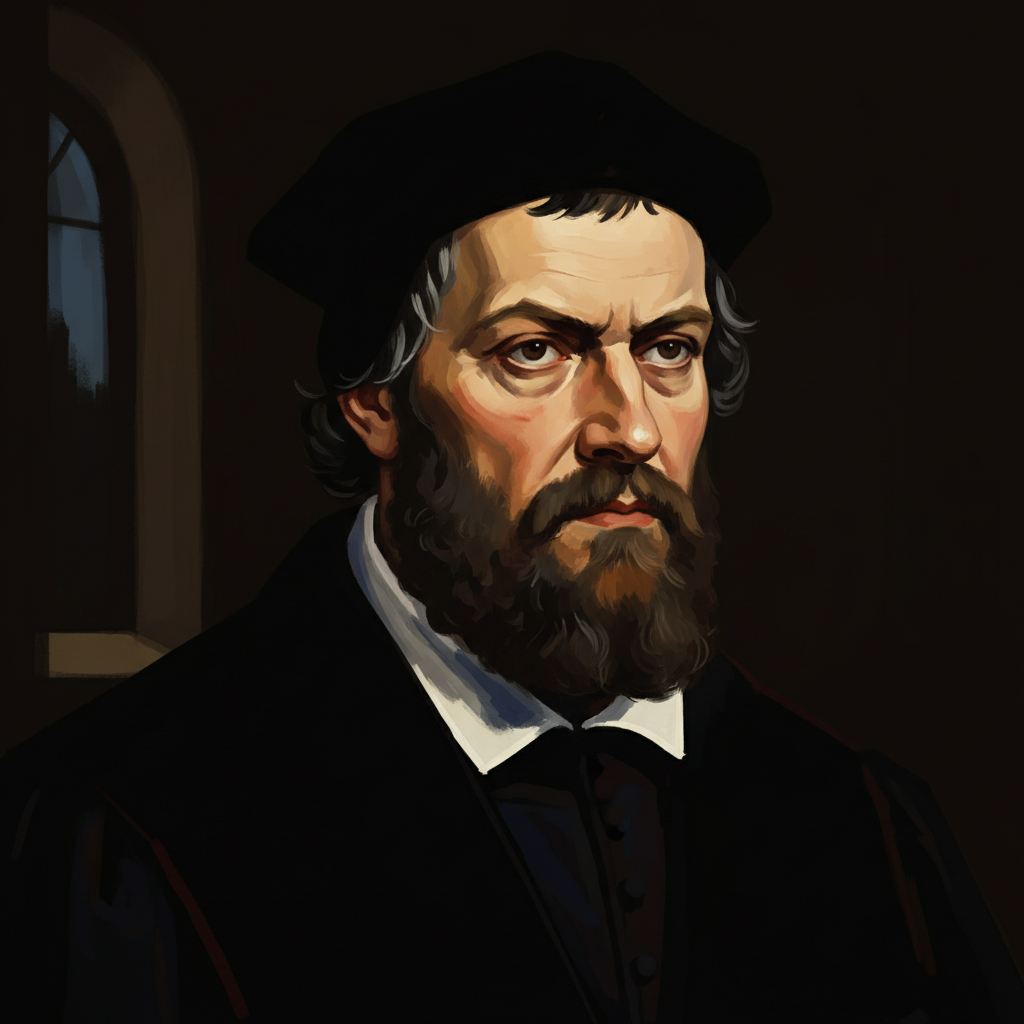
Martin Luther — "A man should not lie with his wife before she has been three nights in bed."
A man should not lie with his wife before she has been three nights in bed.
A man should not lie with his wife before she has been three nights in bed.
Click any product to generate a realistic preview. Up to 3 at a time.
* Initial load can take up to 90 seconds — revising the preview in another color is nearly instant.
"Medicine causes illness, Mathematics melancholy, and Theology sinful people."
"If I am to be a Christian, I must be a Jew."
"We are not yet what we shall be, but we are growing toward it, the process is not yet finished, but it is going on, this is not the end, but it is the road."
"The will is a beast of burden. If God mounts it, it wishes and goes as God wills; if Satan mounts it, it wishes and goes as Satan wills; Nor can it choose its rider... the riders contend for its posse…"
"The word and work of God is quite clear, namely, that women were made to be either wives or prostitutes."
German theologian whose 95 Theses (1517) launched the Protestant Reformation and broke the Catholic Church's monopoly on Western Christianity. Closely associated with Philipp Melanchthon (Lutheran systematizer) and John Calvin (later Reformer who built on Luther's break). For an intellectual contrast, see Pope Leo X, Renaissance pope (1513-1521) — Leo X's indulgence sales triggered Luther's break and Leo excommunicated him in 1521 — Luther's entire Reformation is structured as a direct answer to the indulgence-funded Vatican Leo represented.
Found in 1 providers: grok
1 source checked
This advises a newly married husband to wait three nights before having sexual relations with his bride. The recommendation frames marriage as something that should not begin with immediate physical consummation. Instead, the couple should spend their first nights together building comfort, companionship, and mutual respect before intimacy. It treats restraint at the start of marriage as a sign of consideration for the wife and a foundation for a healthier long-term bond.
Luther, a former Augustinian monk who had taken vows of celibacy, married former nun Katharina von Bora in 1525 and wrote extensively on marriage, sex, and household life. He rejected Catholic teaching that celibacy was holier than marriage, yet still preached sexual discipline. This saying reflects his practical, pastoral voice on domestic matters and his insistence that even within marriage, husbands owed their wives patience and restraint rather than entitlement.
In early sixteenth-century Europe, marriages were often arranged, brides were young, and wedding nights were sometimes publicly witnessed to verify consummation. The Reformation Luther led was overturning clerical celibacy and elevating marriage as a godly estate open to pastors. Protestant reformers issued household advice replacing Catholic confessional manuals, shaping sexual ethics for ordinary Christians. Luther's counsel fit a moment when Protestant Europe was rewriting the rules of marriage, sexuality, and family life outside Rome's authority.
AI-generated insights based on extensive research and information for context. Factual errors? Email [email protected].
Your cart is empty