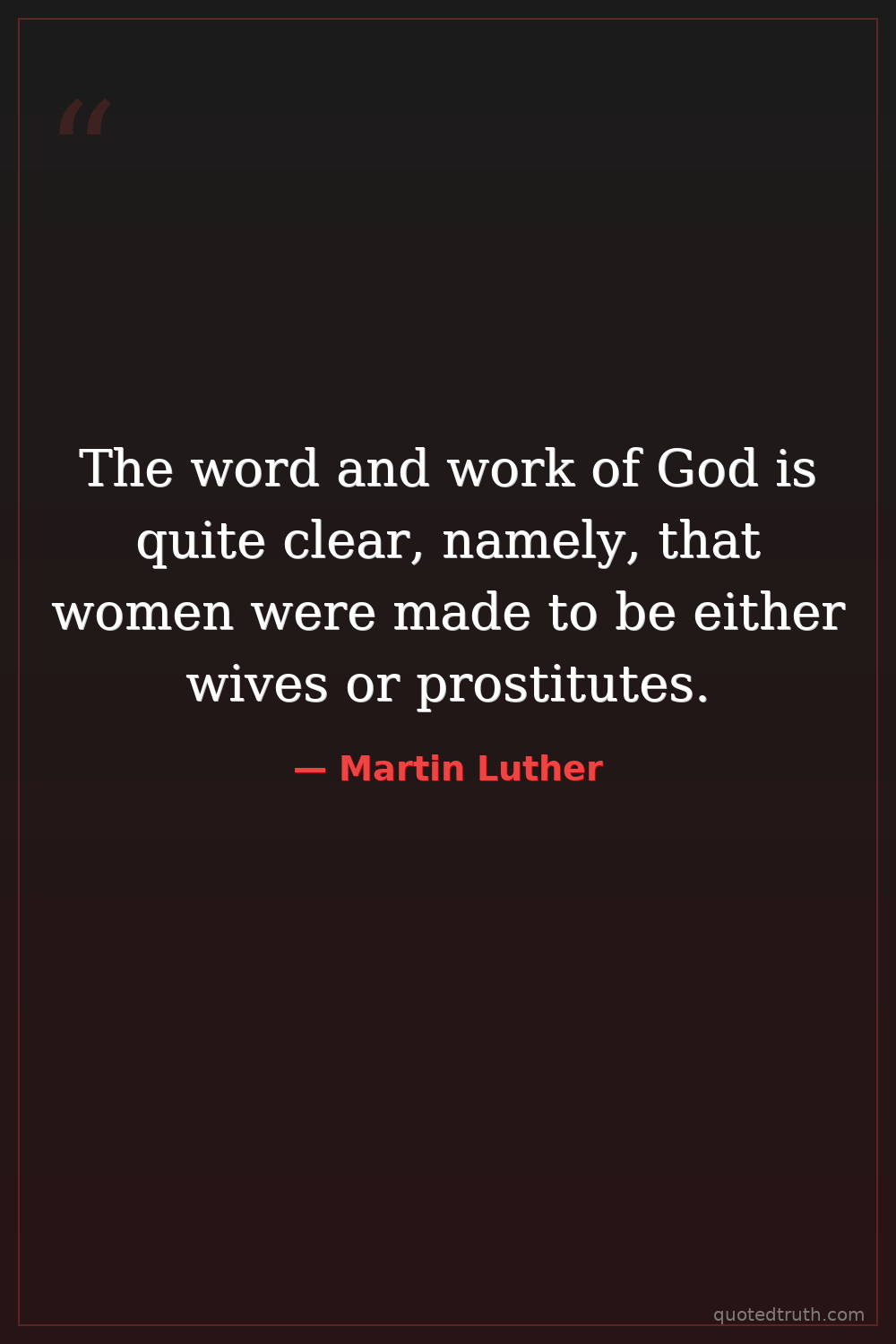
Martin Luther — "The word and work of God is quite clear, namely, that women were made to be eith…"
The word and work of God is quite clear, namely, that women were made to be either wives or prostitutes.
The word and work of God is quite clear, namely, that women were made to be either wives or prostitutes.
Click any product to generate a realistic preview. Up to 3 at a time.
* Initial load can take up to 90 seconds — revising the preview in another color is nearly instant.
"A woman is a human being with a womb."
"The human heart is like a millstone in a mill: when you put wheat under it, it turns and grinds and makes flour; if you put no wheat, it still grinds on, but then 'tis itself it grinds away."
"The greatest good in marriage is the love of husband and wife."
"remember that there is nothing more poisonous, pernicious, and devilish than a rebellious man. Just as one must slay a mad dog, so, if you do not fight the rebels, they will fight you, and the whole c…"
"And so, dear Christian, beware of the Jews . . . you can see how God's wrath has consigned them to the Devil, who has robbed them not only of a proper understanding of the Scriptures, but also of comm…"
German theologian whose 95 Theses (1517) launched the Protestant Reformation and broke the Catholic Church's monopoly on Western Christianity. Closely associated with Philipp Melanchthon (Lutheran systematizer) and John Calvin (later Reformer who built on Luther's break). For an intellectual contrast, see Pope Leo X, Renaissance pope (1513-1521) — Leo X's indulgence sales triggered Luther's break and Leo excommunicated him in 1521 — Luther's entire Reformation is structured as a direct answer to the indulgence-funded Vatican Leo represented.
Found in 1 providers: deepseek
1 source checked
This statement claims God designed women for only two roles: marriage or sex work. It presents female identity as entirely defined by sexual function in relation to men, with no legitimate alternative such as independent single life, celibacy, or religious vocation. Anyone outside marriage is cast as sexually illicit. In modern terms, it reduces women to their reproductive and sexual utility, denying them autonomous purpose beyond serving male needs within or outside wedlock.
Luther rejected Catholic celibacy and monasticism, closed convents, and married ex-nun Katharina von Bora in 1525, promoting marriage as the ideal Christian calling. He viewed women primarily as wives and mothers under husbandly authority, reading Genesis and Paul literally. This quote reflects his binary sexual ethics: legitimate procreative marriage or sinful fornication, with no valid celibate path. It captures his blunt, polemical style and patriarchal theology typical of his German table talks.
Early sixteenth-century Europe was dismantling medieval Catholic structures. Convents, which had offered women literacy, leadership, and singleness, were being dissolved across Protestant territories, eliminating the honorable unmarried path. Reformers redefined marriage as a sacred vocation rather than spiritual compromise. Women faced a narrowing of roles just as printing spread such pronouncements widely. Witch trials intensified, prostitution was simultaneously criminalized, and household patriarchy was legally reinforced, making Luther's stark binary a reflection of hardening gender norms.
AI-generated insights based on extensive research and information for context. Factual errors? Email [email protected].
Your cart is empty