Max Planck — "A scientist is a man who tries to understand the world by experiment, and a phil…"
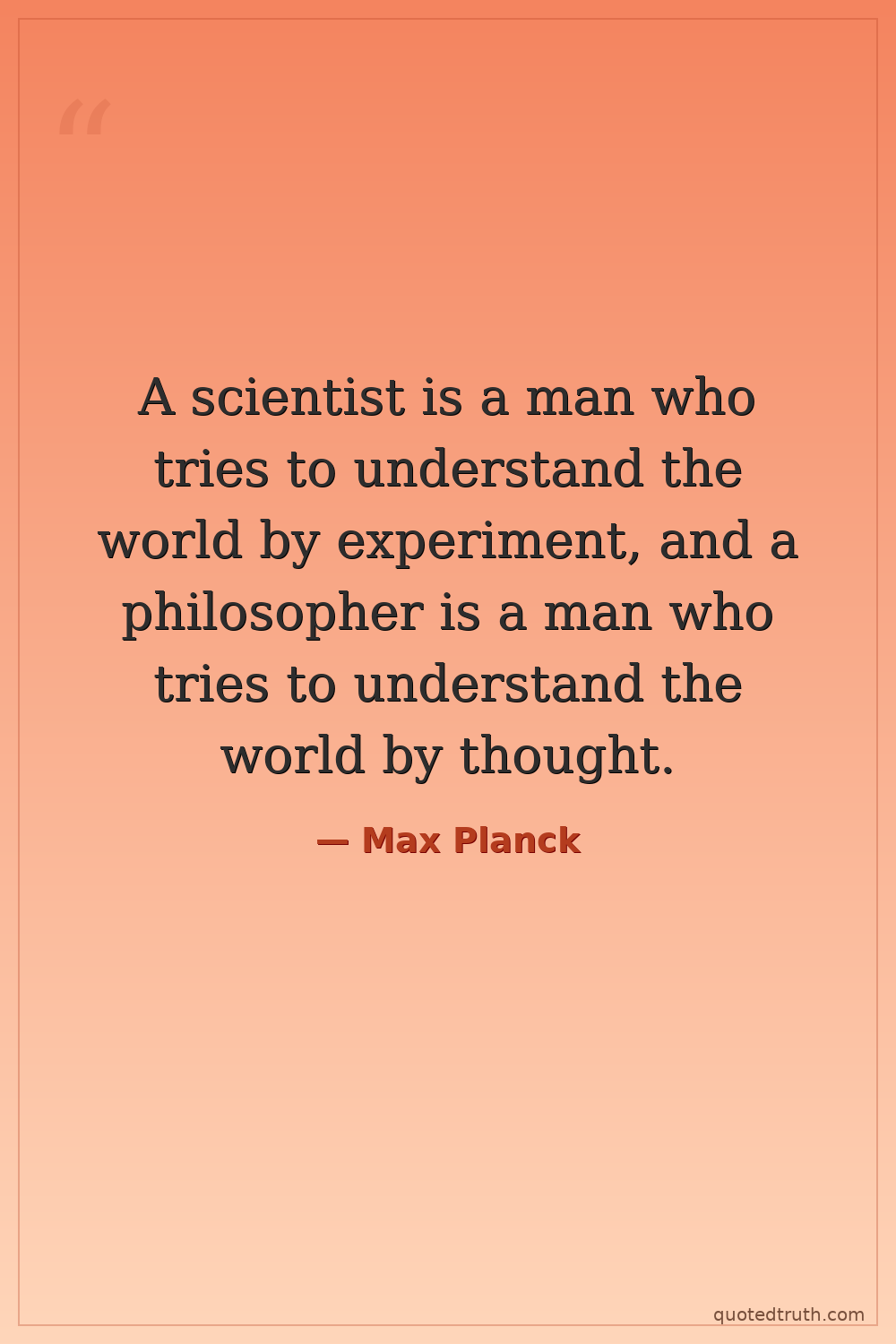
A scientist is a man who tries to understand the world by experiment, and a philosopher is a man who tries to understand the world by thought.
A scientist is a man who tries to understand the world by experiment, and a philosopher is a man who tries to understand the world by thought.
Click any product to generate a realistic preview. Up to 3 at a time.
* Initial load can take up to 90 seconds — revising the preview in another color is nearly instant.
"The greatest discovery of mankind is that man can do what he sets his mind to."
"The man who has not passed through the bitter experience of doubt, has not made a single step forward in science."
"The human mind is the most complex and mysterious thing in the universe."
"The quantum theory is a confirmation of the fact that the world is not a collection of things, but a collection of processes."
"The true scientist is a man of faith."
Found in 1 providers: grok
1 source checked
Planck draws a clean line between two ways of investigating reality. Scientists poke the world with experiments, measuring what nature does under controlled conditions and building knowledge from observed results. Philosophers work the other direction, using reasoning, logic, and reflection to ask what things mean and why they exist. Both pursue understanding, but one trusts the data it collects while the other trusts the structure of careful thinking.
Planck lived this split personally. As the father of quantum theory, he derived his revolutionary energy-quanta hypothesis in 1900 through painstaking experimental fits to blackbody radiation data, the scientist at work. But he also wrote extensively on free will, religion, and positivism, wrestling with what physics meant for human meaning. He respected both modes and refused to reduce reality to measurement alone, famously insisting consciousness was fundamental.
In early twentieth-century Germany, physics was tearing down classical certainties while philosophers like Husserl, Heidegger, and the Vienna Circle debated what knowledge even was. Planck's quantum leap and Einstein's relativity made the universe stranger than any armchair reasoning had predicted, yet logical positivists were arguing philosophy should defer entirely to science. Planck, trained in both traditions, pushed back by respecting each method's territory rather than collapsing one into the other.
AI-generated insights based on extensive research and information for context. Factual errors? Email [email protected].
Your cart is empty