What it means
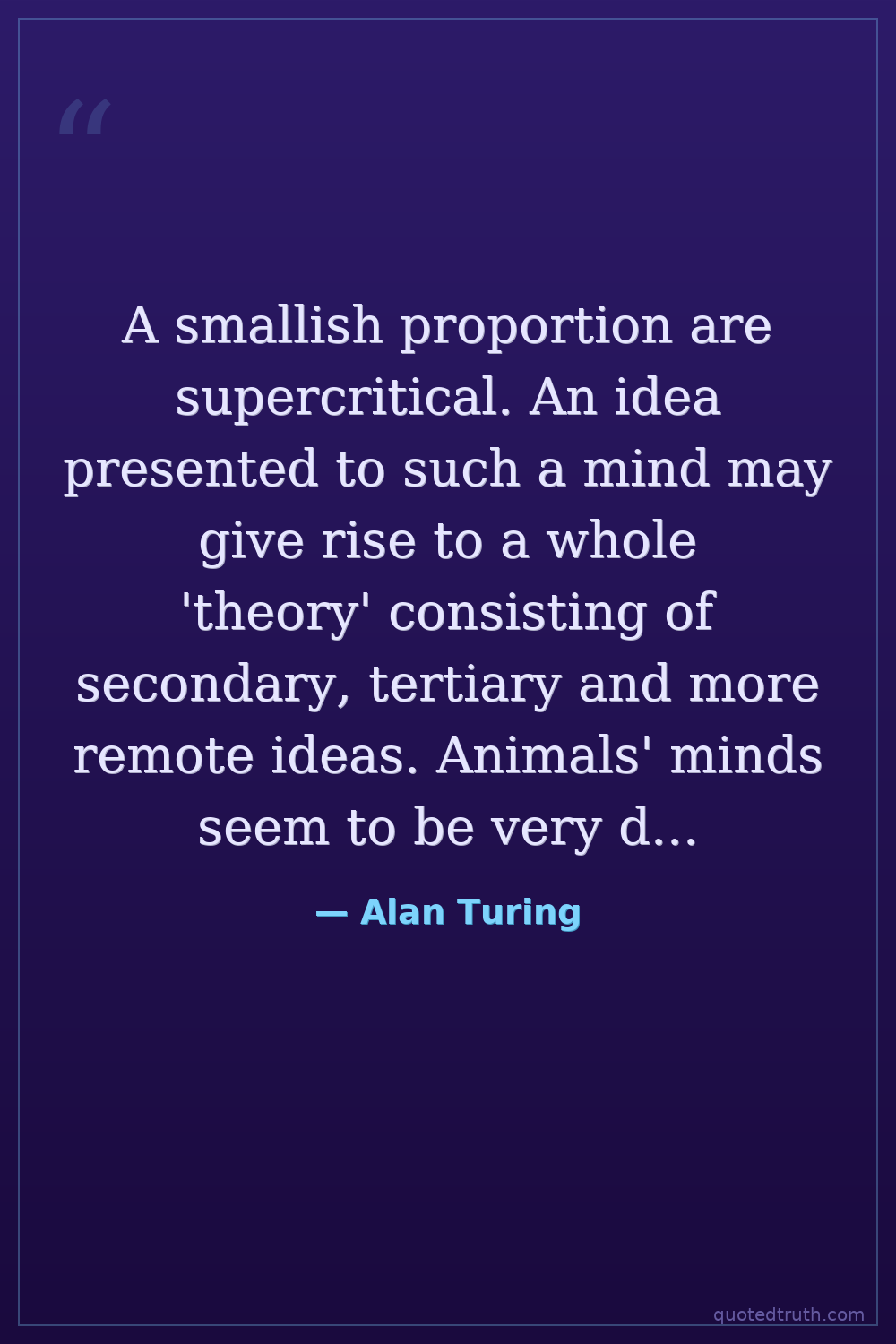
Some minds are explosive multipliers — feed them one idea and they generate cascading theories, connections, and derivatives spontaneously. Most minds, including animals', receive ideas passively without this chain reaction. A supercritical mind doesn't just absorb input; it detonates it, producing far more output than was put in, like a nuclear chain reaction but for thought.
Relevance to Alan Turing
Turing coined this in his 1950 'Computing Machinery and Intelligence' paper, exploring whether machines could think. As someone who cracked Enigma by seeing mathematical patterns others missed, and who single-handedly founded computer science from pure abstraction, Turing was describing himself — a mind that transformed single inputs into entire theoretical universes, from Turing machines to morphogenesis.
The era
Written in 1950, as Cold War competition pushed governments to weaponize intellect and early computers occupied entire rooms. Scientists were asking what separated human cognition from machinery. Turing's supercritical framing emerged from wartime codebreaking culture, where one insight could cascade into breaking an entire cipher system — the intellectual explosion he described was something he had personally witnessed and embodied.
AI-generated insights based on extensive research and information for context. Factual errors? Email [email protected].