Euclid — "The only purpose of the 'Elements' is to demonstrate mathematically certain fund…"
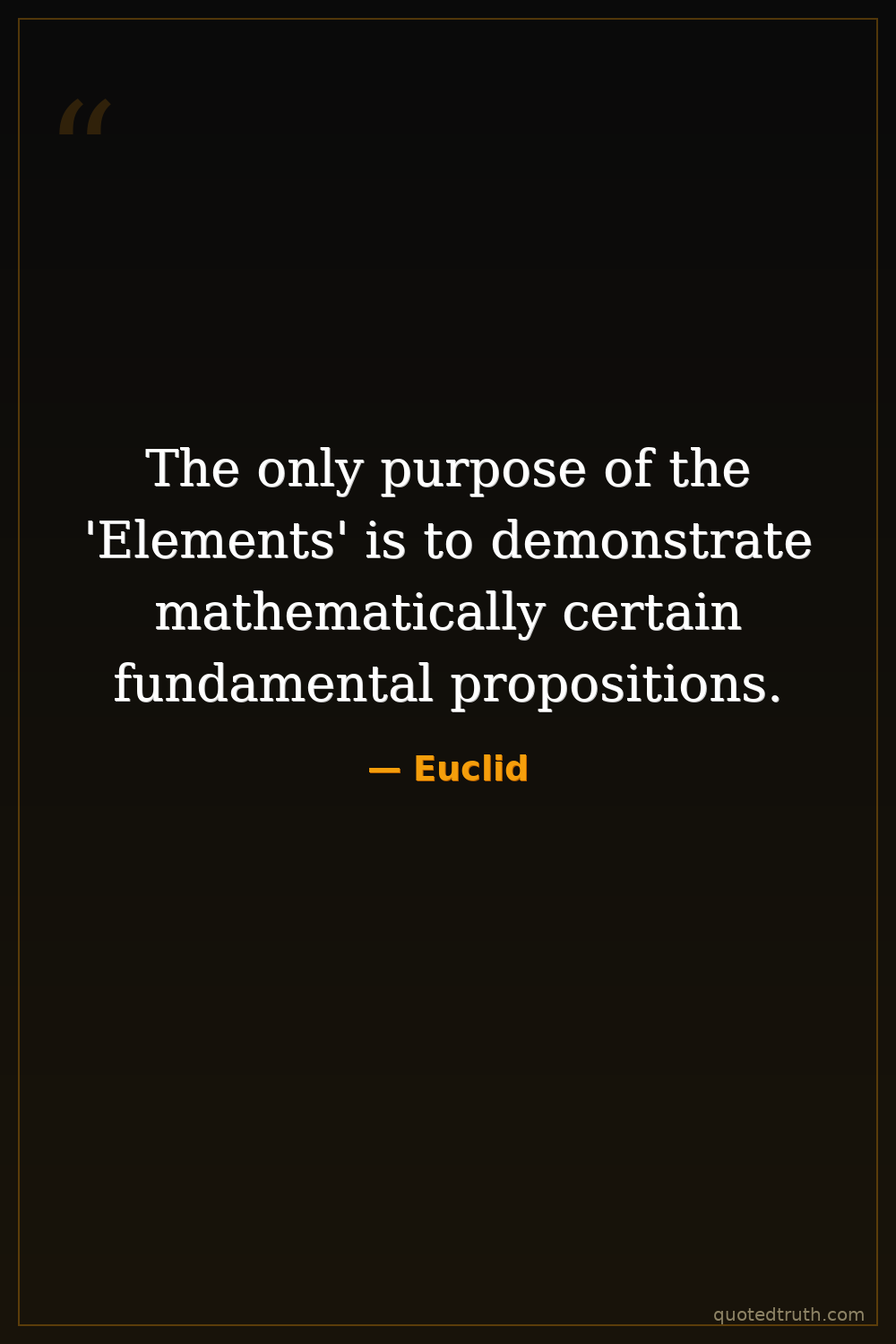
The only purpose of the 'Elements' is to demonstrate mathematically certain fundamental propositions.
The only purpose of the 'Elements' is to demonstrate mathematically certain fundamental propositions.
Click any product to generate a realistic preview. Up to 3 at a time.
* Initial load can take up to 90 seconds — revising the preview in another color is nearly instant.
"There are infinitely many prime numbers."
"In any right-angled triangle, the square on the side subtending the right angle is equal to the squares on the sides containing the right angle."
"An acute angle is an angle less than a right angle."
"Similar triangles are to one another in the duplicate ratio of their corresponding sides."
"A number is a multitude composed of units."
Interpretive summary of his work's intent, not a direct quote but reflecting the nature of 'Elements'. Direct philosophical statements by Euclid are extremely rare.
Date: c. 300 BCE (implied)
ShockingFound in 1 providers: grok
1 source checked
Euclid's 'Elements' was built with one clear aim: to prove fundamental mathematical truths through rigorous logical demonstration. It was not a collection of useful calculations or practical recipes — it was a system where axioms and definitions lead inevitably to proven conclusions. Every proposition exists to show why something is mathematically true, not just that it works. It established proof as the only acceptable standard for mathematical knowledge.
Euclid worked at Alexandria around 300 BCE, compiling Greek mathematics into 13 books of 'Elements.' His contribution was not discovering all the results himself but building an unbreakable logical architecture from five postulates upward. He was first an educator and systematizer — legend says when King Ptolemy asked for a shortcut to geometry, Euclid replied there is no royal road. His mission was proof as method, not answers as product.
Euclid lived during Alexandria's golden age under early Ptolemaic rule, when Egypt's Greek rulers bankrolled the great Library and Museum as centers of scholarship. Greek intellectual culture, shaped by Plato and Aristotle, demanded logos — rational proof over assertion. Mathematics was considered the highest form of certain knowledge. In this environment, a claim without demonstration had no standing. Systematic proof wasn't pedantic formality; it was the cultural currency of intellectual legitimacy.
AI-generated insights based on extensive research and information for context. Factual errors? Email [email protected].
Your cart is empty