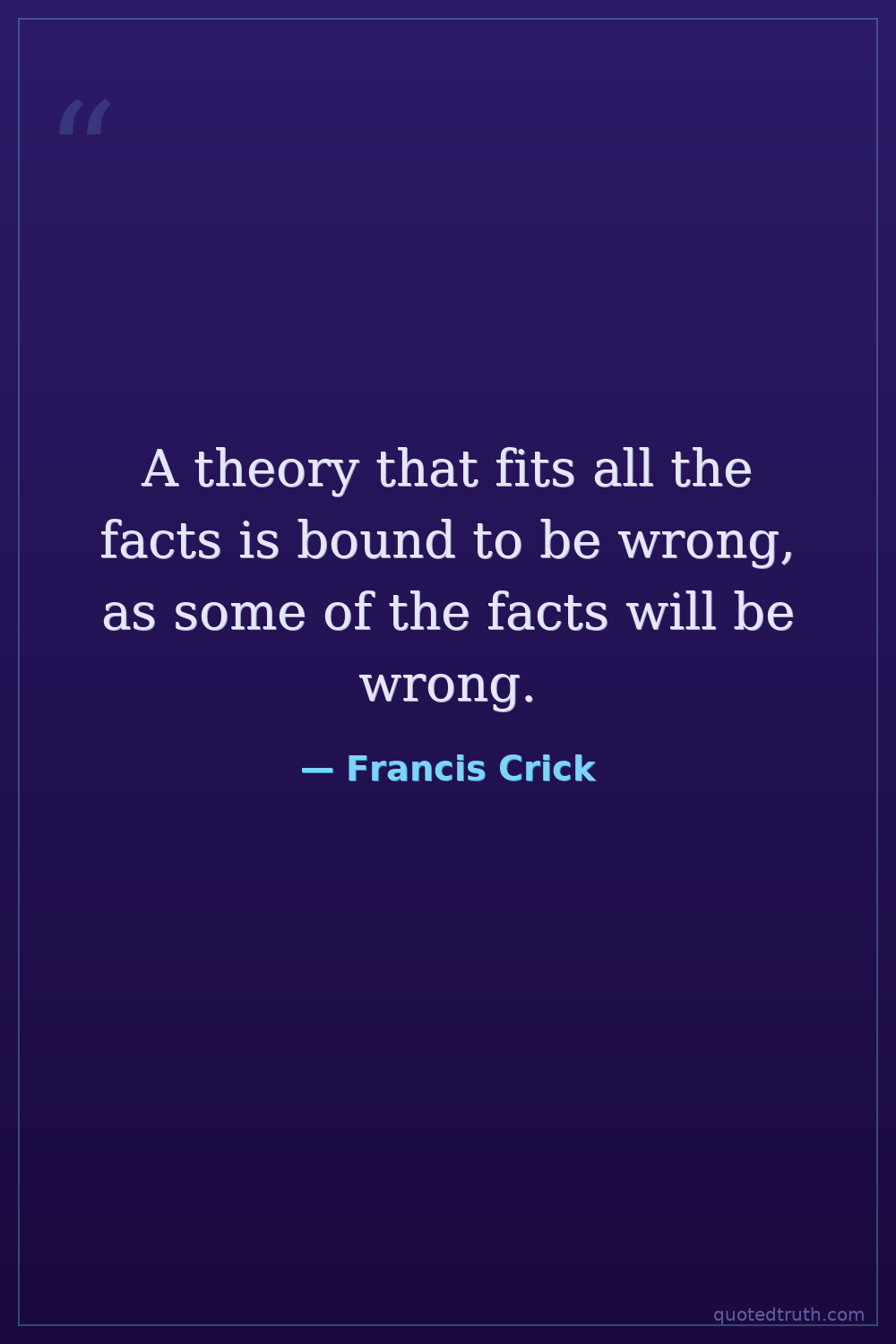
Francis Crick — "A theory that fits all the facts is bound to be wrong, as some of the facts will…"
A theory that fits all the facts is bound to be wrong, as some of the facts will be wrong.
A theory that fits all the facts is bound to be wrong, as some of the facts will be wrong.
Click any product to generate a realistic preview. Up to 3 at a time.
* Initial load can take up to 90 seconds — revising the preview in another color is nearly instant.
"The future of biology is in the brain."
"It is notoriously difficult to get rid of a really bad idea."
"An honest man, armed with all the knowledge available to us now, could only state that in some sense, the origin of life appears at the moment to be almost a miracle, so many are the conditions which …"
"There is no ghost in the machine."
"The universe is a strange place."
Found in 1 providers: deepseek
1 source checked
No matter how well a theory explains every known fact, it will inevitably be flawed—because some of those facts are themselves incorrect. Science advances not by perfect agreement between theory and data, but by recognizing that both observations and interpretations contain errors. A truly good theory should fit most evidence well, but perfect agreement is actually a warning sign, not a virtue.
Crick spent decades in molecular biology, where experimental data was frequently noisy, contested, or later overturned. His own work on DNA relied on Rosalind Franklin's X-ray data, which contained uncertainties. As a physicist-turned-biologist, he understood that instruments lie, experimenters err, and raw data is never perfectly clean—making skepticism toward tidy theories a professional survival skill.
The mid-20th century saw explosive growth in experimental science—biochemistry, particle physics, genetics—all generating vast, sometimes contradictory datasets. Cold War-era funding pressures incentivized publishing confident results. Replication crises existed before the term did. Scientists like Crick, operating at the frontier of molecular biology, routinely encountered conflicting experimental reports and learned that demanding perfect data-theory alignment was epistemically naive.
AI-generated insights based on extensive research and information for context. Factual errors? Email [email protected].
Your cart is empty