What it means
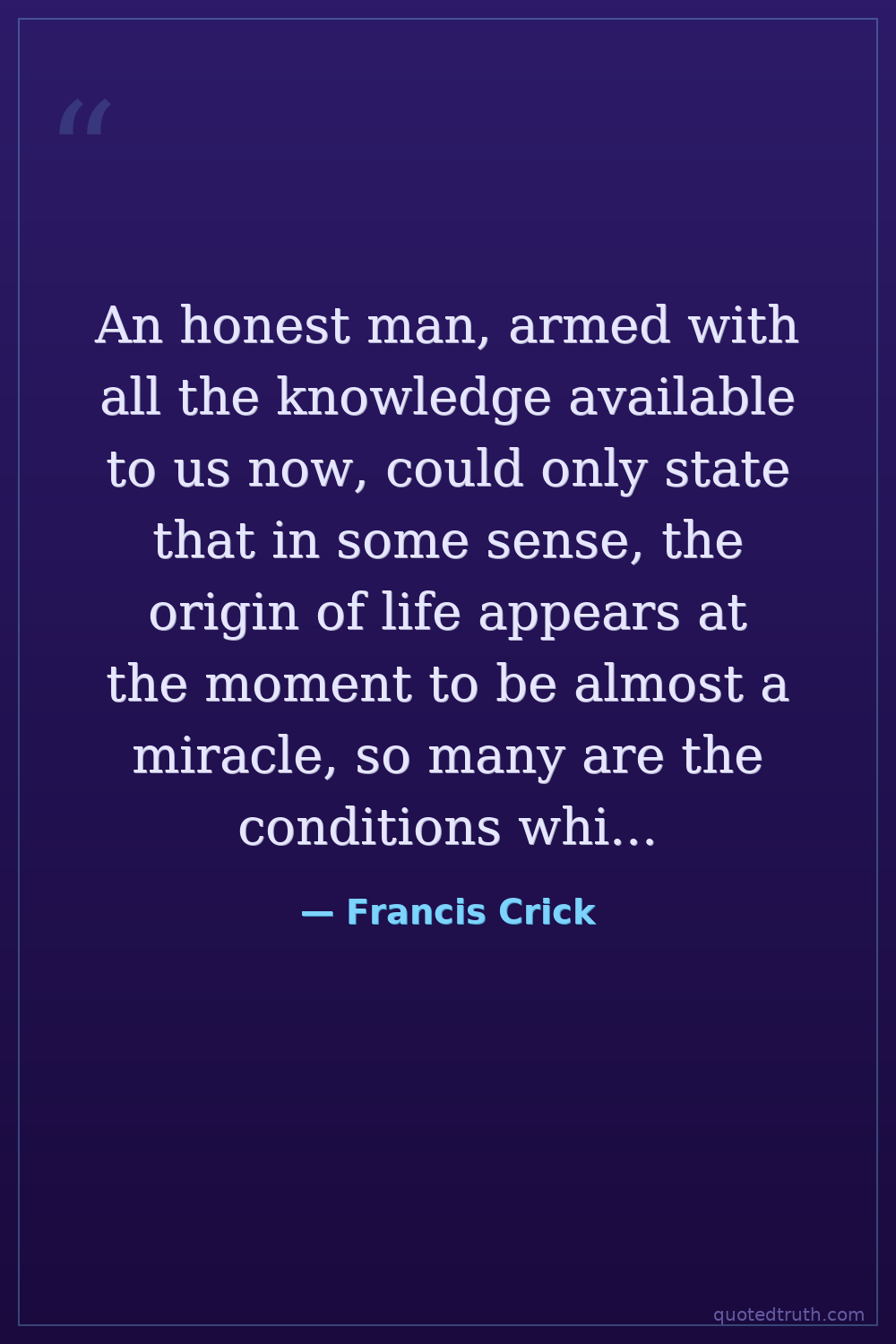
Even with the full weight of modern science, the origin of life remains so statistically improbable that describing it as 'almost a miracle' is the most honest available framing. Crick isn't invoking God — he's noting that the number of simultaneous chemical, physical, and environmental conditions that had to align to generate self-replicating life from raw chemistry defies easy rational explanation without pretending the problem is solved.
Relevance to Francis Crick
Crick was a committed atheist who co-cracked DNA's double helix in 1953, then later proposed directed panspermia — that life was intentionally seeded on Earth from space — precisely because spontaneous abiogenesis seemed too improbable. His blunt intellectual honesty was legendary; he rejected comfort over truth. This quote reflects that same character: a scientist who helped decode life's machinery yet refused to pretend its origins were well understood.
The era
Written in Crick's 1981 book 'Life Itself,' this quote emerged as molecular biology revealed the staggering complexity of even primitive cells. The Viking Mars landers (1976) found no signs of nearby life. Miller-Urey (1953) proved amino acids could self-assemble, but the chasm between simple chemistry and a self-replicating, metabolism-running cell remained unbridged. Origin-of-life science was fragmentary and contested, making Crick's candor about the field's limits both courageous and scientifically accurate.
AI-generated insights based on extensive research and information for context. Factual errors? Email [email protected].