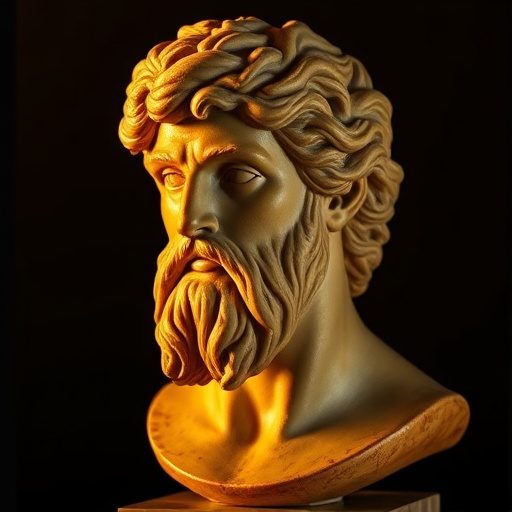
Pythagoras — "Above all things, reverence yourself."
Above all things, reverence yourself.
Above all things, reverence yourself.
Click any product to generate a realistic preview. Up to 3 at a time.
* Initial load can take up to 90 seconds — revising the preview in another color is nearly instant.
"The highest good is the purification of the soul."
"Don't sit on a bushel."
"Do only those things which will not harm thee, and deliberate before you act."
"All is number."
"Don't step over a balance beam."
Greek philosopher and mathematician whose school in Croton combined geometry (the Pythagorean theorem), number-mysticism, and a religious-vegetarian way of life. Closely associated with Thales of Miletus (earlier pre-Socratic and the first philosopher). For an intellectual contrast, see Heraclitus, pre-Socratic Greek philosopher of flux — Heraclitus called Pythagoras 'the chief of swindlers' — among the founding insults of the philosophical-rivalry tradition. Their 'all is flux' vs 'all is number' poles still organize the philosophy of mathematics today (Platonist vs anti-realist).
Though often attributed, direct textual evidence for many Pythagorean quotes is scarce due to the oral tradition and the nature of the Pythagorean school.
Date: c. 570 – c. 495 BC
ShockingFound in 2 providers: grok,gemini
2 sources checked
Treat yourself as something worth protecting and honoring. Before obligations to others, gods, or society, hold your own mind, body, and moral integrity in genuine respect. This isn't vanity — it means maintaining your standards, refusing to degrade yourself, and recognizing your own value as foundational. If you don't respect yourself, you cannot act with integrity toward anything else. Self-reverence is the bedrock all other virtue rests on.
Pythagoras founded a strict brotherhood in Croton around 530 BCE where members followed rigorous rules: vegetarianism, periods of silence, mathematical contemplation, and moral purification. He believed the soul was divine and immortal, cycling through lives until it achieved purity. Self-reverence wasn't mere confidence — it was a spiritual obligation to honor the divine spark within. His school demanded members treat their own souls as sacred objects worthy of lifelong discipline and devotion.
In ancient Greece around 570–495 BCE, individual identity was largely defined by city-state, family lineage, and obligations to the gods. The Delphic maxim 'Know thyself' was culturally prominent but focused on human limitation before divine power. Pythagoras, drawing on Orphic mystery cults and traditions encountered traveling Egypt and Babylon, elevated the individual soul to sacred status — a countercultural shift of moral authority inward at a time when external ritual and civic duty dominated.
AI-generated insights based on extensive research and information for context. Factual errors? Email [email protected].
Your cart is empty