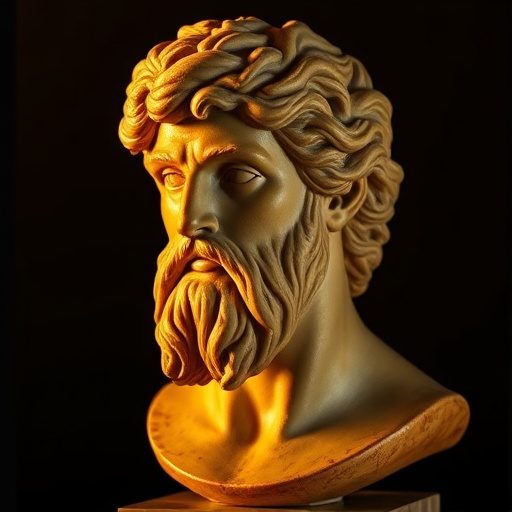
Pythagoras — "The highest good is the purification of the soul."
The highest good is the purification of the soul.
The highest good is the purification of the soul.
Click any product to generate a realistic preview. Up to 3 at a time.
* Initial load can take up to 90 seconds — revising the preview in another color is nearly instant.
"Numbers rule the universe."
"Let no one persuade you by word or deed to do or say whatever is not best for you."
"Do not go to bed until you have gone over the day three times in your mind. What wrong did I do? What good did I accomplish? What did I forget to do?"
"Choose always the way that seems the best, however rough it may be; custom will soon render it easy and agreeable."
"No one is free who has not obtained the empire of himself."
Greek philosopher and mathematician whose school in Croton combined geometry (the Pythagorean theorem), number-mysticism, and a religious-vegetarian way of life. Closely associated with Thales of Miletus (earlier pre-Socratic and the first philosopher). For an intellectual contrast, see Heraclitus, pre-Socratic Greek philosopher of flux — Heraclitus called Pythagoras 'the chief of swindlers' — among the founding insults of the philosophical-rivalry tradition. Their 'all is flux' vs 'all is number' poles still organize the philosophy of mathematics today (Platonist vs anti-realist).
Found in 1 providers: grok
1 source checked
True fulfillment isn't found in wealth, pleasure, or social status—it comes from purifying the soul, stripping away moral corruption, ignorance, and base desires. The soul, when cleansed, reaches its highest potential and aligns with truth. This is a call to prioritize inner transformation over external achievement: the disciplined, morally refined person lives better than the rich or powerful one who neglects their inner life.
Pythagoras founded a secretive religious-philosophical brotherhood in Croton that practiced vegetarianism, mathematical study, and strict asceticism—all aimed at purifying the soul. He taught metempsychosis: souls reincarnate until sufficiently purified to escape the cycle. For Pythagoras, mathematics wasn't merely practical—it was a spiritual discipline training the mind toward eternal truths, reflecting his conviction that reason and moral rigor together cleanse the soul of earthly contamination.
In 6th-century BCE Greece, competing visions of the highest good shaped intellectual life—Homeric heroes prized glory while emerging philosophers debated virtue and reason. Orphic mystery cults taught the soul was divine but imprisoned in corrupted flesh, requiring ritual purification. Pythagoras rationalized this framework: philosophical and mathematical discipline replaced ritual as the purifying force, positioning his school at the crossroads of religious mysticism and early Greek rationalist philosophy.
AI-generated insights based on extensive research and information for context. Factual errors? Email [email protected].
Your cart is empty