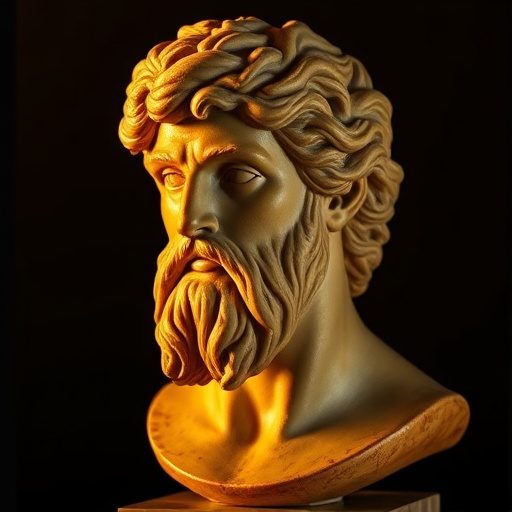
Pythagoras — "Above the cloud with its shadow is the star with its light. Above all things rev…"
Above the cloud with its shadow is the star with its light. Above all things reverence thyself.
Above the cloud with its shadow is the star with its light. Above all things reverence thyself.
Click any product to generate a realistic preview. Up to 3 at a time.
* Initial load can take up to 90 seconds — revising the preview in another color is nearly instant.
"Do not go to bed until you have gone over the day three times in your mind. What wrong did I do? What good did I accomplish? What did I forget to do?"
"Rest satisfied with doing well, and leave others to talk of you as they please."
"Neither be covetous nor stingy; a due measure is excellent in these things."
"Educate the children and it won't be necessary to punish the men."
"Do not give sleep to your eyes nor slumber to your eyelids until you have balanced the account of your soul with what is right."
Greek philosopher and mathematician whose school in Croton combined geometry (the Pythagorean theorem), number-mysticism, and a religious-vegetarian way of life. Closely associated with Thales of Miletus (earlier pre-Socratic and the first philosopher). For an intellectual contrast, see Heraclitus, pre-Socratic Greek philosopher of flux — Heraclitus called Pythagoras 'the chief of swindlers' — among the founding insults of the philosophical-rivalry tradition. Their 'all is flux' vs 'all is number' poles still organize the philosophy of mathematics today (Platonist vs anti-realist).
Found in 2 providers: gemini,deepseek
2 sources checked
Clouds block light and cast shadows, but stars burn clearly above them. The quote uses this image to say: temporary obstacles and doubts cannot diminish your true inner worth. The second line delivers the core instruction — self-respect is the highest virtue. Before honoring gods, teachers, or community, you must first hold yourself in high regard. Self-reverence is the foundation from which all other virtues and wisdom grow.
Pythagoras founded a philosophical brotherhood in Croton built on strict codes of self-discipline, moral purity, and spiritual development. He taught that the soul was divine and immortal, deserving profound reverence. His followers observed rigorous personal rules — dietary restrictions, periods of silence, communal living. This emphasis on self-reverence mirrors his core teaching: purifying and honoring the inner self was the necessary prerequisite to grasping mathematical and cosmic truth.
Pythagoras lived in the 6th century BCE during the Greek Archaic period, when polytheistic religion dominated public life and citizens were expected to subordinate themselves to gods, city-states, and clan hierarchies. Individual self-worth was rarely elevated above civic or divine duty. Against this backdrop, placing self-reverence above all else was radical — it centered inner moral integrity at the heart of existence, predating Socratic ethics and anticipating philosophy's turn toward the examined individual life.
AI-generated insights based on extensive research and information for context. Factual errors? Email [email protected].
Your cart is empty