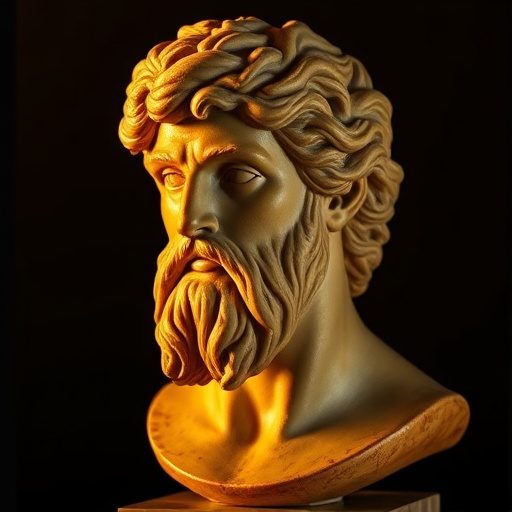
Pythagoras — "Neither be covetous nor stingy; a due measure is excellent in these things."
Neither be covetous nor stingy; a due measure is excellent in these things.
Neither be covetous nor stingy; a due measure is excellent in these things.
Click any product to generate a realistic preview. Up to 3 at a time.
* Initial load can take up to 90 seconds — revising the preview in another color is nearly instant.
"Do not look in a mirror by lamplight."
"Don't mix a fire with a knife."
"Turn sharp blades away from you."
"The most difficult thing in life is to know yourself."
"It is difficult to walk at one and the same time many paths of life."
Greek philosopher and mathematician whose school in Croton combined geometry (the Pythagorean theorem), number-mysticism, and a religious-vegetarian way of life. Closely associated with Thales of Miletus (earlier pre-Socratic and the first philosopher). For an intellectual contrast, see Heraclitus, pre-Socratic Greek philosopher of flux — Heraclitus called Pythagoras 'the chief of swindlers' — among the founding insults of the philosophical-rivalry tradition. Their 'all is flux' vs 'all is number' poles still organize the philosophy of mathematics today (Platonist vs anti-realist).
Found in 1 providers: gemini
1 source checked
Avoid two opposing extremes with money and possessions: greed, which drives you to constantly want more than you need, and miserliness, which makes you hoard what you have and refuse to share. The healthy approach lies in the middle — spending and giving appropriately, neither grasping for more nor clinging tightly to what you own. Balance and proportion, not excess in either direction, is the wisest way to handle wealth.
Pythagoras founded a secretive philosophical brotherhood that practiced communal living and strict ethical codes — members shared property and lived by ascetic rules. His entire worldview centered on harmony, proportion, and numerical balance: the cosmos itself was governed by ratios. This quote mirrors that core belief, applying mathematical proportion to moral conduct. For Pythagoras, excess and deficiency were forms of cosmic disorder, while 'due measure' reflected the same harmony he found in numbers and music.
Pythagoras lived during the 6th–5th centuries BCE, when Greek city-states were expanding rapidly through trade and colonization, creating stark new wealth divides. Coinage had recently replaced barter, making accumulation and hoarding newly visible social vices. Greek moral philosophy was crystallizing around sophrosyne — moderation as a supreme virtue. Living in Magna Graecia's wealthy southern Italian colonies, surrounded by conspicuous prosperity alongside poverty, made advice about balanced conduct with money culturally urgent and immediately recognizable.
AI-generated insights based on extensive research and information for context. Factual errors? Email [email protected].
Your cart is empty