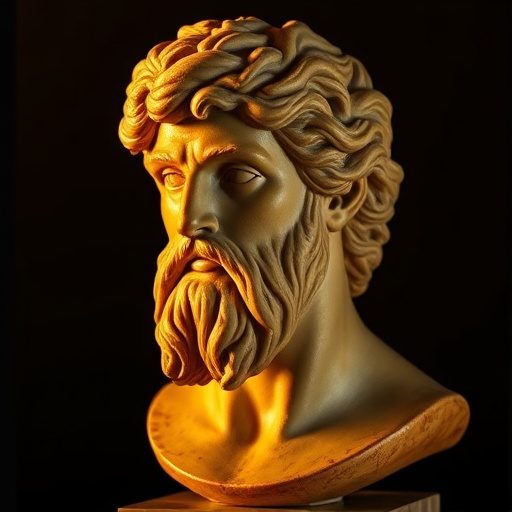
Pythagoras — "Do not give sleep to your eyes nor slumber to your eyelids until you have balanc…"
Do not give sleep to your eyes nor slumber to your eyelids until you have balanced the account of your soul with what is right.
Do not give sleep to your eyes nor slumber to your eyelids until you have balanced the account of your soul with what is right.
Click any product to generate a realistic preview. Up to 3 at a time.
* Initial load can take up to 90 seconds — revising the preview in another color is nearly instant.
"There is geometry in the humming of the strings. There is music in the spacing of the spheres."
"Respect yourself, and others will respect you."
"The most beautiful thing is harmony."
"The soul is a self-moving number."
"The 'tetractys' is the source of all things."
Greek philosopher and mathematician whose school in Croton combined geometry (the Pythagorean theorem), number-mysticism, and a religious-vegetarian way of life. Closely associated with Thales of Miletus (earlier pre-Socratic and the first philosopher). For an intellectual contrast, see Heraclitus, pre-Socratic Greek philosopher of flux — Heraclitus called Pythagoras 'the chief of swindlers' — among the founding insults of the philosophical-rivalry tradition. Their 'all is flux' vs 'all is number' poles still organize the philosophy of mathematics today (Platonist vs anti-realist).
Found in 1 providers: deepseek
1 source checked
Before sleeping each night, examine your actions and ensure they align with what is morally right. This is a call for daily self-accountability — a nightly audit of your conscience. Refuse rest until you've honestly reviewed your behavior and reconciled any gap between how you acted and how you should have. It treats moral integrity as a discipline requiring daily maintenance, not a passive trait you simply possess.
Pythagoras founded a secretive philosophical brotherhood in Croton whose members followed strict ethical codes, dietary rules, and daily self-examination rituals. He taught that the soul must harmonize with universal mathematical order. This quote reflects his community's actual practice of evening reflection, where members reviewed their day's actions aloud. For Pythagoras, moral discipline was inseparable from intellectual and spiritual development — inner harmony mirrored the numerical harmony he saw governing the cosmos.
In 6th-century BCE Greece, morality was primarily social — honor and shame depended on public reputation, not private conscience. The pre-Socratic era was just beginning to develop philosophical frameworks for individual ethics. Pythagoras lived amid competing city-states where civic duty and religious ritual defined righteousness. His call for private nightly self-examination was culturally significant, internalizing moral accountability at a time when right action was measured mainly by community standing, not personal reflection.
AI-generated insights based on extensive research and information for context. Factual errors? Email [email protected].
Your cart is empty