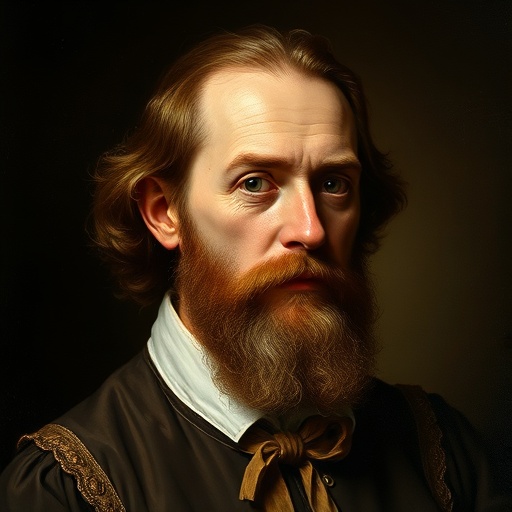
William Harvey — "All animals, even man himself, are produced from an egg."
All animals, even man himself, are produced from an egg.
All animals, even man himself, are produced from an egg.
Click any product to generate a realistic preview. Up to 3 at a time.
* Initial load can take up to 90 seconds — revising the preview in another color is nearly instant.
"The life of man is a perpetual motion."
"Only by understanding the wisdom of natural foods and their effects on the body, shall we attain mastery of disease and pain, which shall enable us to relieve the burden of mankind."
"The circulation of the blood is a discovery that overthrows all the ancient doctrines of medicine."
"The blood in the animal body is impelled in a circle, and is in a state of ceaseless motion."
"The heart is the seat of the affections."
English physician whose On the Motion of the Heart and Blood in Animals (1628) demonstrated blood circulation, overturning 1,400 years of Galenic medicine. Closely associated with Francis Bacon (his contemporary in the new English empiricism). For an intellectual contrast, see Galenic medicine, the 2nd-century Greek medical tradition (humors, blood-as-consumed-fuel) — Harvey calculated that the heart pumps more blood per hour than the body could possibly produce as fuel — a single quantitative observation that demolished the entire Galenic-Aristotelian medical worldview. The cleanest example in medical history of arithmetic disproving 14 centuries of authority.
Exercitationes de generatione animalium (On the Generation of Animals), Preface
Date: 1651
Nature & WorldFound in 1 providers: grok
1 source checked
Every living creature, including humans, originates from an egg — a single reproductive cell or embryonic structure. Harvey is asserting that generation, the process of new life coming into existence, follows a universal biological principle. Life does not spontaneously arise from mud or decay, nor is it pre-formed in miniature inside sperm or blood. There is always a discrete origin point: the egg.
Harvey spent decades investigating animal reproduction after his landmark work on blood circulation. His 1651 treatise Exercitationes de Generatione Animalium culminated in this principle, 'ex ovo omnia.' Having dissected deer from Charles I's royal parks and studied embryos systematically, Harvey extended the same observational rigor he applied to the heart to embryology, arguing reproduction required empirical study, not inherited Aristotelian assumption.
In the early seventeenth century, spontaneous generation — the idea that life emerged from nonliving matter — was standard doctrine inherited from Aristotle. Harvey's era saw the rise of empirical natural philosophy through figures like Francis Bacon and Galileo. His egg-origin claim challenged preformationism and spontaneous generation simultaneously, anticipating cell theory by two centuries and aligning with the emerging scientific revolution's demand for observable, reproducible evidence over ancient authority.
AI-generated insights based on extensive research and information for context. Factual errors? Email [email protected].
Your cart is empty