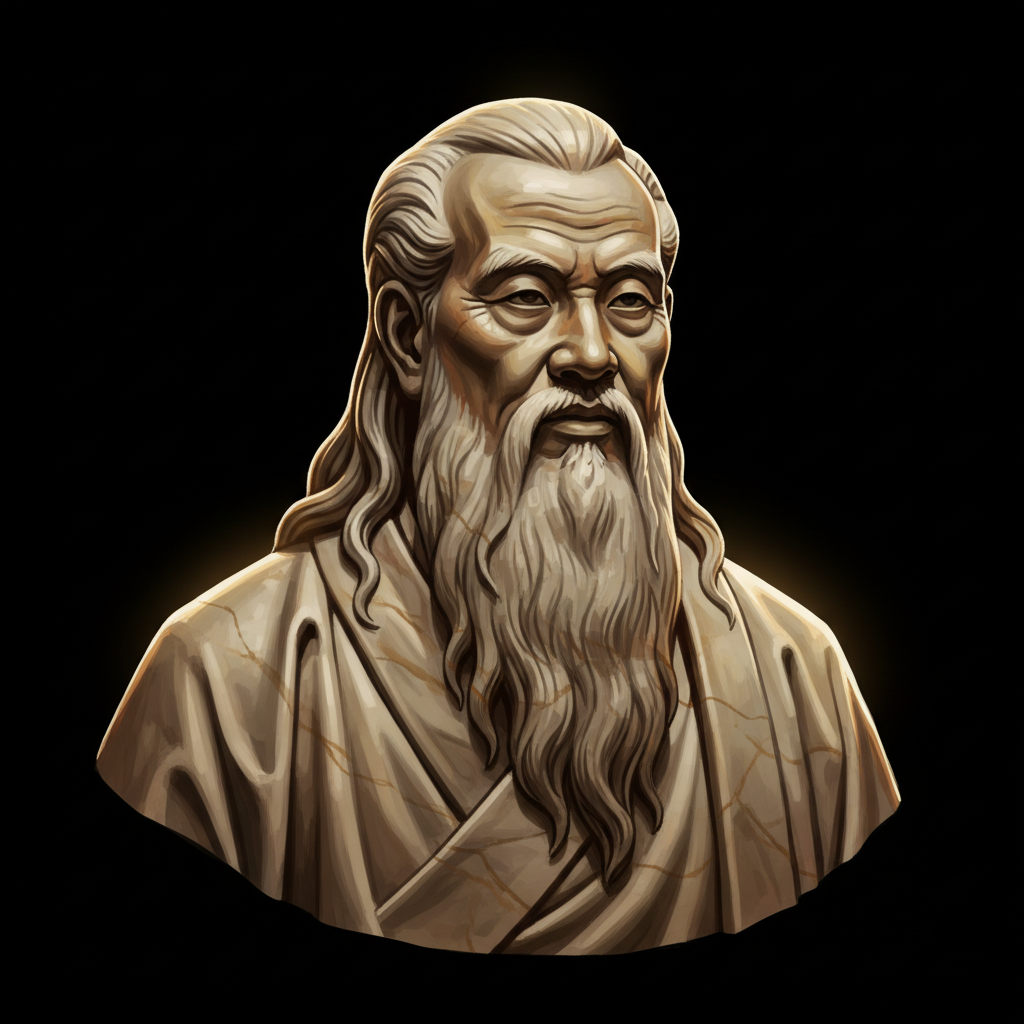
Laozi — "Although he travels all day, the sage never loses sight of his luggage carts."
Although he travels all day, the sage never loses sight of his luggage carts.
Although he travels all day, the sage never loses sight of his luggage carts.
Click any product to generate a realistic preview. Up to 3 at a time.
* Initial load can take up to 90 seconds — revising the preview in another color is nearly instant.
"Yield and overcome; Bend and be straight; Empty and be full; Wear out and be new; Have little and gain; Have much and be confused."
"He who talks much is soon exhausted."
"Govern a great nation as you would cook a small fish. (Do not overdo it.)"
"The sage puts his person last and finds his person first. He treats his person as external and his person is preserved."
"Make the small big and the few many; Do good to him who has done you an injury."
Reputed founder of Taoism and author of the Tao Te Ching, whose wu wei (effortless action) shaped East Asian philosophy. Closely associated with Zhuangzi (later Taoist who extended Laozi's framework). For an intellectual contrast, see Confucius, near-contemporary Chinese sage of social ritual and duty — Confucius systematized social order through ritual and hierarchy; Laozi argued that all such systems were the disease, not the cure — the two founding poles of Chinese moral philosophy.
Found in 1 providers: gemini
1 source checked
Even when fully engaged in activity and movement, a wise person stays anchored to what truly matters. They don't get swept up in the journey or distracted by passing scenery. The 'luggage carts' represent their grounding—their principles, responsibilities, and inner center. No matter how busy life gets or how far they roam from home, they remain aware of their foundation and never abandon what sustains them.
Laozi championed wu wei (effortless action) and rootedness amid change, themes central to the Tao Te Ching he traditionally authored. As a quiet archivist in the Zhou court who reportedly left civilization on a water buffalo, he valued stillness within motion. This saying mirrors his teaching that the sage acts in the world without being consumed by it, keeping the Tao—the deep root—as constant companion regardless of outward circumstance.
Laozi lived during the turbulent late Zhou dynasty (6th century BCE), when feudal states warred constantly and social order unraveled into what became the Warring States period. Rulers chased power, scholars chased position, and ordinary people suffered displacement. Against this frantic ambition, Laozi's counsel to stay grounded and unhurried was radical. His teachings offered a counterweight to Confucian activism, urging leaders to govern by restraint rather than aggressive striving.
AI-generated insights based on extensive research and information for context. Factual errors? Email [email protected].
Your cart is empty