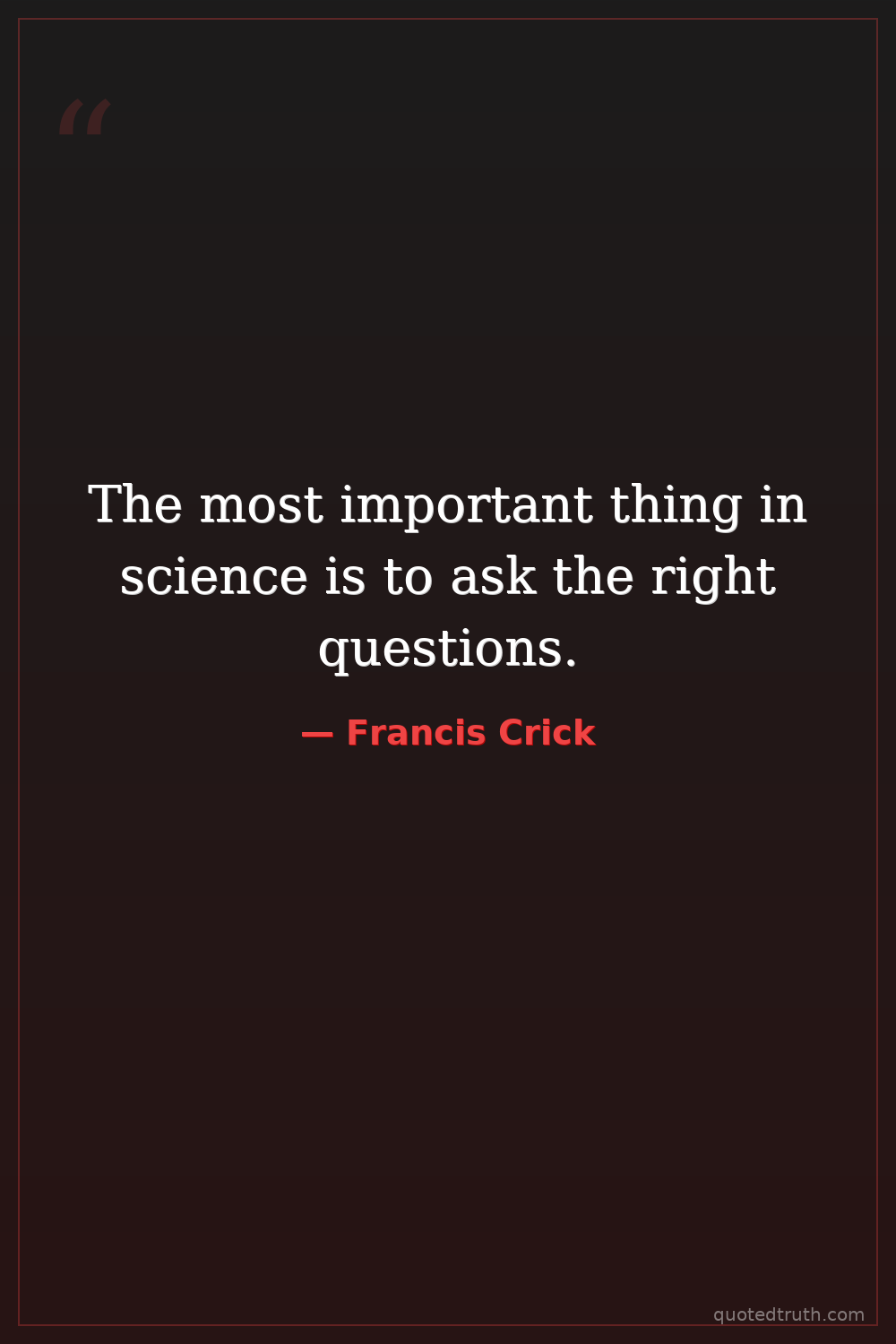
Francis Crick — "The most important thing in science is to ask the right questions."
The most important thing in science is to ask the right questions.
The most important thing in science is to ask the right questions.
Click any product to generate a realistic preview. Up to 3 at a time.
* Initial load can take up to 90 seconds — revising the preview in another color is nearly instant.
"The idea of God is a childish fantasy."
"Free will is an illusion."
"Chance is the only source of true novelty."
"The genetic code is not an arbitrary code, but one which was determined by the laws of physics and chemistry."
"I was never a very good experimentalist."
Found in 1 providers: grok
1 source checked
Progress in science depends less on raw intelligence or technique than on choosing which problem to investigate. A poorly framed question wastes years and yields trivial answers, while a sharp, well-aimed question opens entire fields. The skill lies in spotting what is genuinely unknown, what is answerable with current tools, and what would matter if solved. Picking the target is the hardest and most consequential step in any inquiry.
Crick built his career on this principle. Trained in physics, he switched to biology and deliberately chose the structure of the gene as his target because he judged it the most important unanswered question in life science. With Watson he cracked DNA's double helix in 1953, then later asked equally bold questions about the genetic code, molecular biology's central dogma, and finally consciousness, jumping fields whenever he felt the right question lay elsewhere.
Crick worked through the mid-twentieth century, when physics-trained researchers were flooding into biology after WWII, armed with X-ray crystallography, radioisotopes, and information theory. The Cold War poured money into basic research, and the molecular nature of heredity was wide open. Cambridge's MRC unit, Caltech, and Cold Spring Harbor became hothouses where framing the right question, not just running experiments, separated landmark discoveries from forgotten ones during this founding era of molecular biology.
AI-generated insights based on extensive research and information for context. Factual errors? Email [email protected].
Your cart is empty