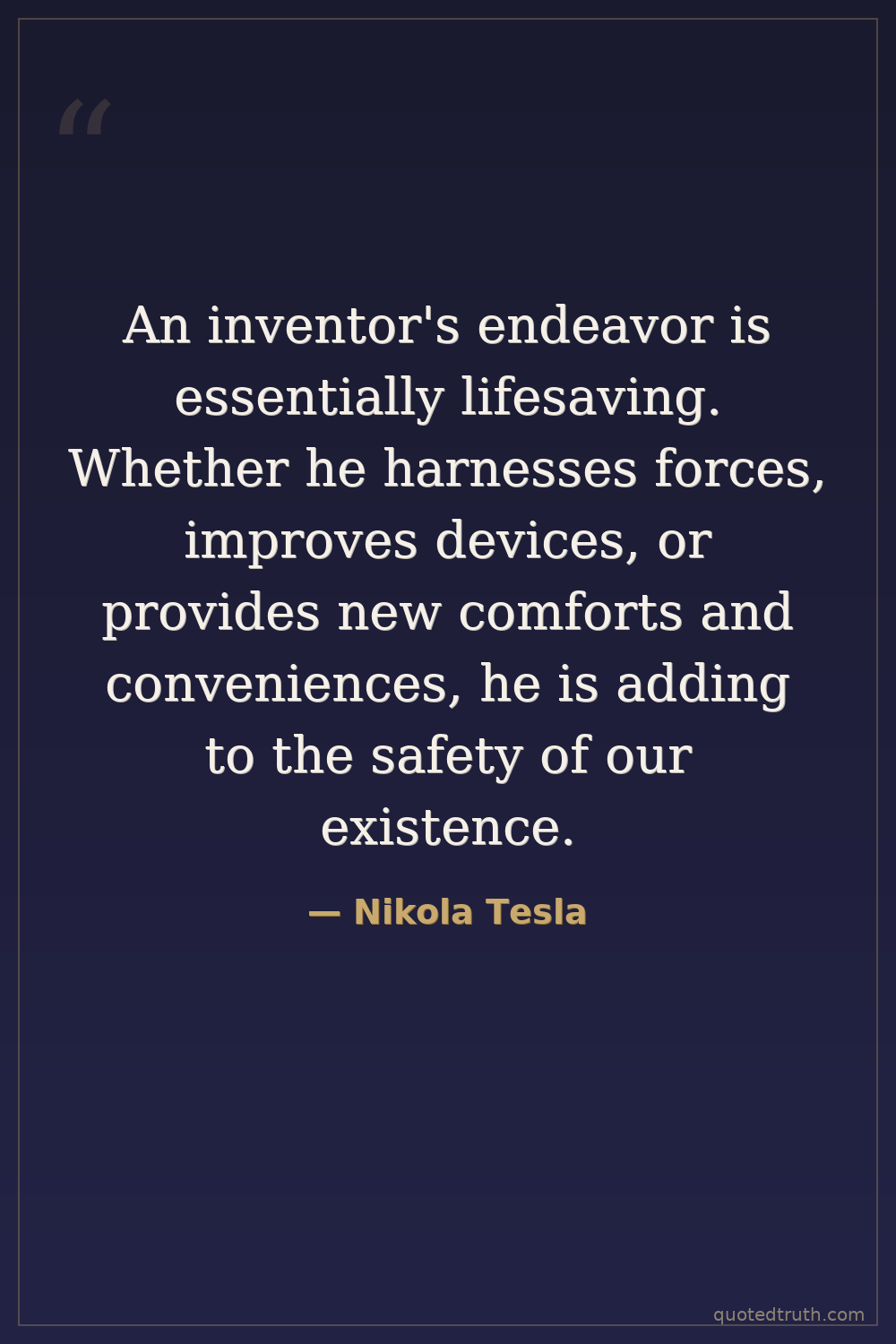
Nikola Tesla — "An inventor's endeavor is essentially lifesaving. Whether he harnesses forces, i…"

An inventor's endeavor is essentially lifesaving. Whether he harnesses forces, improves devices, or provides new comforts and conveniences, he is adding to the safety of our existence.
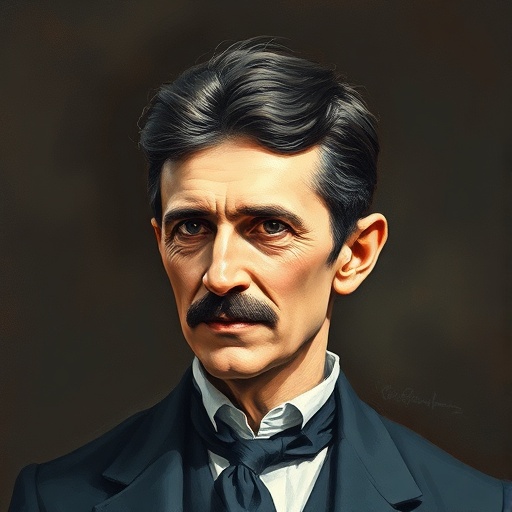
Nikola Tesla — Nikola Tesla Modern · AC electrical system, inventor

Get This Quote & Author's Image Illustrated On:

Click any product to generate a realistic preview. Up to 3 at a time.
* Initial load can take up to 90 seconds — revising the preview in another color is nearly instant.

Kitchen

Apparel

Other

About Nikola Tesla (1856-1943)

Serbian-American inventor and electrical engineer whose alternating-current designs powered the modern electrical grid; died poor and largely forgotten. Closely associated with George Westinghouse (his AC-power business partner) and Mihajlo Pupin (fellow Serbian-American physicist at Columbia). For an intellectual contrast, see Thomas Edison, American inventor and direct-current advocate — Edison's direct-current power-distribution scheme was displaced by Tesla-Westinghouse AC in the 1890s 'War of Currents'. Edison ran a public-relations campaign electrocuting animals to discredit AC — the most famous engineering-ethics rivalry in American history. Tesla's AC won and powers nearly every electrical grid on Earth.

Details

Philosophical view on the life-affirming purpose of invention.

Date: Approximate

Philosophical

Verification

Unverifiable

Found in 1 providers: gemini

1 source checked

Understanding this quote

What it means

Inventors do more than create gadgets — they fundamentally protect and extend human life. Every improvement to tools, energy systems, or daily comforts reduces danger, disease, and hardship. Even convenience innovations matter because they free human energy from tedious or risky tasks, making civilization safer and more resilient overall.

Relevance to Nikola Tesla

Tesla's AC power system literally saved lives by enabling safer, more efficient electricity distribution than Edison's DC over long distances. His work on motors, turbines, and wireless transmission wasn't abstract science — it powered hospitals, factories, and cities. Tesla saw himself as a humanitarian engineer, driven by the belief that technology was civilization's greatest protector.

The era

Tesla lived through industrialization's brutal realities: factory accidents, electrical fires, dangerous manual labor, and disease from poor infrastructure. The late 1800s and early 1900s saw inventors like Tesla transform daily survival — electrifying cities, enabling refrigeration, advancing medical equipment. Invention wasn't abstract; it was the difference between communities that thrived and those devastated by preventable hazards.

AI-generated insights based on extensive research and information for context. Factual errors? Email [email protected].
Your Cart

Your cart is empty