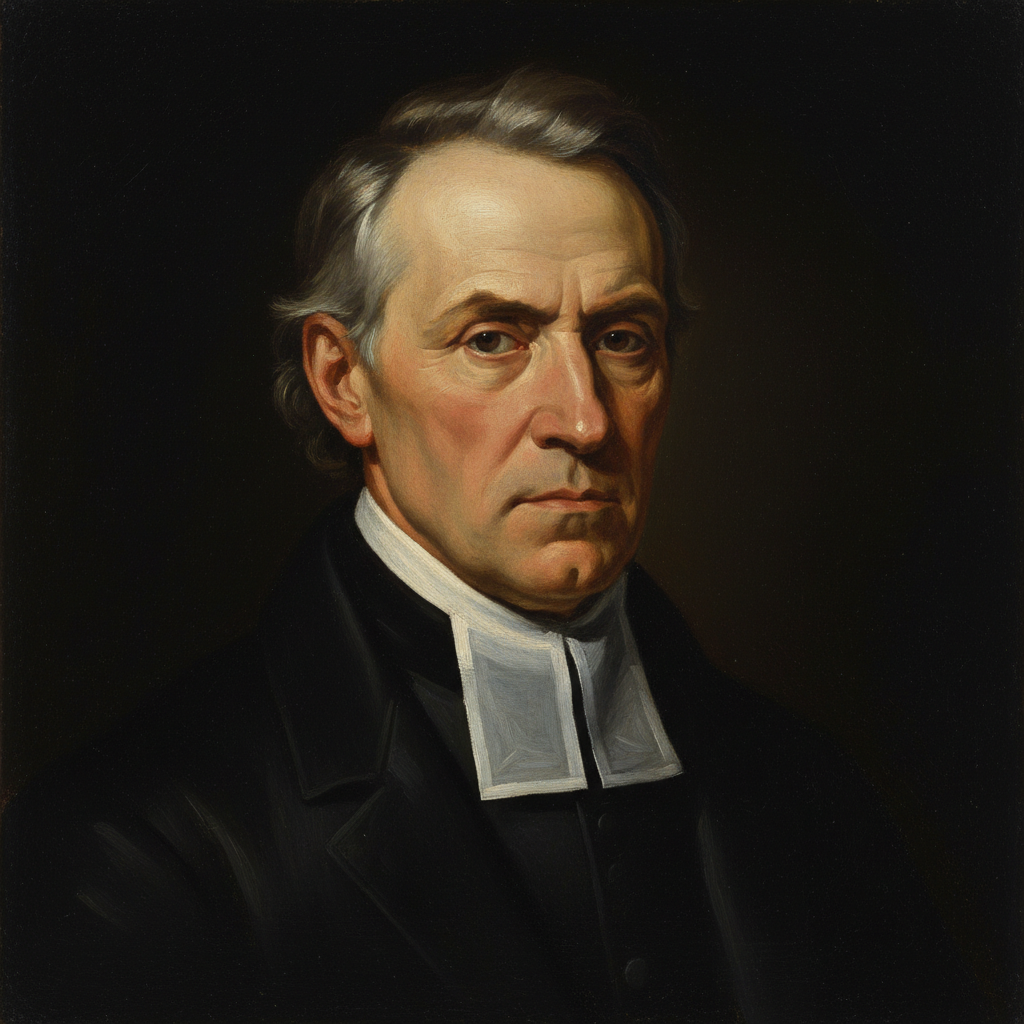
John Wesley — "And are we not to use our reason? Unquestionably. But no more than we are to use…"
And are we not to use our reason? Unquestionably. But no more than we are to use our hands or feet. We are to use it as a servant, not as a master.
And are we not to use our reason? Unquestionably. But no more than we are to use our hands or feet. We are to use it as a servant, not as a master.
Click any product to generate a realistic preview. Up to 3 at a time.
* Initial load can take up to 90 seconds — revising the preview in another color is nearly instant.
"It is a poor religion that consists in negatives only."
"I have often thought, that if I were to choose a carriage to ride in, it should be a plain one."
"I am a man of one book."
"I had rather have a thousand common people to hear me, than a thousand fine gentlemen."
"Holy tempers are the very essence of religion."
English Anglican cleric and founder of Methodism, whose open-air preaching and class-meeting structure created the largest 18th-century evangelical revival. Closely associated with Charles Wesley (his hymn-writing brother) and George Whitefield (early co-revivalist, later doctrinal opponent). For an intellectual contrast, see George Whitefield, Calvinist evangelical revivalist — Whitefield's predestinarian Calvinism vs Wesley's free-grace Arminian theology split the early Methodist movement permanently in the 1739-41 break. The founding evangelical Calvinist-Arminian schism — the two parallel evangelical traditions American Christianity descends from.
Found in 1 providers: grok
1 source checked
Reason is a legitimate and necessary tool, but it should never become the ruling authority over a person's life. Just as hands and feet serve the body without directing it, reason should serve deeper values — faith, conscience, scripture — not override them. Letting reason become the master produces cold intellectualism that loses sight of what matters most: lived, transformative faith and genuine human flourishing.
Wesley was Oxford-educated and deeply intellectual, yet he built Methodism on four pillars — Scripture, tradition, reason, and experience — deliberately subordinating reason to revelation. He rejected both irrational enthusiasm and the cold Deism fashionable among Enlightenment elites. His open-air preaching to coal miners demonstrated that faith must be felt, not merely analyzed. This quote reflects his lifelong effort to keep intellect in service of genuine spiritual transformation rather than academic abstraction.
Wesley lived at the height of the Enlightenment, when Locke, Hume, and Voltaire elevated reason as humanity's supreme guide and Deism reduced God to a distant clockmaker. England's educated classes grew skeptical of revealed religion while industrial poverty reshaped society and the established Church ignored it. Wesley's insistence that reason serves rather than rules directly challenged Enlightenment supremacy while guarding against the opposite danger of anti-intellectual religious fanaticism.
AI-generated insights based on extensive research and information for context. Factual errors? Email [email protected].
Your cart is empty