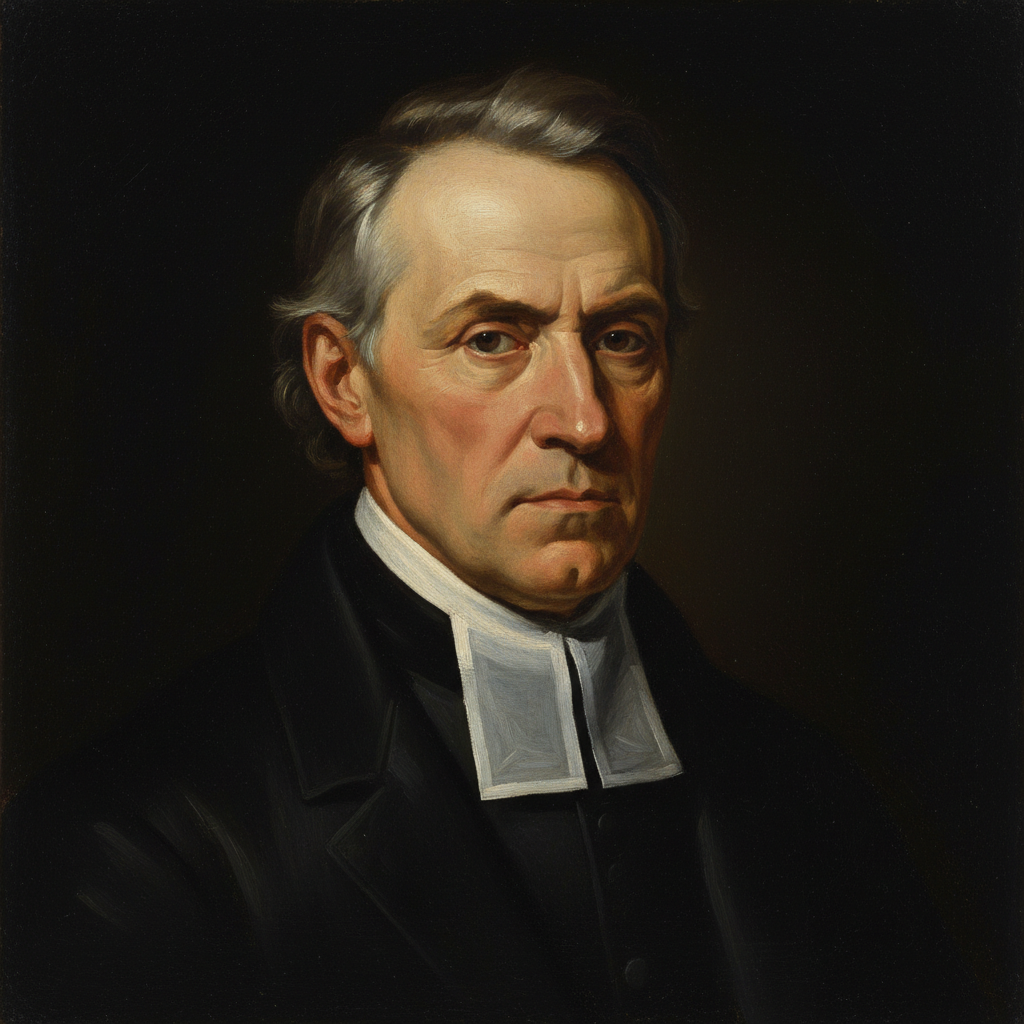
John Wesley — "I had rather have a thousand common people to hear me, than a thousand fine gent…"
I had rather have a thousand common people to hear me, than a thousand fine gentlemen.
I had rather have a thousand common people to hear me, than a thousand fine gentlemen.
Click any product to generate a realistic preview. Up to 3 at a time.
* Initial load can take up to 90 seconds — revising the preview in another color is nearly instant.
"I have often thought, that if I were to choose a text to preach from, it should be 'God is love.'"
"Reading the Scripture, I find there no other way to heaven than the way of holiness."
"I have but one point in view, to promote, as far as I am able, vital, practical religion."
"I am not afraid of giving too much trouble to God. He is able to bear it."
"We have nothing to do but to save souls."
English Anglican cleric and founder of Methodism, whose open-air preaching and class-meeting structure created the largest 18th-century evangelical revival. Closely associated with Charles Wesley (his hymn-writing brother) and George Whitefield (early co-revivalist, later doctrinal opponent). For an intellectual contrast, see George Whitefield, Calvinist evangelical revivalist — Whitefield's predestinarian Calvinism vs Wesley's free-grace Arminian theology split the early Methodist movement permanently in the 1739-41 break. The founding evangelical Calvinist-Arminian schism — the two parallel evangelical traditions American Christianity descends from.
Found in 1 providers: grok
1 source checked
Wesley preferred audiences of ordinary, working-class people over wealthy, high-status elites. He believed the common person was more genuinely open to spiritual transformation, less encumbered by pride and social performance. Rather than seeking approval from society's powerful, he wanted to reach those whose lives could meaningfully change. This expresses a radical inversion of social priorities: mass spiritual impact matters more than elite validation or social respectability.
Wesley famously abandoned Oxford comfort to preach in open fields to coal miners, factory workers, and prisoners. He rode over 250,000 miles on horseback across Britain, deliberately targeting the poor and uneducated. Methodism's explosive growth came precisely from this grassroots approach. Wesley believed salvation was available to all, not a gentlemen's club — this quote captures his lifelong rejection of class-gated religion and his embrace of the marginalized.
Eighteenth-century England was rigidly stratified by class, with the Church of England closely aligned with aristocratic power. The Industrial Revolution was displacing thousands into urban poverty, creating vast unchurched working populations. 'Fine gentlemen' wielded social and political control through established institutions. Wesley's preference for common audiences was provocative — it challenged the assumption that religion should flow downward from elites and that spiritual legitimacy required their endorsement or approval.
AI-generated insights based on extensive research and information for context. Factual errors? Email [email protected].
Your cart is empty