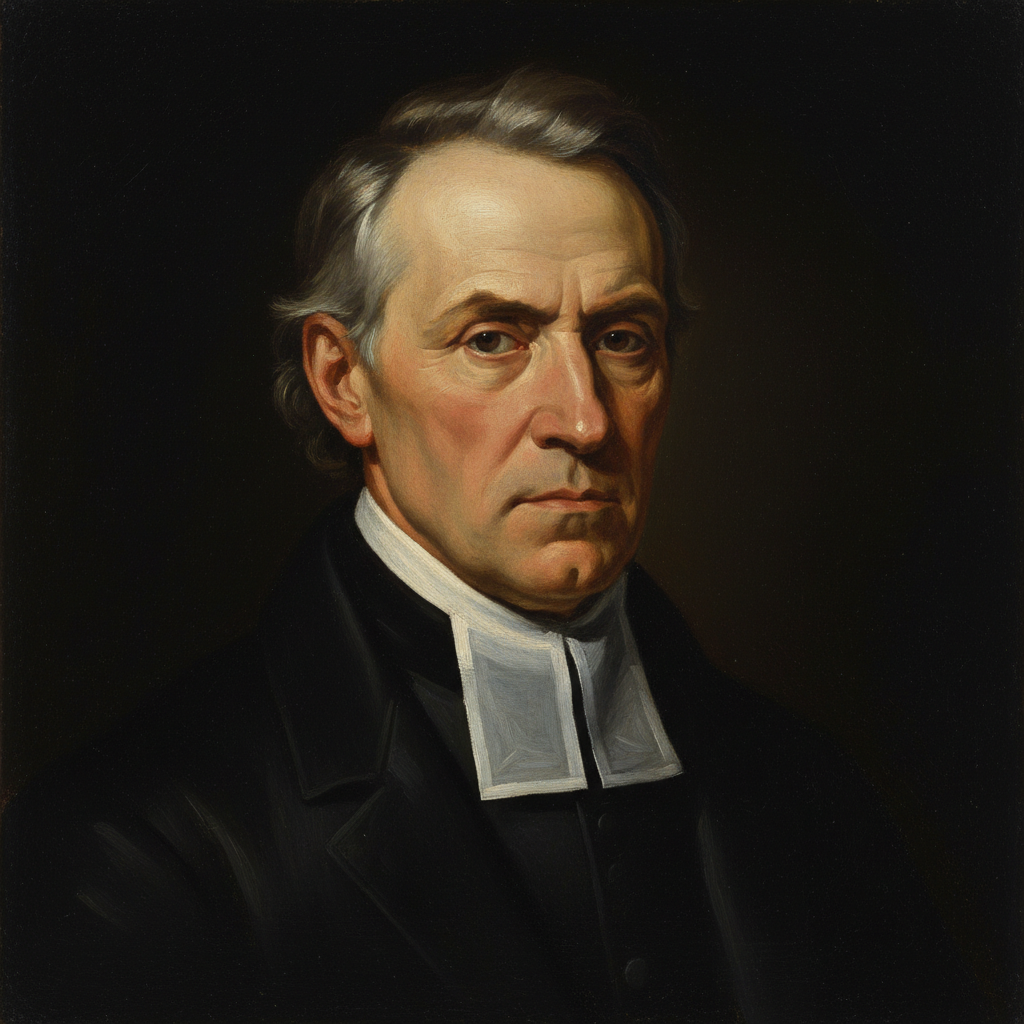
John Wesley — "I am a man of one book."
I am a man of one book.
I am a man of one book.
Click any product to generate a realistic preview. Up to 3 at a time.
* Initial load can take up to 90 seconds — revising the preview in another color is nearly instant.
"When I have money, I get rid of it quickly, lest it find a way into my heart."
"I have found that the more I pray, the more I have to pray for."
"What God has joined together, let no man put asunder."
"I am a debtor to all the world, to do all the good I can, in every place, to every soul."
"I conceive slavery to be such a thing as is odious to the God of love."
English Anglican cleric and founder of Methodism, whose open-air preaching and class-meeting structure created the largest 18th-century evangelical revival. Closely associated with Charles Wesley (his hymn-writing brother) and George Whitefield (early co-revivalist, later doctrinal opponent). For an intellectual contrast, see George Whitefield, Calvinist evangelical revivalist — Whitefield's predestinarian Calvinism vs Wesley's free-grace Arminian theology split the early Methodist movement permanently in the 1739-41 break. The founding evangelical Calvinist-Arminian schism — the two parallel evangelical traditions American Christianity descends from.
Found in 1 providers: grok
1 source checked
A person who has deeply mastered one foundational text rather than skimming many. It signals intellectual discipline and conviction — choosing depth over breadth, committing fully to a single source of truth rather than accumulating scattered knowledge. The phrase implies that one authoritative work, thoroughly understood, outweighs a library of half-digested volumes.
Wesley's singular book was the Bible, which he read in Greek and Hebrew daily, preached from relentlessly, and used as the sole measure of Methodist doctrine. He rode 250,000 miles on horseback across Britain, Bible in hand, delivering roughly 40,000 sermons. His entire movement — small groups, hymns, social reform — flowed from rigorous scriptural study.
The 18th century saw an Enlightenment explosion of print culture, encyclopedias, and secular philosophy challenging religious authority. Wesley's declaration was partly a counter-cultural stand against fashionable rationalism and theological drift. Amid Voltaire, Hume, and Deism eroding biblical literalism, Wesley anchored Methodism firmly in Scripture as Christianity's sufficient and complete guide for faith and practice.
AI-generated insights based on extensive research and information for context. Factual errors? Email [email protected].
Your cart is empty