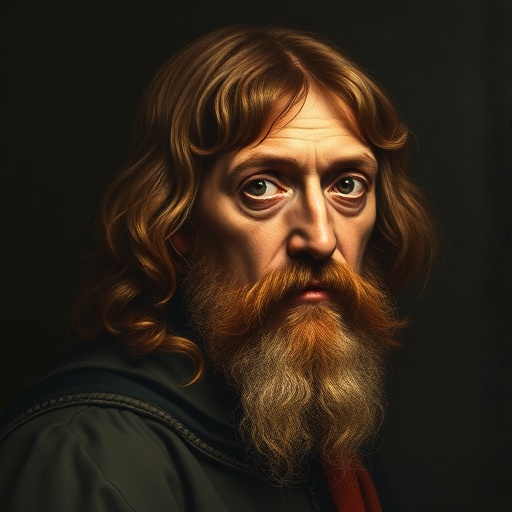
Nicolaus Copernicus — "And if the earth were not to move, such a great diversity of phenomena could not…"
And if the earth were not to move, such a great diversity of phenomena could not be observed.
And if the earth were not to move, such a great diversity of phenomena could not be observed.
Click any product to generate a realistic preview. Up to 3 at a time.
* Initial load can take up to 90 seconds — revising the preview in another color is nearly instant.
"Perhaps there will be babblers who, although completely ignorant of mathematics, nevertheless dare to pass judgment on these things and, on the strength of some passage in Scripture, twisted to their …"
"For it is not the magnitude of the stars, but the magnitude of their distance from us, that causes them to appear small."
"The world is spherical; whether it is finite or infinite is an open question."
"The earth has a spherical shape, for it is bounded on all sides by the circumference of a circle."
"The universe is a spherical whole, and of all possible forms, the sphere is the most perfect."
Found in 1 providers: grok
1 source checked
Earth's movement is necessary to explain the complex patterns visible in the sky — retrograde planetary motion, the shifting positions of stars through seasons, variations in day length across the year. Without Earth moving, the rich diversity of celestial phenomena actually observed couldn't be logically accounted for. Motion isn't abstract theory; it's the only coherent explanation for what careful, systematic sky-watching consistently reveals about how celestial bodies behave.
Copernicus spent decades making meticulous observations from Frombork, Poland, where he served as a church canon. His heliocentric model emerged not from speculation but observational necessity — retrograde planetary loops and seasonal celestial shifts demanded explanation beyond Ptolemy's epicycles. He withheld publishing De revolutionibus until 1543, near his death, fearing controversy. His empirical discipline defined his character: heliocentrism wasn't a bold assertion but the only logical fit for what the sky actually showed.
In Copernicus's time, Ptolemy's geocentric model — Earth fixed at the universe's center — had dominated astronomy and theology for 1,400 years. The Catholic Church wove this cosmology into Scripture. Renaissance humanism was encouraging direct inquiry, but challenging Earth's special place risked heresy. Astronomers kept adding epicycles to patch the geocentric model's mismatch with observations. Copernicus recognized a simpler, truer solution existed — but publishing it meant confronting both institutional authority and the intuitive human assumption that solid ground doesn't move.
AI-generated insights based on extensive research and information for context. Factual errors? Email [email protected].
Your cart is empty