What it means
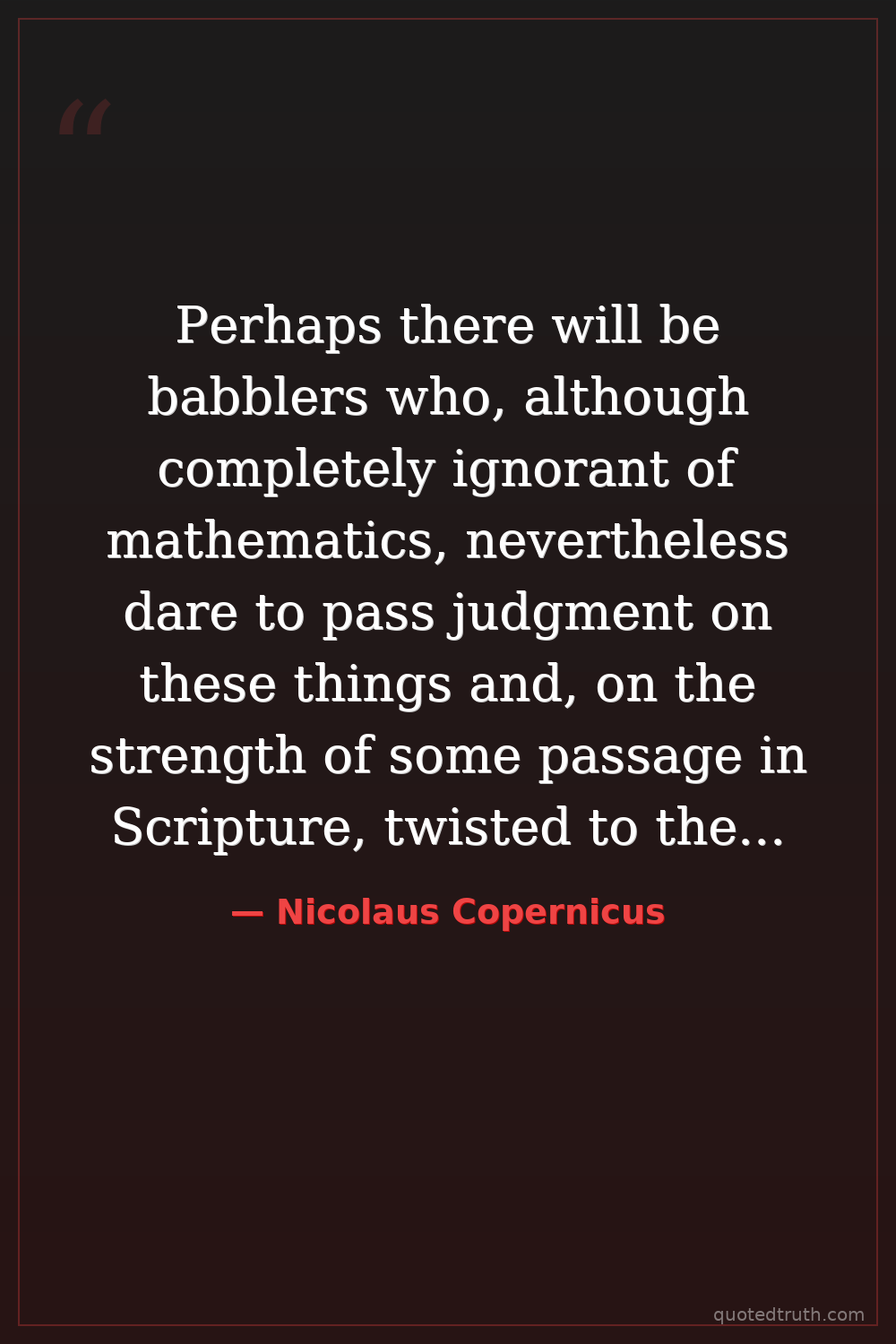
Copernicus warns that mathematically ignorant critics will twist Scripture to condemn his work without engaging its actual evidence. He draws a sharp line between those qualified to evaluate astronomical theory through mathematics and those substituting religious authority for technical understanding. The quote captures a timeless conflict in scientific progress: discoveries that contradict inherited doctrine face rejection not from qualified experts, but from those weaponizing sacred texts against ideas they cannot honestly assess.
Relevance to Nicolaus Copernicus
These words open De Revolutionibus Orbium Coelestium (1543), Copernicus's heliocentric masterwork. He withheld publication for roughly 30 years, fearing exactly this reception. As both a Catholic canon and trained mathematician, he inhabited the tension his quote describes. His caution proved warranted: the Church banned his book in 1616. He reportedly received the first printed copy on his deathbed — a deliberate act of timing that let him avoid direct confrontation with the critics he predicted.
The era
Copernicus wrote during the Protestant Reformation, when Luther and Calvin fractured Christian unity and made Scripture interpretation a fierce battleground. Both Catholic and Protestant authorities demanded biblical literalism as doctrinal proof. Aristotelian geocentrism was embedded in Church theology through Aquinas, making cosmological challenges feel like spiritual attacks. The Inquisition actively prosecuted heresy. Passages like Joshua 10:13, where God halts the sun, gave literalists direct ammunition against any astronomer claiming Earth moved.
AI-generated insights based on extensive research and information for context. Factual errors? Email [email protected].