Nicolaus Copernicus — "The earth has a spherical shape, for it is bounded on all sides by the circumfer…"
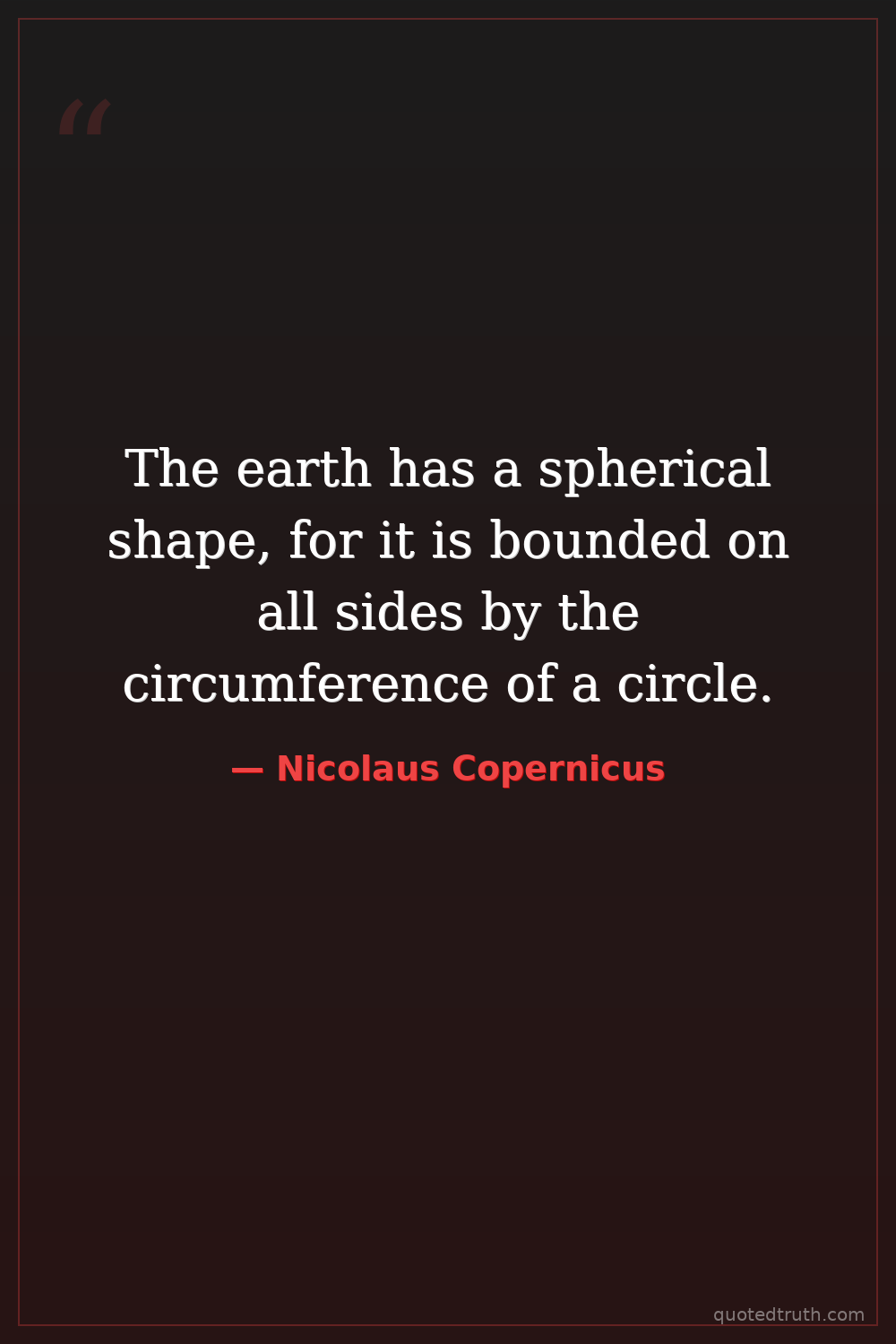
The earth has a spherical shape, for it is bounded on all sides by the circumference of a circle.
The earth has a spherical shape, for it is bounded on all sides by the circumference of a circle.
Click any product to generate a realistic preview. Up to 3 at a time.
* Initial load can take up to 90 seconds — revising the preview in another color is nearly instant.
"For I am not so enamored of my own opinions that I would disregard what others may think of them."
"I consider it the chief duty of an astronomer to gather the observations of the heavenly bodies, and to explain their motions by hypotheses."
"I confess that I have been led to conceive of a different arrangement of the spheres of the universe from that of the ancient astronomers."
"For it is the duty of an astronomer to gather by careful and skilled observation the history of the celestial movements, and then to investigate their causes or hypotheses about them, and then to pred…"
"The difficulty of the task, and the novelty of the opinion, almost deterred me from publishing the work."
Found in 1 providers: grok
1 source checked
Earth is spherical in shape — every cross-section, observed from any direction, traces a perfect circle. Rather than appealing to authority, Copernicus grounds this in geometric logic: a body enclosed on all sides by circular boundaries must itself be a sphere. It is a clean mathematical assertion that Earth's form follows directly from observable geometry, establishing a foundational physical fact through reasoning rather than tradition or scripture.
Copernicus trained in mathematics and astronomy at Kraków and Italian universities, making geometric proof his native language. Earth's sphericity was essential to his heliocentric model — a spherical Earth could orbit the Sun just as the other planets did. This claim appears in De revolutionibus orbium coelestium (1543), his life's masterwork. His habit of reasoning from geometry rather than Church-endorsed authority foreshadows the intellectual courage required to displace Earth from the cosmos's center entirely.
Copernicus lived 1473–1543 during the Age of Exploration. Magellan's circumnavigation (1519–1522) had just physically confirmed Earth's sphericity through navigation. Yet Ptolemaic geocentric cosmology, blending ancient Greek astronomy with Church doctrine, still governed academic thought. Renaissance scholars were recovering classical Greek texts in which Aristotle and Pythagoras had argued for a spherical Earth, but Copernicus needed to re-establish these geometric foundations before overturning Ptolemy's Earth-centered universe, making this assertion a deliberate, load-bearing starting point for his revolutionary argument.
AI-generated insights based on extensive research and information for context. Factual errors? Email [email protected].
Your cart is empty