Joseph Smith — "And it shall come to pass, after many days, slaves shall rise up against their m…"
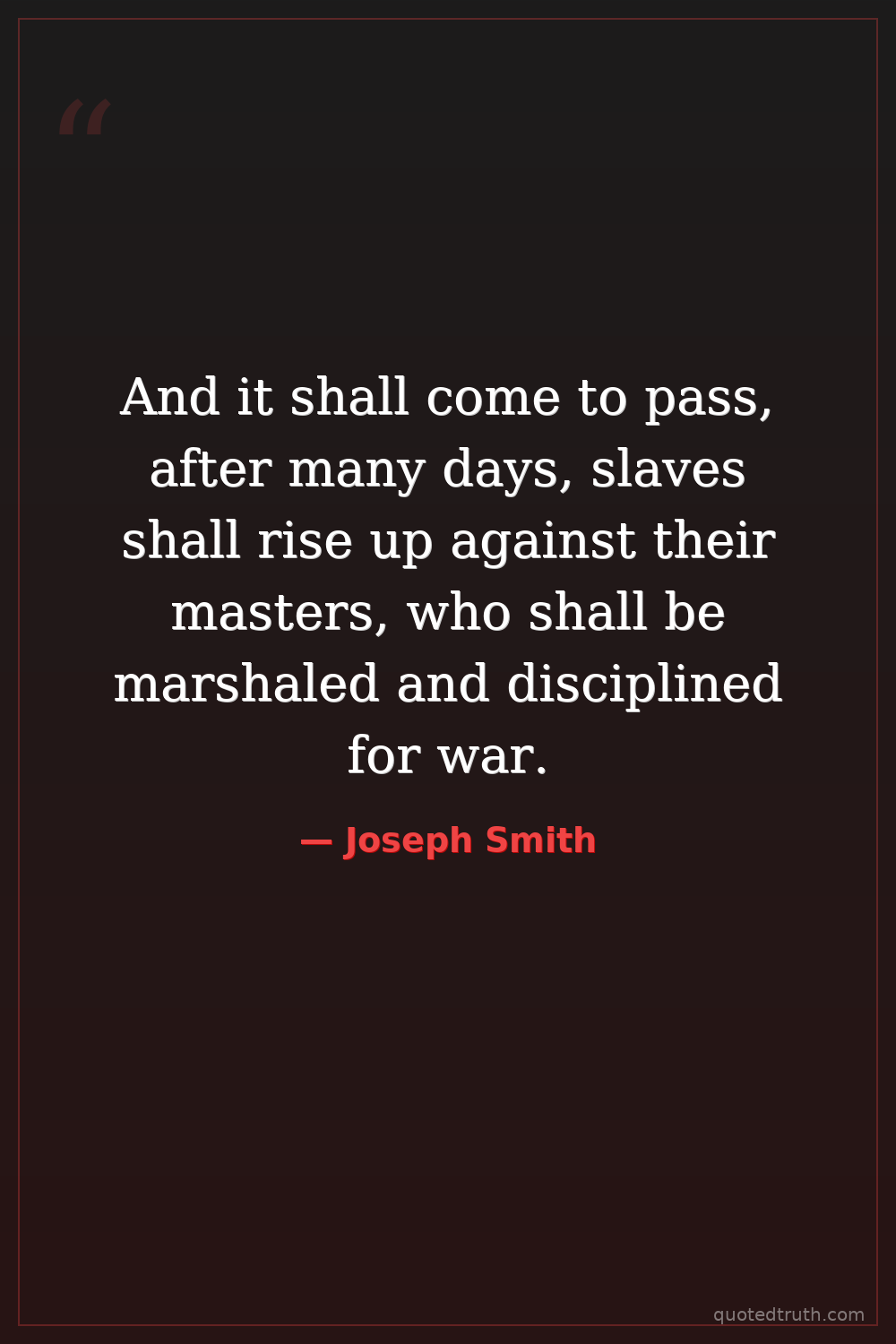
And it shall come to pass, after many days, slaves shall rise up against their masters, who shall be marshaled and disciplined for war.
And it shall come to pass, after many days, slaves shall rise up against their masters, who shall be marshaled and disciplined for war.
Click any product to generate a realistic preview. Up to 3 at a time.
* Initial load can take up to 90 seconds — revising the preview in another color is nearly instant.
"I wish to do something to distinguish myself, and so I am going to get up a religion."
"I am going to bring about the redemption of Zion, and build up the kingdom of God."
"I am a friend to the poor, and an enemy to oppression."
"I have asked of the Lord concerning the practice of the Saints, and I have received for answer, that I should take unto myself more wives than one, and that the Saints should do likewise."
"I have more to boast of than ever any man had. I am the only man that has ever been able to keep a whole church together since the days of Adam."
Found in 1 providers: gemini
1 source checked
A prophetic declaration that enslaved people will eventually rise in organized rebellion against their enslavers, who will then mobilize militarily in response. It frames the collision between slavery and freedom as inevitable — a long-foreseen reckoning where the oppressed finally refuse subjugation and the powerful answer with war. The phrase 'after many days' underscores patient endurance followed by explosive consequence, capturing how systems built on human bondage carry within them the seeds of violent collapse.
This comes from Joseph Smith's Civil War prophecy (Doctrine and Covenants 87), revealed December 25, 1832 — nearly three decades before the Civil War began. Smith regularly received and recorded divine revelations he believed came directly from God, and his prophetic role was central to his identity. This prediction linking slavery's end to armed conflict reflects both his apocalyptic theological framework and his acute awareness of explosive social tensions fracturing antebellum America around him.
In 1832 America, slavery was the nation's defining crisis. Nat Turner's rebellion (1831) had just proven enslaved people would fight back. South Carolina's Nullification Crisis threatened secession, with slavery lurking beneath tariff disputes. Abolitionist William Lloyd Garrison launched The Liberator in 1831. The Missouri Compromise was already fraying. Smith's prophecy emerged from a society increasingly aware that its foundational contradiction — a republic of freedom built on bondage — was hurtling toward catastrophic, violent resolution.
AI-generated insights based on extensive research and information for context. Factual errors? Email [email protected].
Your cart is empty