What it means
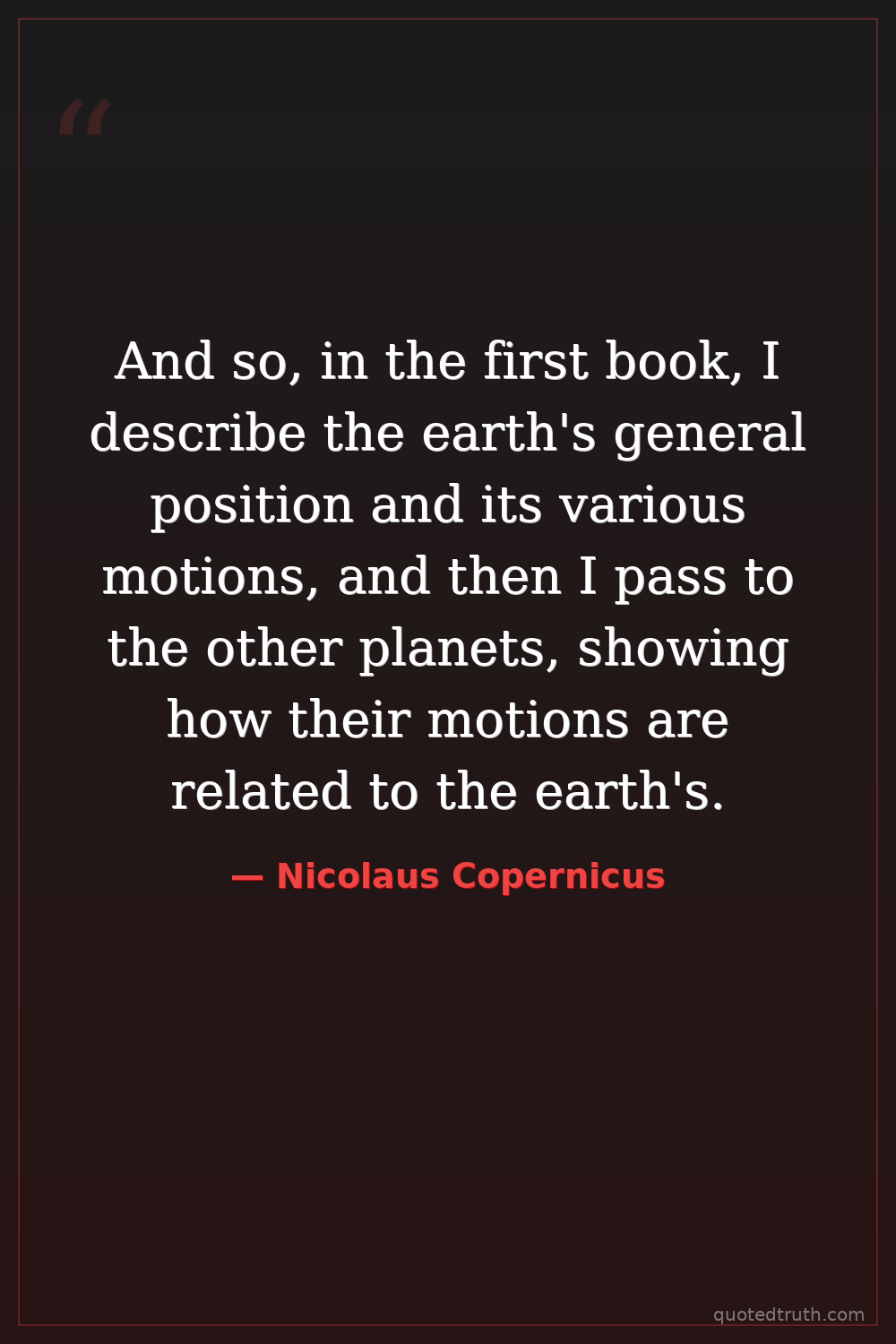
This outlines the logical architecture of Copernicus's masterwork. He first establishes Earth not as a fixed centerpiece but as a body with its own position and real motions. From that foundation, he maps every other planet's movement relative to Earth's orbit. The implication: understanding the cosmos requires first accepting that Earth itself moves — a total inversion of how humanity had conceived the universe for more than a thousand years.
Relevance to Nicolaus Copernicus
Copernicus spent over 30 years refining his heliocentric model before publishing it in 1543, the year he died. A church canon by profession, he was cautious and methodical. This quote reflects his systematic mathematical approach: establish Earth's motion as the foundational premise, then derive all planetary behavior from it. His dual identity as astronomer and clergyman made him acutely aware that repositioning Earth from cosmic center to ordinary orbiting planet carried profound consequences.
The era
Ptolemy's geocentric model had been scientific and theological orthodoxy for over 1,400 years when Copernicus wrote this. The Catholic Church taught Earth's centrality as scripturally aligned. Meanwhile, Renaissance scholars were rediscovering ancient Greek texts, including earlier heliocentric ideas. The Protestant Reformation was fracturing Christendom. Copernicus dedicated De Revolutionibus to Pope Paul III, framing his theory carefully as mathematical modeling to blunt ecclesiastical resistance — knowing the idea of a moving Earth would unsettle both science and faith.
AI-generated insights based on extensive research and information for context. Factual errors? Email [email protected].