What it means
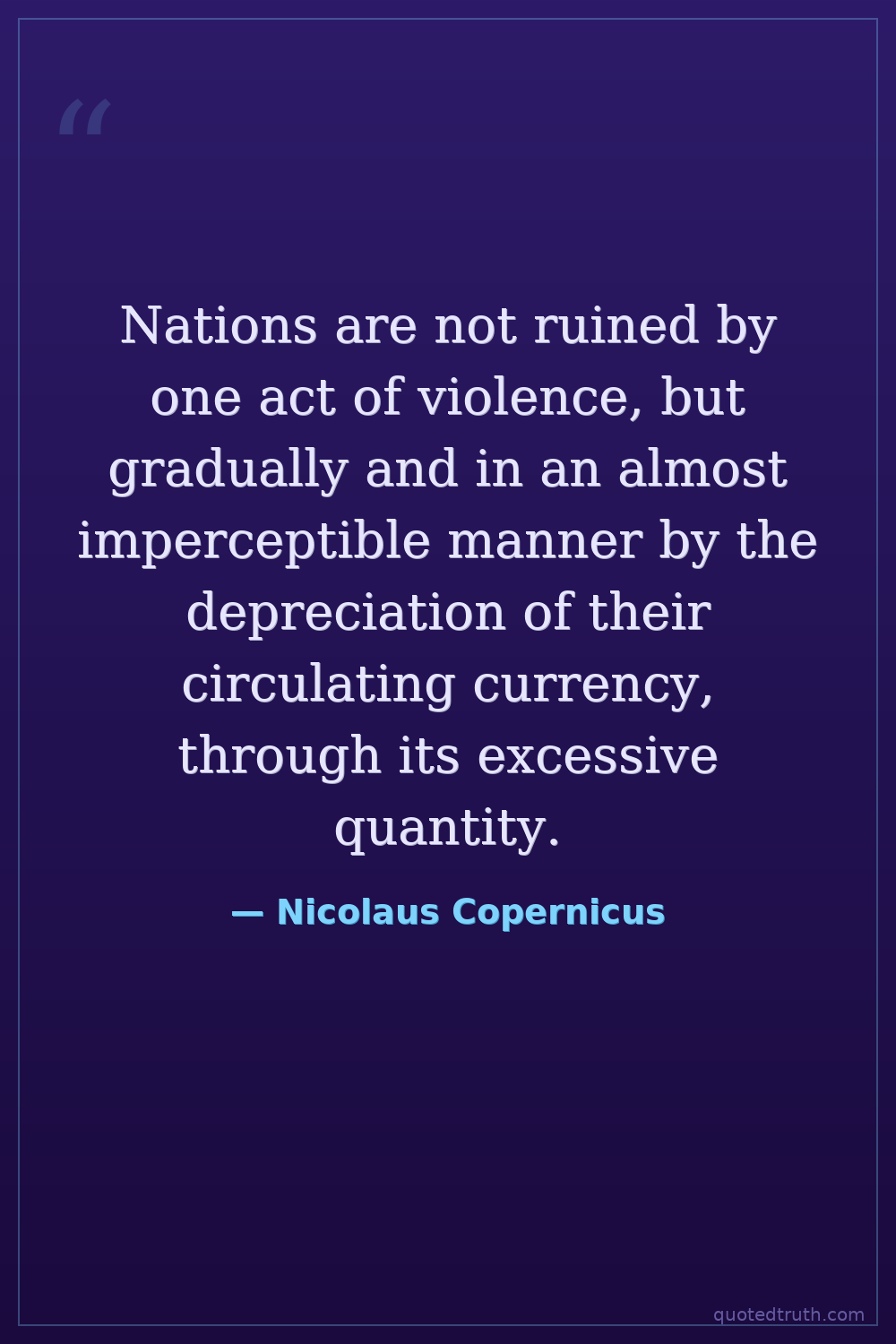
Nations collapse not from single dramatic blows but from slow, invisible monetary rot. When a currency is flooded with excess supply — through debasement or overissuance — purchasing power quietly erodes. Prices creep up, savings lose value, commerce grows uncertain. By the time citizens recognize the damage, institutions are already undermined. It is an early, precise articulation of inflation economics: the most dangerous collapses arrive imperceptibly, without a single identifiable moment of rupture.
Relevance to Nicolaus Copernicus
Copernicus was far more than an astronomer — he was a trained physician, church canon, and serious monetary theorist. In 1526 he wrote Monetae Cudendae Ratio, urging Poland-Prussia to reform its debased coinage. He directly observed currency debasement destabilizing Royal Prussia's economy and independently articulated what later became Gresham's Law — bad money drives out good. His signature empirical rigor, applied to planetary orbits, translated naturally into diagnosing monetary systems with equal precision.
The era
Copernicus lived through severe monetary chaos in early 16th-century Europe. The Teutonic Order had systematically debased Prussian coinage; multiple currencies circulated with wildly inconsistent silver content. Simultaneously, Spanish conquest of the Americas was beginning to flood Europe with precious metals, igniting what historians call the Price Revolution — a century of creeping inflation that destabilized governments across the continent. His economic writings responded directly to observable crisis in his own Polish-Prussian region.
AI-generated insights based on extensive research and information for context. Factual errors? Email [email protected].