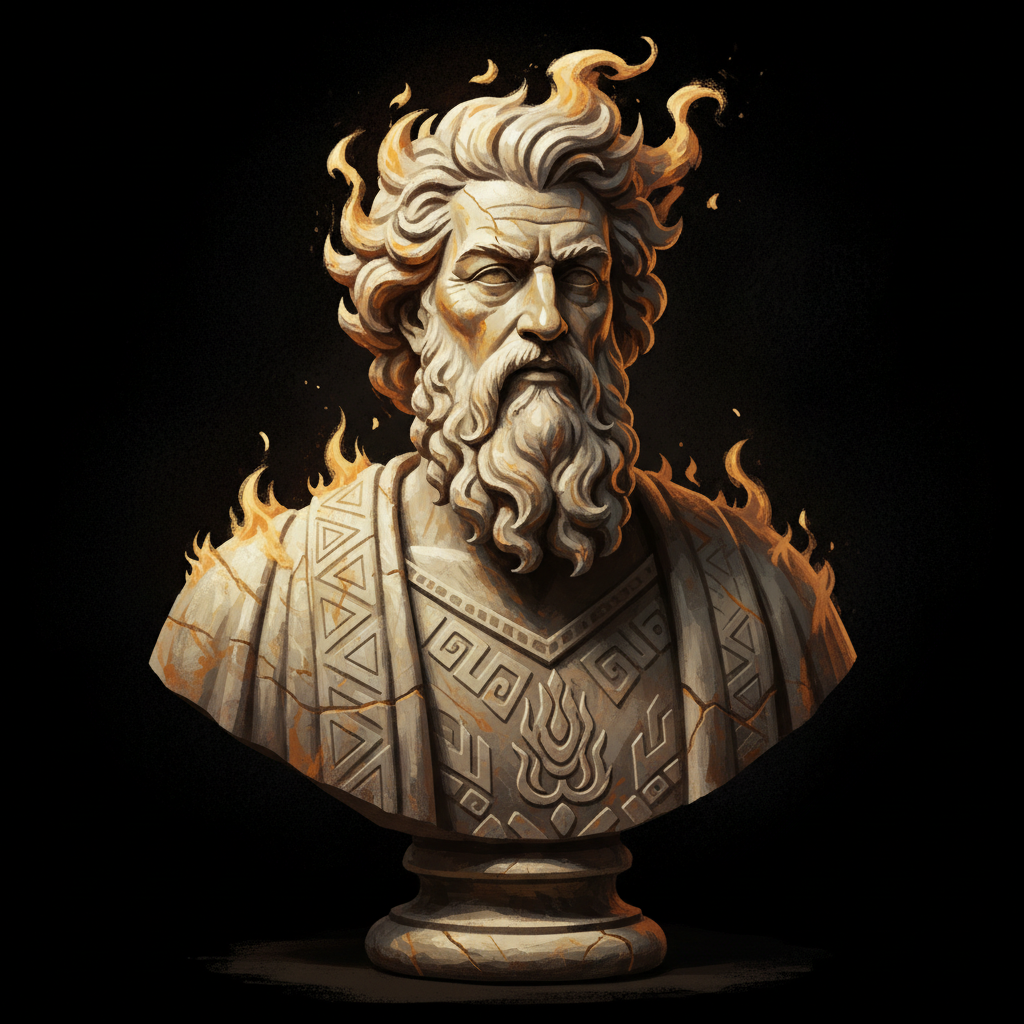
Zoroaster — "And the reward of the evil man shall be the darkness of the nether world."
And the reward of the evil man shall be the darkness of the nether world.
And the reward of the evil man shall be the darkness of the nether world.
Click any product to generate a realistic preview. Up to 3 at a time.
* Initial load can take up to 90 seconds — revising the preview in another color is nearly instant.
"He who takes delight in the cattle and in the pasture, he is the one who serves Mazda."
"May the good thoughts, good words, and good deeds of those who strive for righteousness be manifested in this world."
"The wise man chooses Righteousness, the unwise man chooses the Lie."
"He who chooses the good mind, he who chooses righteousness, he who chooses the spirit of devotion, he shall attain immortality."
"The Lie-demon shall be bound, and the Good Mind shall be unbound."
Iranian prophet who founded Zoroastrianism, the first major religion of cosmic dualism between good (Ahura Mazda) and evil (Angra Mainyu). Closely associated with The Buddha (near-contemporary Eastern moral-cosmological revolutionary). For an intellectual contrast, see Friedrich Nietzsche, German philosopher of 'beyond good and evil' — Nietzsche appropriated Zarathustra's name for Thus Spoke Zarathustra (1883) precisely to invert the original's moral cosmology — the historical Zoroaster founded the good-versus-evil framework Nietzsche's character announces the end of.
Found in 1 providers: grok
1 source checked
People who choose to do evil face a bleak, painful afterlife in a place of darkness, separated from light and goodness. The statement sets up a moral accounting where actions during life determine one's fate after death. Wrongdoers are not simply forgotten but actively punished by being cast into a shadowy underworld, a consequence framed as the natural result of their own choices rather than arbitrary divine anger.
Zoroaster founded a faith built on a stark moral dualism between Asha (truth, order) and Druj (lie, chaos), teaching that each soul is judged after death at the Chinvat Bridge. Evildoers fall into the 'House of the Lie,' a dark realm beneath existence. As a prophet-priest reforming older Iranian polytheism, he emphasized personal moral responsibility, making this warning a cornerstone of his ethical preaching rather than ritual obligation.
Zoroaster likely preached in ancient eastern Iran sometime between roughly 1500 and 1000 BCE, amid tribal pastoral societies, cattle raiding, and polytheistic priesthoods offering blood sacrifices. Concepts of a clearly moralized afterlife with individual judgment were revolutionary; neighboring Mesopotamian traditions imagined a gloomy, undifferentiated underworld for everyone. His teaching that behavior determined postmortem destiny helped seed ideas of heaven, hell, and final judgment that later influenced Judaism, Christianity, and Islam.
AI-generated insights based on extensive research and information for context. Factual errors? Email [email protected].
Your cart is empty