What it means
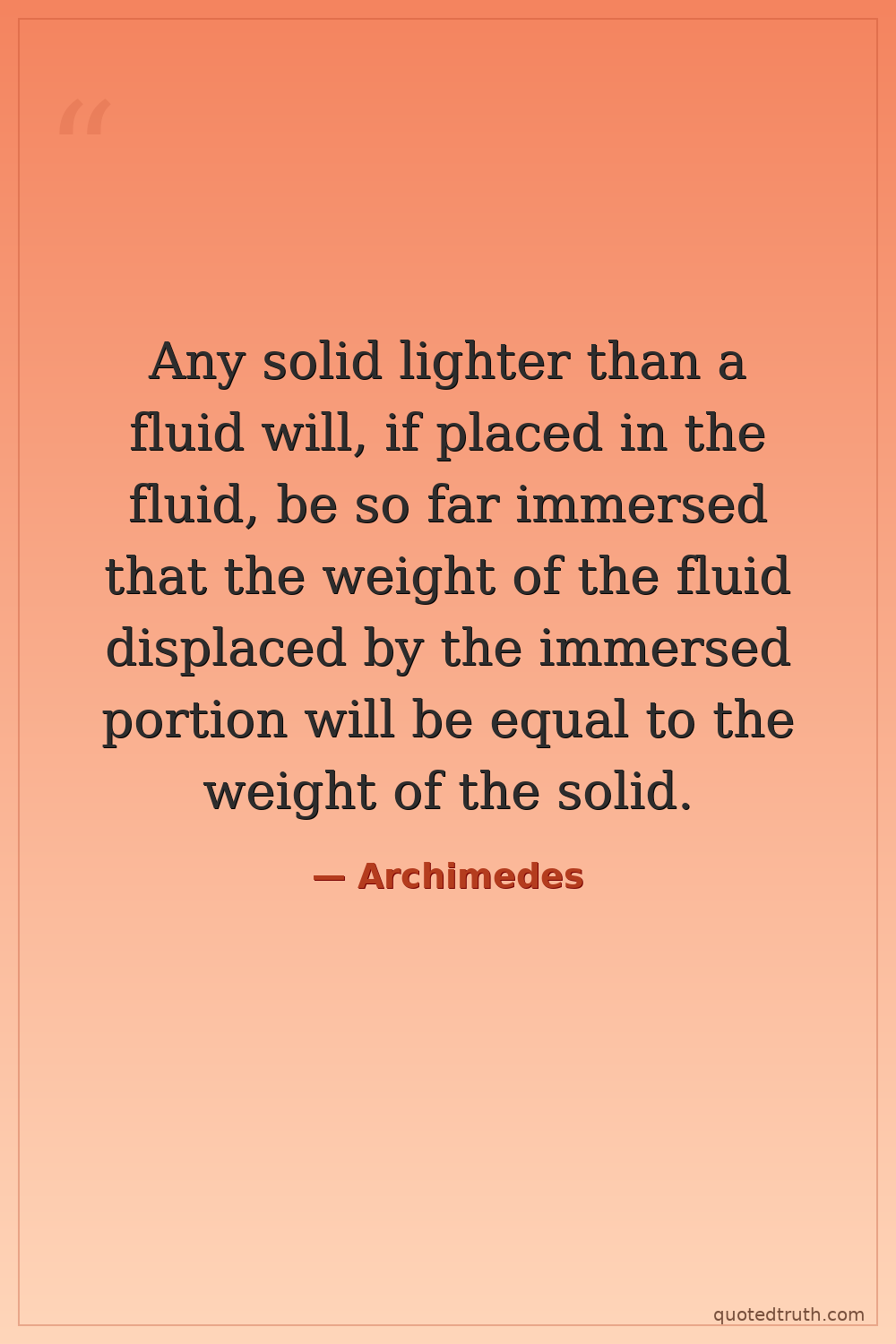
When a solid object floats in a liquid, it sinks just deep enough that the liquid it pushes aside weighs exactly as much as the object. This is why a steel ship floats — its hull shape displaces enough water to match the ship's total weight. Objects denser than the fluid sink completely; lighter ones settle at the exact depth where displaced fluid weight equals object weight.
Relevance to Archimedes
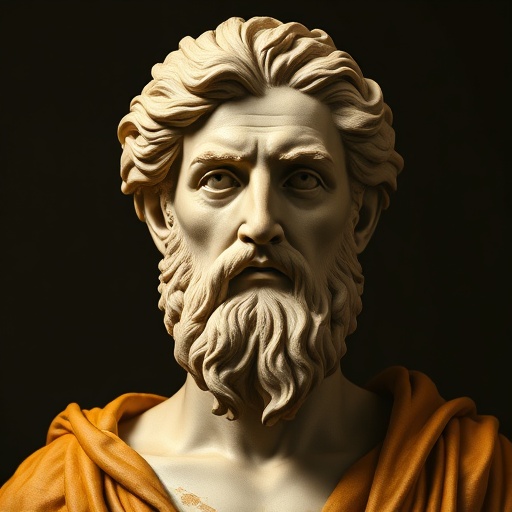
Archimedes discovered this while solving a practical royal problem: King Hiero II of Syracuse suspected his goldsmith had diluted a gold crown with silver. Archimedes needed a non-destructive purity test. Noticing bath water overflow relative to his body's volume, he grasped the principle — famously shouting Eureka. He formalized it in his treatise On Floating Bodies, exemplifying his rare gift for transforming everyday physical observations into rigorous mathematical law.
The era
In 3rd-century BC Syracuse, maritime power was existential — warships and trade galleys determined a city-state's fate. The Hellenistic world following Alexander's conquests saw a surge in Greek scientific inquiry, with Alexandria's Library as its intellectual center. Archimedes formalized buoyancy as Rome and Carthage were fighting the Punic Wars for Mediterranean naval dominance, giving engineers a mathematical framework for ship design at the precise moment such knowledge held strategic military value.
AI-generated insights based on extensive research and information for context. Factual errors? Email [email protected].