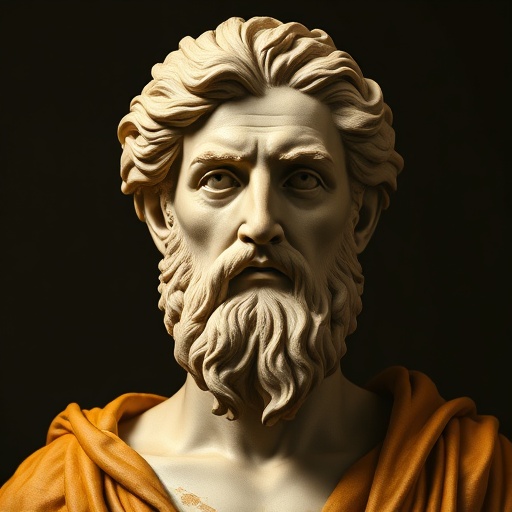
Archimedes — "It is not possible to find a number greater than the number of grains of sand wh…"
It is not possible to find a number greater than the number of grains of sand which could be contained in a sphere of the size of the universe.
It is not possible to find a number greater than the number of grains of sand which could be contained in a sphere of the size of the universe.
Click any product to generate a realistic preview. Up to 3 at a time.
* Initial load can take up to 90 seconds — revising the preview in another color is nearly instant.
"He who understands the world well will not find it difficult to understand the laws that govern it."
"The surface of any segment of a sphere is equal to a circle whose radius is the straight line drawn from the vertex of the segment to any point on the circumference of its base."
"I will show you how to calculate the number of grains of sand that would fit into the universe."
"The method of exhaustion is a powerful tool."
"The shortest distance between two points is a straight line."
From 'The Sand Reckoner', demonstrating large number notation.
Date: c. 250 BCE
Food & DrinkFound in 1 providers: grok
1 source checked
Even the most immense quantity imaginable — grains of sand packed into a universe-sized sphere — is a finite, expressible number. No quantity escapes mathematical naming. In modern terms: infinity is not a cop-out; every physical limit, however staggering, has an upper bound that reason can reach. The statement asserts that the universe is numerically tractable and that human mathematics is powerful enough to bound even cosmic-scale quantities.
Archimedes wrote 'The Sand Reckoner' precisely to demonstrate this, inventing a new number system capable of expressing 10^63. His entire career refused 'too large to handle' as an answer — he calculated precise bounds for pi, proved sphere-cylinder volume relationships, and engineered war machines through rigorous method. This quote is his intellectual signature: systematic reason can domesticate any problem. His dedication of the work to King Gelon shows he wanted this insight widely understood.
In ancient Greece, 'infinity' carried mystical weight — philosophers like Anaximander treated the boundless as fundamentally unknowable. Greek numeral systems lacked positional notation, making enormous numbers genuinely difficult to express. The Hellenistic cosmos was imagined as a finite sphere of fixed stars, yet culturally treated as beyond human reckoning. Writing around 250 BC, Archimedes challenged both traditions simultaneously: the cosmos is finite and mathematics can name its limits.
AI-generated insights based on extensive research and information for context. Factual errors? Email [email protected].
Your cart is empty