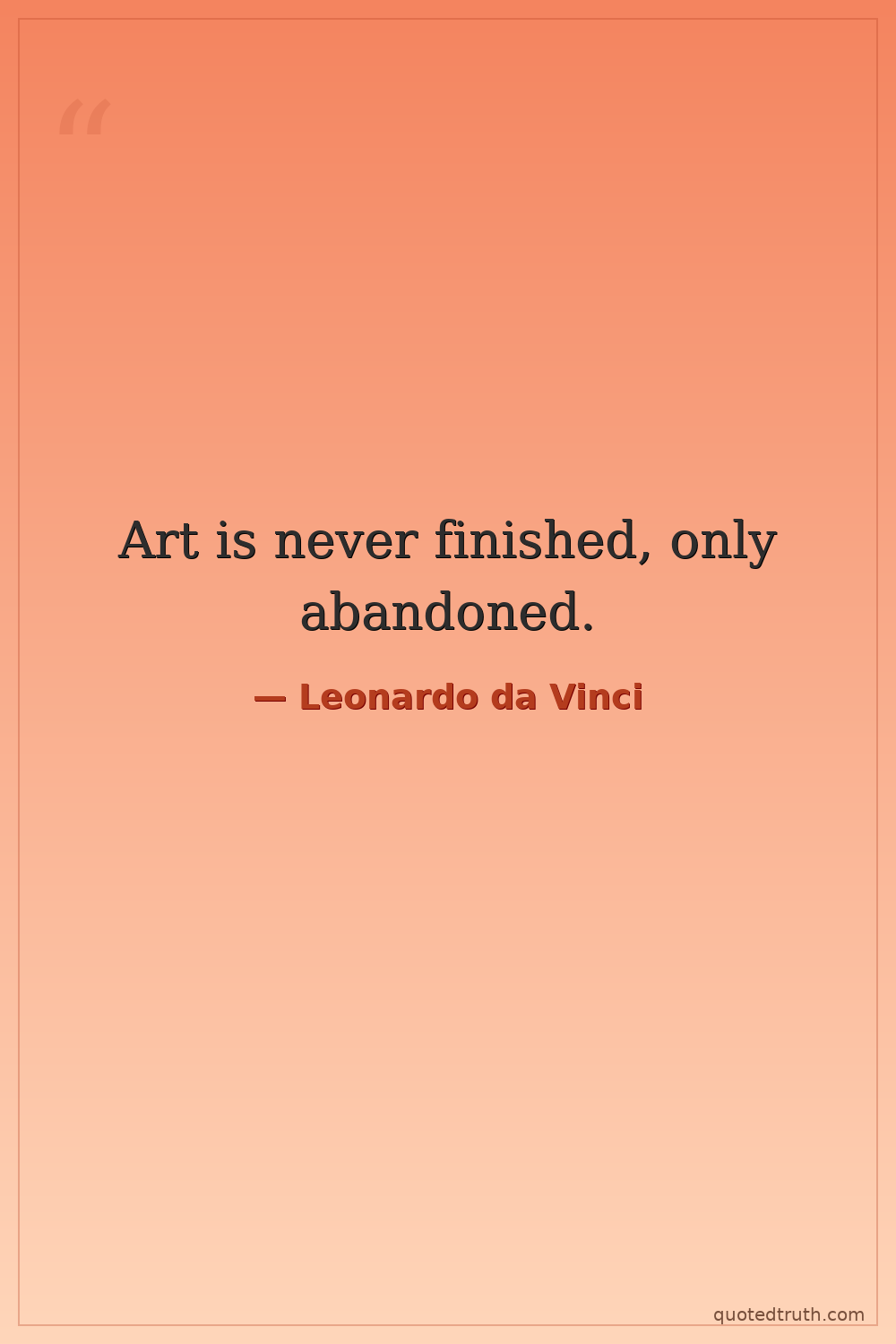
Leonardo da Vinci — "Art is never finished, only abandoned."
Art is never finished, only abandoned.
Art is never finished, only abandoned.
Click any product to generate a realistic preview. Up to 3 at a time.
* Initial load can take up to 90 seconds — revising the preview in another color is nearly instant.
"An average human looks without seeing, listens without hearing, touches without feeling, eats without tasting, moves without physical awareness, inhales without awareness of odour or fragrance, and ta…"
"The works of nature are such that they do not exist without cause."
"I have been impressed with the urgency of doing. Knowing is not enough; we must apply. Being willing is not enough; we must do."
"It is an easy thing to praise and blame, but not so easy to know what to praise and what to blame."
"Nothing strengthens authority so much as silence."
Found in 1 providers: grok
1 source checked
No creative work ever reaches a state of true completion — refinements, corrections, and improvements remain possible indefinitely. The artist doesn't finish a piece; they stop working on it. Calling it 'abandonment' is deliberately honest: you don't conquer a painting, you simply walk away at some point, driven by deadline, exhaustion, or external pressure, while the work itself could always receive more.
Leonardo left dozens of works unfinished — the Adoration of the Magi, Saint Jerome in the Wilderness, and others remained incomplete. He reportedly continued refining the Mona Lisa for years, carrying it until his death. His notebooks overflow with thousands of ideas, inventions, and studies never executed. His obsessive perfectionism and insatiable curiosity made abandonment a lived reality throughout his career, not mere philosophy.
The Renaissance positioned artists as intellectual geniuses pursuing ideal beauty — an inherently unreachable standard. Noble and church patrons commissioned works with strict deadlines, creating tension between perfectionism and obligation. The rediscovery of classical Greek and Roman ideals raised expectations for what art should achieve. In Leonardo's Florence and Milan, the pressure to surpass antiquity made completion feel philosophically impossible when the ideal was always receding.
AI-generated insights based on extensive research and information for context. Factual errors? Email [email protected].
Your cart is empty