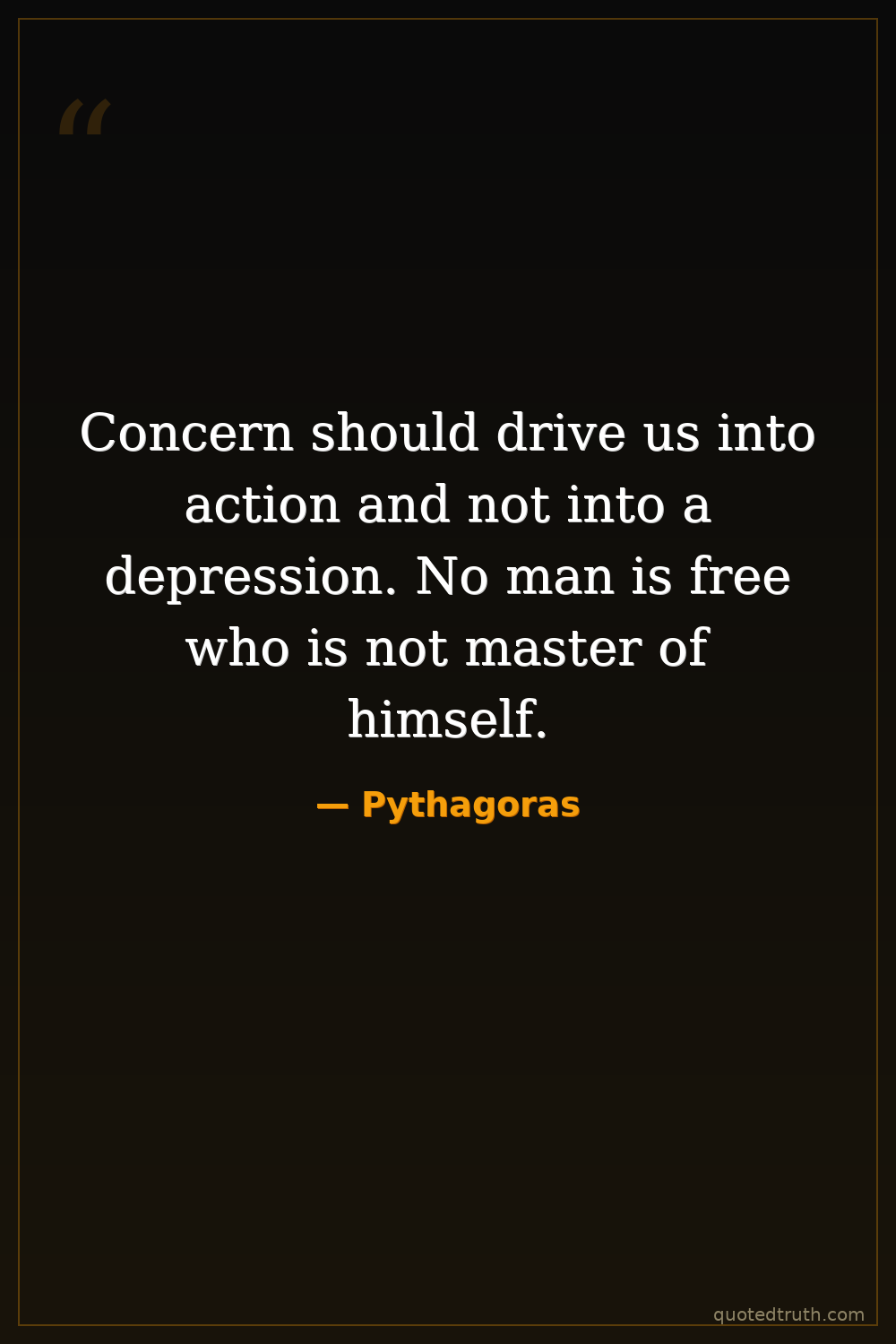
Pythagoras — "Concern should drive us into action and not into a depression. No man is free wh…"
Concern should drive us into action and not into a depression. No man is free who is not master of himself.
Concern should drive us into action and not into a depression. No man is free who is not master of himself.
Click any product to generate a realistic preview. Up to 3 at a time.
* Initial load can take up to 90 seconds — revising the preview in another color is nearly instant.
"Do not sit on a quart measure."
"Sacrifice an odd number to the celestial gods, and to the infernal an even."
"Don't leave the outline of a pan in ashes."
"It is only necessary to make war with five things; with the maladies of the body, the ignorances of the mind, with the passions of the body, with the seditions of the city and the discords of families…"
"Leave not a trace of the pot in the ashes."
Greek philosopher and mathematician whose school in Croton combined geometry (the Pythagorean theorem), number-mysticism, and a religious-vegetarian way of life. Closely associated with Thales of Miletus (earlier pre-Socratic and the first philosopher). For an intellectual contrast, see Heraclitus, pre-Socratic Greek philosopher of flux — Heraclitus called Pythagoras 'the chief of swindlers' — among the founding insults of the philosophical-rivalry tradition. Their 'all is flux' vs 'all is number' poles still organize the philosophy of mathematics today (Platonist vs anti-realist).
Found in 1 providers: grok
1 source checked
When something worries you, let that worry push you to act rather than paralyze you. True freedom isn't about external circumstances — it's about governing your own impulses, emotions, and reactions. A person ruled by fear, appetite, or passion is a slave regardless of their social status. Self-mastery is the prerequisite for any meaningful autonomy.
Pythagoras founded a philosophical brotherhood in Croton demanding strict personal discipline — specific diet, silence, daily self-examination. He believed the soul's purification required mastering bodily desires. His mathematical worldview held that order and ratio govern the cosmos; a person mirroring that internal order through self-control embodied his highest ideal of the rational, liberated life.
In 6th-century BCE Greece, most humans were literally enslaved or bound by tyrants. Pythagoras taught in Magna Graecia during constant political upheaval and factional violence. Stoic philosophy hadn't yet codified these ideas — Pythagoras was pioneering the notion that inner governance mattered more than civic status, radical when freedom meant only birthright or military conquest.
AI-generated insights based on extensive research and information for context. Factual errors? Email [email protected].
Your cart is empty