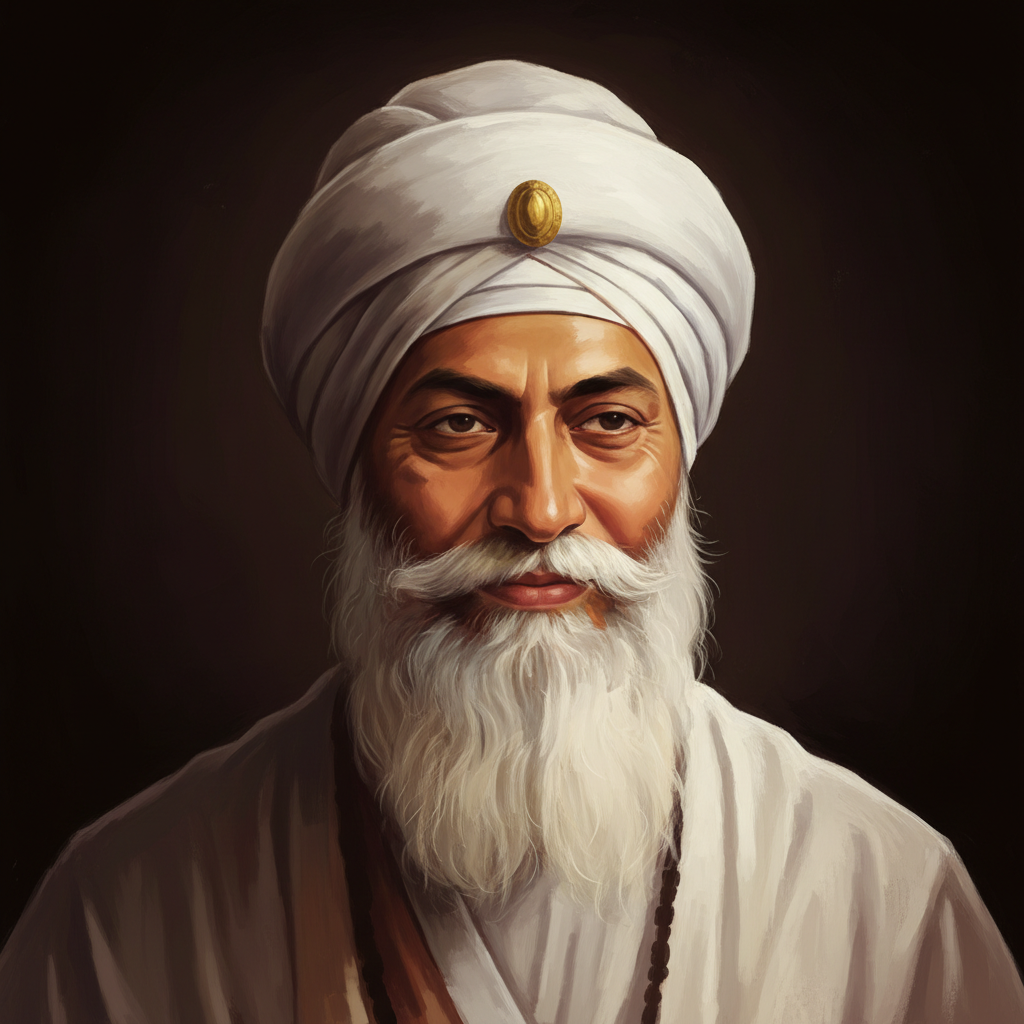
Guru Nanak — "Be the wisdom your support. Be the compassion your guide and listen to the Divin…"
Be the wisdom your support. Be the compassion your guide and listen to the Divine Music that beats in every heart.
Be the wisdom your support. Be the compassion your guide and listen to the Divine Music that beats in every heart.
Click any product to generate a realistic preview. Up to 3 at a time.
* Initial load can take up to 90 seconds — revising the preview in another color is nearly instant.
"The mind is a mad elephant, intoxicated by ego. Only the Guru's teachings can tame it."
"Serve the true Guru, and attain the fruit of liberation."
"He alone is a true Yogi who knows the essence of the Self."
"The world is burning in the fire of desire, O Nanak, save it, save it, Lord!"
"May your path be clear and your coffee be strong."
Founder of Sikhism and the first of the Ten Sikh Gurus, whose teachings of one universal God and rejection of caste shaped Punjab. Closely associated with Kabir (mystical poet whose verses appear in the Sikh Guru Granth Sahib). For an intellectual contrast, see Brahmanical orthodoxy, the Hindu caste-and-ritual establishment of his era — Sikhism was founded as a deliberate alternative to both Hindu ritual hierarchy and Islamic exclusivism — Nanak's universalism was a structural rejection of caste and priestly mediation.
Found in 1 providers: gemini
1 source checked
Anchor your decisions in wisdom rather than impulse; let compassion direct your actions rather than self-interest. The 'Divine Music' — Naad in Sikh thought — is a sacred inner resonance present in every person, crossing all social divisions. To listen to it means recognizing a shared spiritual essence in all humanity and allowing that recognition to shape how you think, decide, and treat others every day.
Nanak (1469–1539) undertook four Udasi journeys spanning South Asia, Arabia, and Central Asia, engaging Hindus, Muslims, and lower-caste communities alike. He rejected priestly gatekeeping and caste hierarchy, insisting the Divine was accessible to all. The concept of Naad — cosmic divine sound — was central to his theology. His Shabads in the Guru Granth Sahib embody these twin pillars: wisdom and compassion as the only legitimate paths toward God.
Nanak lived when the Mughal Empire was consolidating power across Punjab and religious tensions between Islam and Hinduism ran deep. The caste system rigidly stratified Hindu society; Brahmin priests controlled access to the sacred. Sufi mysticism offered spiritual alternatives within Islam. Into this fractured, hierarchical world, proclaiming that a Divine pulse beats equally in every heart — regardless of caste, creed, or birth — was a radical, unifying challenge to every established power.
AI-generated insights based on extensive research and information for context. Factual errors? Email [email protected].
Your cart is empty